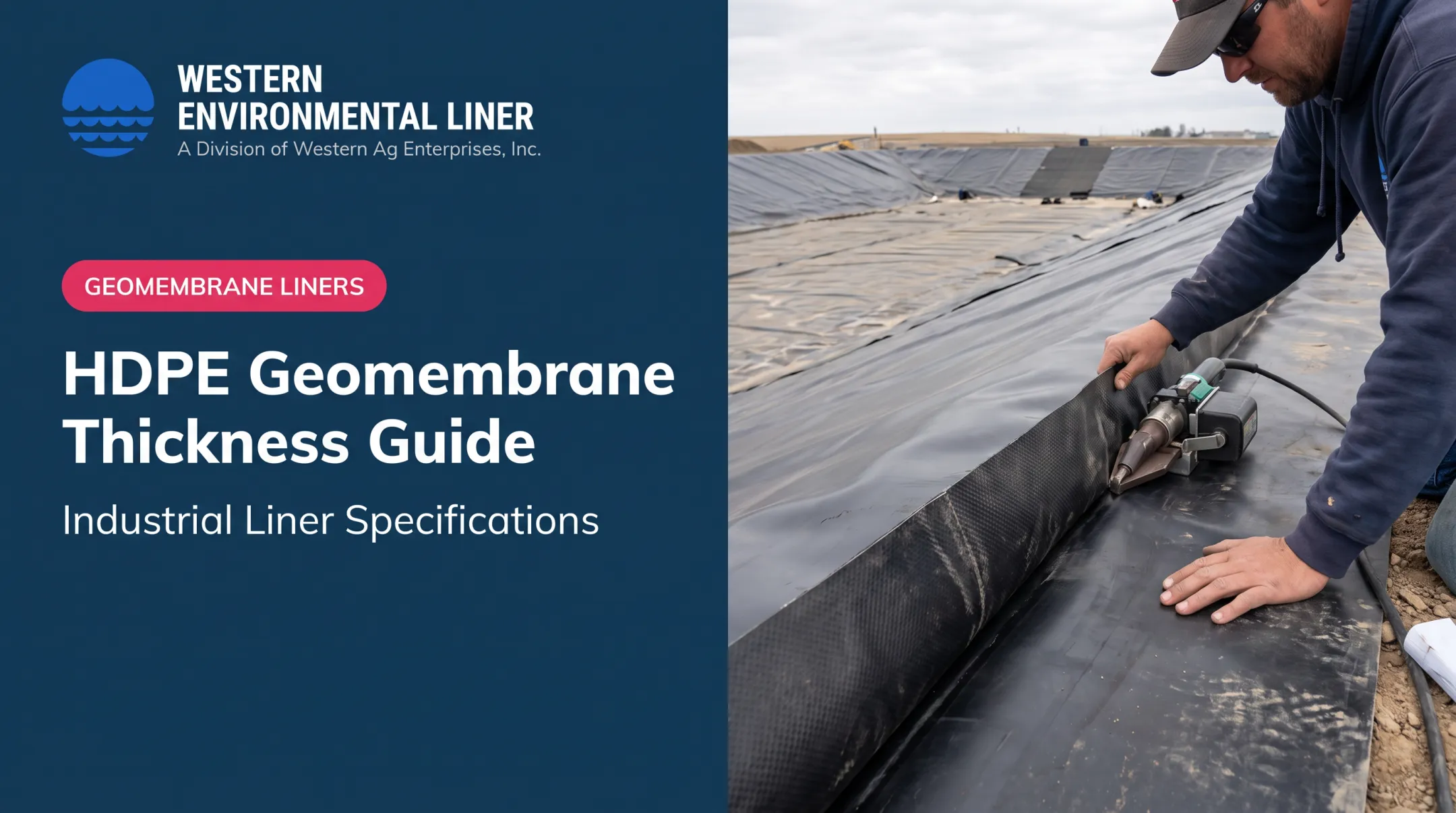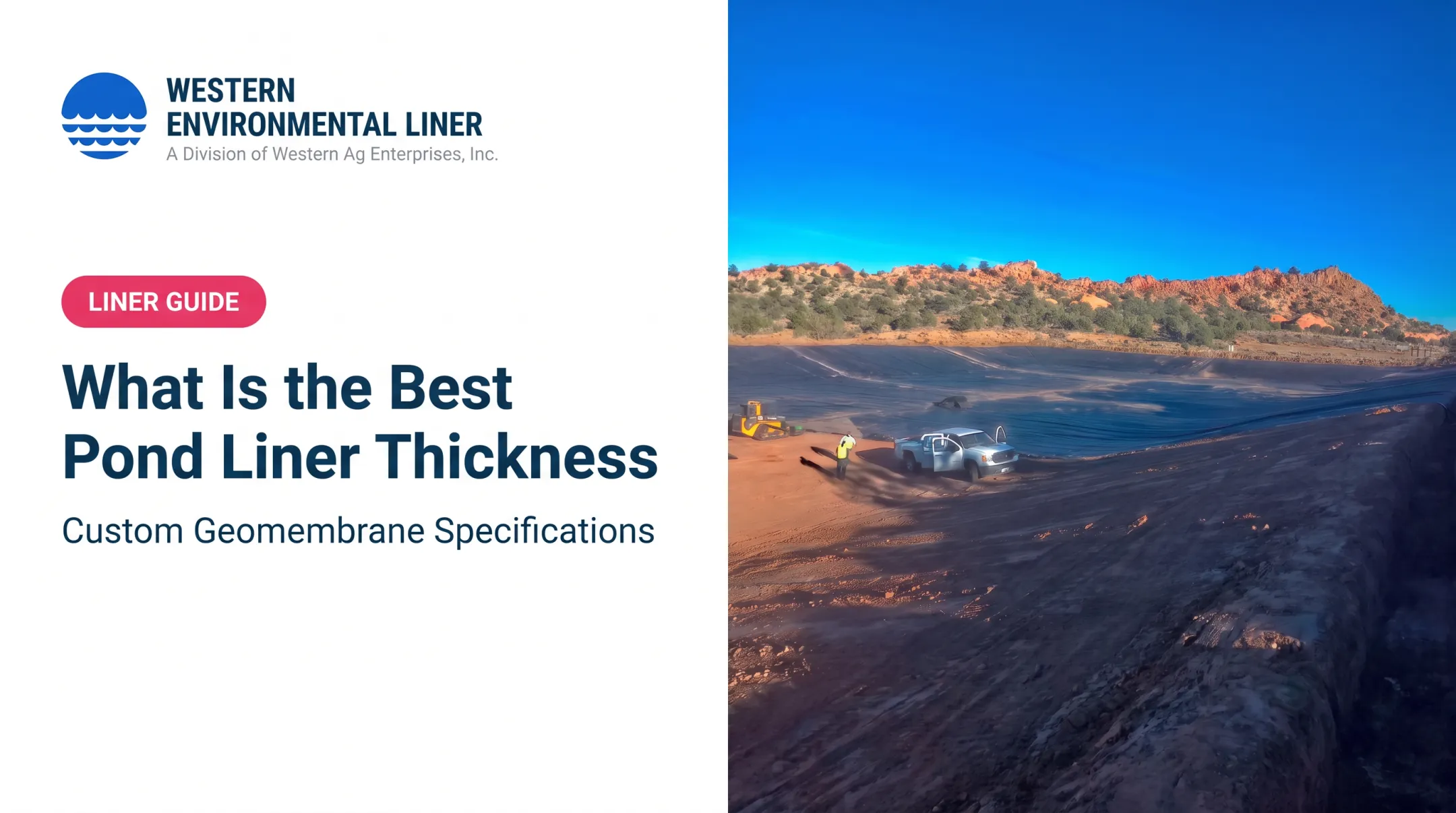

UV-resistant HDPE is a common answer for long-term containment. But "HDPE" on a quote doesn't guarantee UV performance. You confirm it in the product specifications.
This guide covers how UV degrades liners, what HDPE offers, how it compares with EPDM, PVC and reinforced polyethylene, and how to select, install and maintain a liner so it lasts.
Key Takeaways
- UV-resistant HDPE reduces embrittlement and cracking, but formulation and test data decide the result.
- UV resistance is one factor; puncture, chemical compatibility, seams and subgrade matter as much.
- Factory-fabricated panels and protected edges cut leak risks on large ponds.
- Match the liner to the pond's contents, geometry, exposure and maintenance plan before ordering.
What Makes HDPE Pond Liners UV Resistant?
How ultraviolet exposure affects pond liners
Prolonged sunlight breaks down polymer chains. The result is fading, stiffness, brittleness, and eventually cracking. Laboratory research on HDPE geomembranes shows UV can start free-radical reactions that cut chains, while heat and oxygen add to the damage.
Exposure isn't even across a pond. The most vulnerable spots are:
- The waterline, where levels rise and fall
- Side slopes above the water
- The exposed perimeter and anchor trench
- Steep slopes where soil slides and uncovers liner
Built-in UV protection in HDPE formulations
Manufacturers protect HDPE with carbon black and antioxidant packages. The GRI-GM13 specification calls for:
- 2.0-3.0% carbon black, plus oxidative induction time (OIT) minimums
- 1,600 hours of cycled UV and condensation testing
- At least 50% of high-pressure OIT retained

Carbon black content alone isn't the full spec, because dispersion is also evaluated.
Not all HDPE is equal. Resin quality, manufacturing consistency, thickness and documented weathering results all vary. Ask for the current technical data sheet covering UV and oxidation resistance, tensile properties, elongation and puncture resistance. Skip the marketing copy.
Reinforced polyethylene (RPE) is a different construction. Aqua 20, for example, uses a woven black HDPE scrim and reports more than 90% strength retained after 2,000 hours of accelerated UV exposure. Compare actual data, not product names.
UV resistance versus overall liner durability
Sunlight is only one threat. Liners also fail from:
- Punctures, tears and stress cracking
- Chemicals and thermal movement
- Animal damage and abrasion during installation
A liner with strong UV performance can still leak if sharp stones, roots, folds, excessive tension, poor seams or unprotected penetrations go unaddressed. Lab tests aren't service-life guarantees either: the 1,600-hour test isn't a calendar limit. Review test data, the manufacturer's warranty and your design requirements together.
Why Use UV-Resistant HDPE for Pond Applications?
Water retention and soil protection
An impermeable geomembrane cuts seepage from irrigation reservoirs, retention ponds, fire ponds and aquaculture ponds. The NRCS pond lining standard addresses ponds with excessive natural-soil seepage, with goals of reducing seepage and protecting soil and water.
In practice that means conserving stored water, protecting surrounding soil, controlling contamination pathways and keeping pond capacity predictable. No credible source gives a universal water-savings percentage, so beware of anyone quoting one.
Durability in demanding environments
HDPE is tough and resistant to many chemicals, but compatibility depends on the stored liquid. Screening charts rate 20% hydrochloric acid as having little to no effect, while carbon tetrachloride has a severe effect. For anything beyond clean water, request written compatibility confirmation.
Full sun, fluctuating water, heat, wind and maintenance traffic all favor a documented UV-resistant material. Priorities differ by project:
- Aquaculture: fish safety. NRCS cautions against PVC for aquatic production because stabilizers can leach.
- Industrial containment: chemical compatibility with the stored liquid
- Construction and earthwork sites: abrasion resistance under traffic and equipment
Long-term value versus material cost
Judge cost over the life of the pond. Material price is one line. Add replacement, leak investigation, repairs, water loss, downtime, access difficulty and maintenance.
Argonne National Laboratory's 2023 reservoir study lists material, single versus double lining, and exposed versus covered configuration as key cost drivers. No transferable payback figure exists, so build your own from site numbers.
Welded seams and factory fabrication
Properly welded HDPE seams create continuous containment. Quality depends on compatible materials, trained technicians, suitable equipment, weather and inspection.
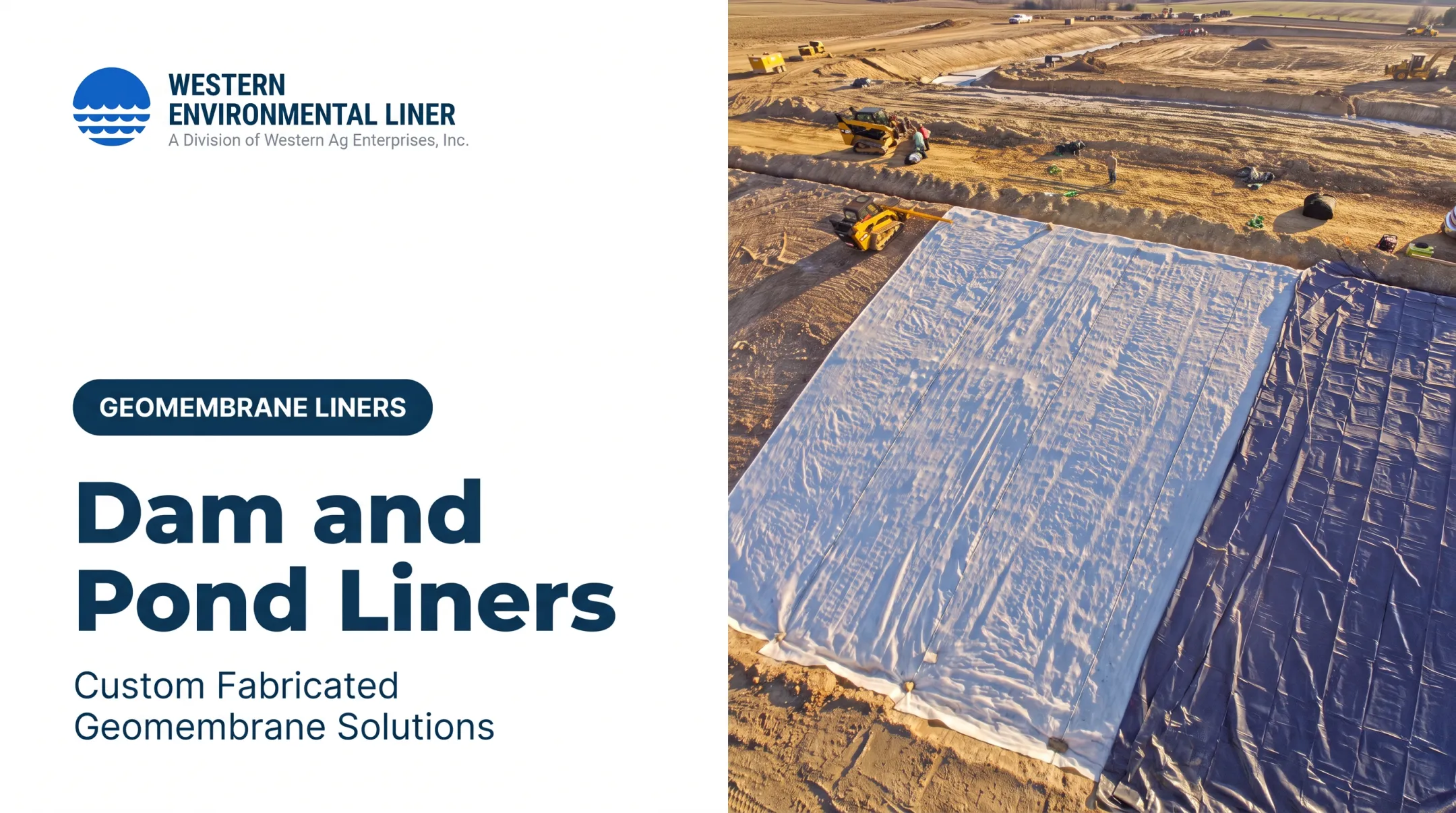
Conventional HDPE is typically seamed in the field. Factory fabrication is more common with RPE, PVC and EPDM. Factory fabrication advantages include:
- Fewer field seams
- Consistent factory welding conditions
- Easier deployment
- Less installation complexity
Western Environmental Liner, for example, fabricates panels up to 300' x 300' and one-piece liners up to 150,000 square feet.
How to Choose the Right UV-Resistant HDPE Pond Liner
Start with the pond's purpose and contents
Identify what the pond holds: irrigation water, stormwater, wastewater, aquaculture water, fire-suppression water, industrial liquids or recreational water. Fish, plants, livestock, salts, nutrients and chemicals each carry different safety and compatibility needs. Get compatibility in writing for anything other than ordinary clean water.
Evaluate site geometry and exposure
Account for dimensions, depth, slope ratios, corners, benches, pipe connections, anchor trenches and fluctuating water levels. Steep or irregular slopes raise the risk of wrinkling, tension, sliding and abrasion.
Measure carefully and lay out the liner to minimize seams, folds and unsupported transitions. Western Environmental Liner suggests at least 5 feet of overlap around the edges of large ponds for trench securing.
Select thickness, surface and reinforcement
There's no universal thickness. Base it on:
- Subgrade quality and puncture hazards
- Traffic, slope, fluid and exposure
Within the NRCS standard, HDPE minimums are 30 mil for clear water and 60 mil for wastewater. Those are floors for that standard, not universal recommendations.
Smooth versus textured matters too. Textured sheet adds friction where interface shear strength is inadequate on slopes, though it affects deployment, cleaning and welding. Don't treat HDPE, RPE and other polyethylene products as interchangeable. Check actual construction and performance data.
Specify subgrade and underlayment
The subgrade should be smooth, flat and unyielding, free of sharp stones, standing water, mud, vegetation and frozen soil. NRCS requires cushioning where sharp or angular stones larger than 3/8 inch are exposed, using a nonwoven geotextile of at least 10 oz/yd².
Where groundwater could push up under the liner, drainage is required, including inverts within 2 feet of seasonal high groundwater. Western Environmental Liner notes 8 oz geotextile is the most common choice, and recommends at least 6 inches of compacted bedding when the subgrade can't be cleaned of obstructions.
Confirm documentation and quality requirements
Use this buyer checklist:
- Technical data sheet and thickness tolerance
- UV and oxidation performance results
- Chemical compatibility confirmation
- Seam requirements and installation procedures
- Warranty terms (Western Environmental Liner offers 10 to 20 years for weathering and UV, by product)
- Inspection and acceptance documentation
Standards must match the product. For example, ASTM D7177 covers PVC dual-track seams, not HDPE. Construction quality assurance should include:
- Seam testing (ASTM D6392 destructive tests, D5820 air-channel for dual seams, D5641 vacuum-box for patches)
- Visual inspection
- Repair records and final acceptance
Compare HDPE with EPDM, PVC and RPE
| Material | UV exposure | Flexibility | Seaming | Best fit |
|---|---|---|---|---|
| HDPE | Performs well uncovered | Stiffer | Thermal welding | Large, chemical-resistant containment |
| EPDM | Excellent | Flexible in cold | Cements, careful field work | Small or contoured ponds |
| PVC | Needs soil cover under NRCS | Plasticizers can be lost | Solvent, adhesive, heat | Covered liners, contoured ponds |
| RPE | Grade-dependent; some are for short-term exposure | Good, prefabricated panels | Heat or specialized tape | Large seepage-control ponds |
No material wins everywhere. PVC may suit a large pond that must conform to every contour, while HDPE or RPE favors toughness and large-scale containment. Decide by contents, geometry, exposure, budget and installation method.
Installing and Protecting an HDPE Pond Liner
Prepare the site before deployment
Do the groundwork before the liner arrives:
- Excavate, grade and compact the subgrade
- Remove rocks, roots and debris
- Dewater and control drainage
- Place underlayment
- Dig anchor trenches
- Check the weather

Under IAGI guidance, the installer and owner's representative accept the subgrade in writing each day. Don't drag the liner, fold it sharply, trap rocks beneath it, or park equipment on it unprotected. Deploy only what you can anchor and seam in a day, with ballast for wind.
Weld, inspect, and detail
Use compatible welding equipment and trained installers, and inspect every seam. Weld in suitable conditions: IAGI requires precautions below 32 °F and approval above 167 °F sheet temperature. Any repair should be tested nondestructively.
Leaks tend to start at:
- Pipe boots, drains, inlets and outlets
- Corners, transitions and anchors
Custom pipe boots fabricated to the pipe diameter help here. Factory panels and professional installation pay off most on large or complex shapes.
Protect exposed portions from sunlight and damage
Where design allows, bury or cover edges, stabilize anchor trenches and limit foot traffic. NRCS requires anchoring against wind uplift, and HDPE should generally rest at least 24 hours before backfilling to allow for thermal movement. Protection options include:
- Soil cover
- Protective geotextile
- Floating covers
- Shade systems
Choose covers that do not trap damaging heat or add abrasion.
Western Environmental Liner offers custom geomembrane fabrication, large one-piece liners, technical support and on-site installation. Confirm the right material and design for your HDPE pond project before ordering.
Inspecting and Maintaining a UV-Exposed Pond Liner
Inspect the liner after first filling, then quarterly, according to the FGI reservoir O&M manual. Walk the waterline, edges, seams, penetrations, anchor trenches, and areas hit by erosion or changing water levels.
Call a professional if you see:
- Unusual fading or chalky residue
- Stiffness or cracking
- Exposed subgrade
- Seam separation
- Wrinkles under stress
- Punctures or unexplained water loss
Fix problems early using the manufacturer's repair procedures. Address patching, edge stabilization, vegetation, and drainage promptly. FGI also suggests electrical leak location about every five years as guidance, separate from visual checks.

Consistent upkeep closes the loop: a documented UV-resistant material, protected by sound design, installation, and maintenance, beats a choice based only on material name or upfront price.
Frequently Asked Questions
Is HDPE liner UV resistant?
Many HDPE geomembranes are formulated for outdoor exposure, but results depend on the product, thickness, exposure and manufacturer testing. Specifications call for carbon black and retained-OIT performance, not indefinite immunity.
Which is better for my pond, EPDM or PVC?
EPDM offers excellent UV resistance and cold-weather flexibility. PVC conforms well but loses plasticizers, and NRCS requires soil cover over it. Weigh geometry, seaming and scale, then consult the manufacturer.
What is the most durable pond liner?
It depends on the application. Judge UV exposure, puncture and tear resistance, chemical compatibility, seam quality, installation and maintenance together, not material name alone.
How do I protect an HDPE pond liner from UV exposure?
Choose UV-stabilized material, bury or protect edges, add soil or cover where specified, and reduce exposure at vulnerable areas. Inspect the waterline and perimeter regularly.
How should an HDPE pond liner be installed?
Prepare the subgrade, add underlayment where needed, deploy carefully, and use qualified thermal welding. Detail penetrations and anchors, test seams and complete a final inspection.