
Introduction
A drainage ditch takes runoff from a wide area and squeezes it into a narrow channel. Under heavy or prolonged flow, that water strips soil, undermines banks, and cuts into the ditch's capacity to move water.
Dumping rock in a ditch or reseeding the banks rarely fixes this on its own. The stabilization method has to match the flow, slope, soil, service life, and the drainage system around it.
This guide covers what causes ditch erosion, how to assess a ditch, how the main control methods compare, what matters during installation, and how to maintain the result.
Key Takeaways
- Match the lining to flow, slope, soil, and whether the fix is temporary or permanent.
- Armor the weak points first: toes, bends, culvert ends, and material transitions.
- Vegetation and mats suit lower-energy flow; riprap, geocells, or liners suit harder conditions.
- Inspect after major storms and fix small failures before they become gullies.
What Causes Drainage Ditch Erosion?
Concentrated runoff raises water velocity and shear stress against the ditch bottom and banks. Soil moves downstream, leaving rills, gullies, scour holes, and undercut banks.
Hydraulic Drivers
FHWA's HEC-15 guidance evaluates shear stress at the water-channel boundary. Permissible stress is the maximum a lining can withstand without serious bed erosion. Several conditions push a ditch past that limit:
- Heavy rainfall and large contributing drainage areas
- Steep grades, since applied shear rises with slope
- Sharp bends and constricted crossings
- Culvert discharges and unprotected outlets, where outlet velocity is a primary erosion indicator
Site-Specific Factors
Local conditions often make things worse:
- Erodible or poorly compacted soil
- Thin or failed vegetation
- Construction traffic that breaks down banks
- Debris and sediment that force water against the sides
- A lining too light for the actual flow
Seepage and Hidden Failure
Surface protection can look fine while the ditch fails underneath. Water moving through a bank or beneath a lining can cause piping, uplift, and soil migration. The U.S. Bureau of Reclamation documents liner bulges and soil migration in canals. Rigid linings fail when they are undermined.
Seepage also wastes water. Irrigation canals can lose an estimated 30-40% of their flow, with seepage as a main cause.
How to Assess a Ditch and Choose the Right Control Method
Start With the Site
Walk the ditch and record:
- Length, width, depth, side slopes, and grade
- Bends, crossings, inlets, and outlets
- Visible erosion patterns
- Nearby roads, structures, utilities, and property lines
Gather the Hydraulic and Soil Data
Get the contributing drainage area, expected peak flow, flow duration, velocity, and storm design requirements. Check local, state, municipal, or project specifications too. HEC-15 notes that permanent roadside linings are usually designed for 5- or 10-year storms, though your project criteria govern.
Then look at the ground: soil type, compaction, groundwater, seepage, soft subgrade, and bank stability. A lining placed over settling soil will not last.
Temporary or Permanent?
Silt fence, wattles, check structures, blankets, and temporary seeding control sediment during construction. They are not built for long-term concentrated flow. Decide early which job you are doing.
A Practical Decision Framework
| Condition | Typical approach |
|---|---|
| Low flow, suitable soil | Vegetation, with blankets while it establishes |
| Moderate to high flow, slope reinforcement | Turf reinforcement mats or geocells |
| High-energy flow, where permitted | Engineered riprap or concrete |
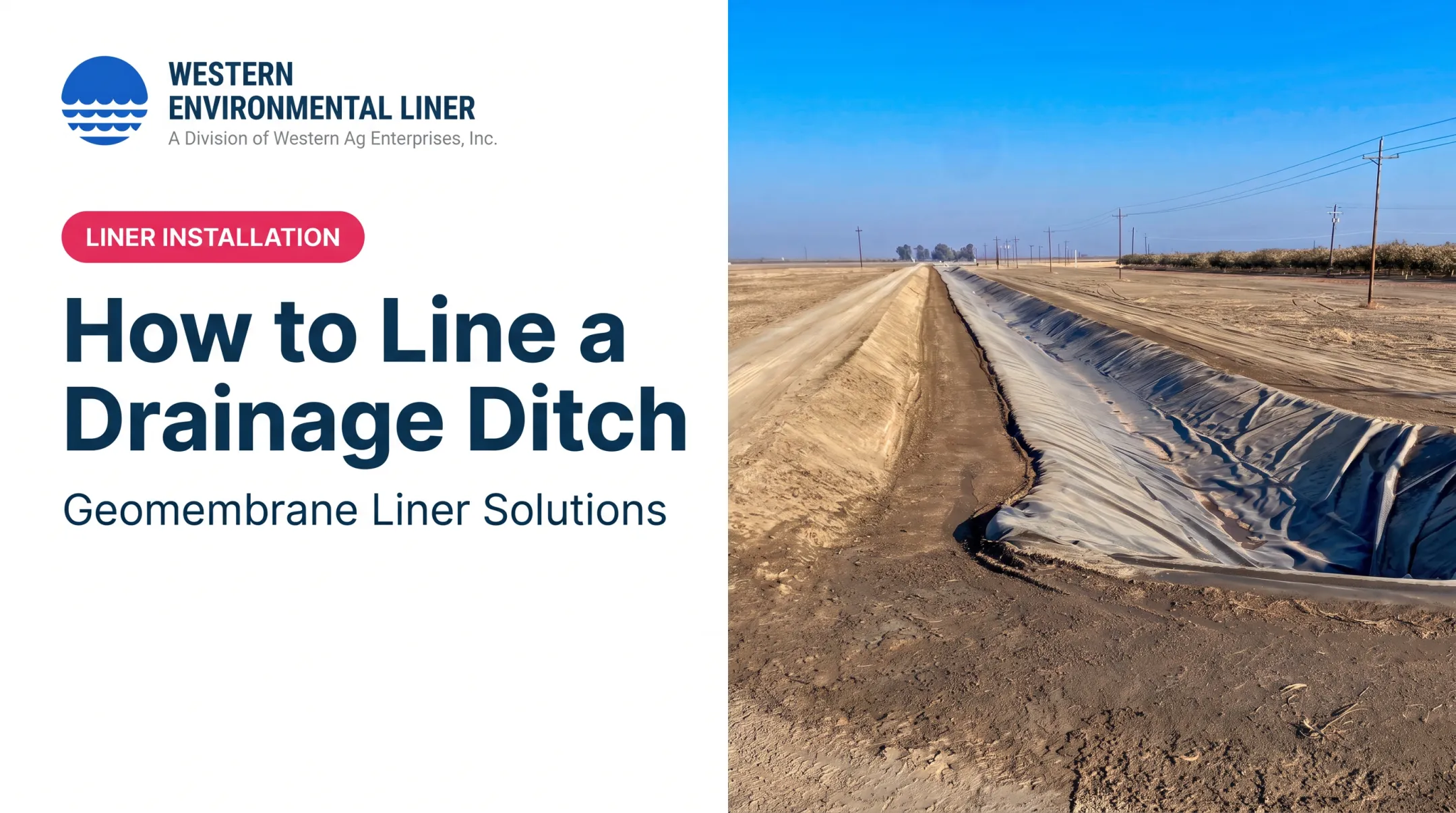
| Seepage control or an impermeable surface needed | Geomembrane liner |
Bring in a civil, drainage, or geotechnical professional if the ditch threatens infrastructure, carries significant runoff, has unstable banks, or keeps failing after basic repairs. Caltrans, for example, sends channels beyond its listed values to a hydraulic engineer.

Drainage Ditch Erosion Control Methods
Vegetation and Erosion Control Blankets
Blankets protect bare soil while roots take hold. Success depends on seed selection, soil preparation, firm anchoring, and overlaps. Keep concentrated flow out of the ditch until the vegetation establishes.
Temporary blankets are rated for roughly 1.0-2.25 psf of shear and last 3 to 36 months, depending on the product.
Turf Reinforcement Mats
Turf reinforcement mats (TRMs) add permanent, three-dimensional reinforcement to vegetation. The ECTC specification rates them at 2.0 psf bare but 6.0-14.0 psf once vegetated. Those are different conditions, so pick products based on expected flow, slope, soil retention, and the manufacturer's installation rules.
Riprap
Riprap armors the channel and dissipates energy. It is not a dump-and-go fix. Doing it properly means:
- Angular, well-graded stone sized for design shear
- A prepared subgrade
- Filter fabric or aggregate beneath the stone
- Toe protection and full bank coverage
Stone also takes up channel volume, so check that capacity survives.
Geocells
Geocells confine aggregate, soil, or vegetated fill in a cellular grid. They work well on slopes and in channels where flow conditions change, offering a reinforced surface that is more adaptable than rigid armor.
Permeable Systems Versus Geomembrane Liners
Permeable systems resist surface erosion. A geomembrane does that and also limits seepage, protecting the soil underneath where impermeability is required. The Bureau of Reclamation's Year 25 durability report found concrete over geomembrane to be the best combination in its demonstration, while exposed membranes were vulnerable to uplift and soil migration.

Western Environmental Liner manufactures and installs custom geomembrane liners for ditches and other containment applications. Factory-fabricated panels come with technical support for anchoring, slope, and subgrade requirements. Not every ditch needs a geomembrane, so request a project evaluation to find out whether yours does.
How to Install a Ditch Liner or Stabilization System
Prepare the Ditch
- Remove debris, roots, unstable material, and unsuitable soil.
- Restore the designed profile.
- Repair gullies and bank failures.
- Compact or improve the subgrade per the engineered plan.
Secure Edges and Transitions
Use anchor trenches, toe-ins, keyways, or other specified restraints at crests, toes, and edges. Water that gets beneath the protection can lift, peel, or undermine it.
Inlets, outlets, culvert ends, driveway crossings, bends, confluences, and lined-to-unlined changes each need their own detail. Otherwise flow bypasses the lining and cuts behind it.
Material-Specific Details
- Blankets and mats: FHWA's standard drawing shows 6-inch minimum overlaps. SCDOT specifies check slots at maximum 30-foot intervals. Mats must touch the soil without bridging.
- Riprap: Place stone over the filter layer without damaging the fabric, and key cutoff walls into the channel bottom.
- Geocells: Anchor cells fully before infill, and keep infill drop height to 3 feet.
- Geomembranes: NRCS inspection guidance calls for rounded anchor trench corners, compacted backfill, a passed seam test strip, and air-pressure or vacuum testing of seams.
Quality-Control Checklist
- Verify grades and drainage capacity
- Inspect seams and overlaps
- Confirm anchoring and toe protection
- Check for exposed subgrade or damaged material
- Document the installation
- Keep equipment and unauthorized traffic off finished areas
If your ditch needs seepage control or a durable custom liner, contact Western Environmental Liner for custom fabrication, installation support, and a project-specific recommendation from an IAGI Certified Installer.

Maintenance and Long-Term Inspection
What to Look For
Inspect during routine site visits and after significant rainfall. Watch for:
- New rills or gullies and exposed soil
- Displaced rock or lifted edges
- Seam damage and undercut banks
- Outlet scour
- Sediment buildup, debris, and vegetation loss
Schedules vary. The EPA's 2022 construction permit allows weekly inspections or every 14 days plus within 24 hours of 0.25 inches of rain, but that applies to covered construction sites. EPA riprap guidance suggests annual checks and post-storm checks.
Keep Capacity and Protection Intact
Act before the next major flow:
- Remove obstructions and excess sediment
- Repair small damage quickly
- Re-establish vegetation
- Restore displaced protection
HEC-15 lists mowing, weed control, and sediment removal for grass-lined channels.
When It Is a Design Problem
Repeated damage usually points to design, not upkeep. Common causes include:
- Increased upstream runoff
- Inadequate outlet protection
- A lining too weak for the flow
- Unstable subgrade
- A ditch profile that no longer fits site conditions
New seepage, cracking, or slumping signals a subsurface stability problem that surface repairs will not fix.
Assign Responsibility
Spell out who handles inspections, storm response, documentation, and acceptance criteria among the owner, contractor, operator, or public agency.
Frequently Asked Questions
What is a drainage ditch?
A drainage ditch is a purpose-built channel that collects runoff and carries it to a safe outlet. Its shape, lining, and maintenance reduce flooding, standing water, and erosion.
How do you stop a drainage ditch from eroding?
Assess the flow, then grade and prepare the subgrade. Add vegetation or a structural lining, protect transitions and outlets, and inspect after major rainfall.
What is the best material to line a drainage ditch?
It depends on flow, slope, soil, seepage needs, and project life. Options include vegetation, mats, riprap, geocells, concrete, and geomembranes.
Should you use riprap or an erosion control blanket in a drainage ditch?
Blankets suit lower-energy flow and help vegetation establish. Riprap suits higher flow energy and needs engineered filter and toe details.
How often should a drainage ditch be inspected and maintained?
Inspect routinely and after major rainfall. The exact schedule should follow site conditions, project specifications, and local requirements.
Can a geomembrane liner be used for drainage ditch erosion control?
Yes. Properly designed and anchored, it can control seepage and protect the subgrade. Material choice, subgrade, drainage, seams, and transitions need project-specific review.