
The core decision for owners is choosing a geomembrane and supporting system that fits the brine chemistry, temperature, pond design, ground conditions, and operating loads. Salt alone doesn't settle that choice.
This guide covers where brine ponds are used, how to evaluate liner materials, what a complete containment system includes, how installation and testing should work, and what to prepare before requesting a quote.
Key Takeaways
- Choose the liner from actual liquid chemistry and operating conditions, not from the word "brine."
- A full system can include geotextile, prepared subgrade, anchoring, leak detection, and secondary containment.
- Factory fabrication reduces field seams and simplifies quality control.
- Require compatibility data, seam-test records, and written warranty terms before approval.
Understanding Brine Ponds and Why They Need Geomembrane Liners
What brine ponds are
A brine pond is an engineered basin that stores, concentrates, treats, evaporates, or manages water with high concentrations of dissolved salts. The term covers several pond types:
- Storage ponds that hold brine until it is used or disposed of
- Evaporation ponds that are shallow and rely on solar evaporation, leaving salt sludge that must be retained or removed
- Mineral-recovery ponds, where evaporation and crystallization produce salt products
- Produced-water ponds at oil and gas sites
- Process-water containment ponds at industrial plants
Common industries
Brine ponds started with salt harvesting. Today they serve:
- Mining and mineral recovery
- Oil and gas produced water
- Desalination concentrate
- Power generation and chemical processing
- Industrial wastewater management
The liquid's source matters. Oils, solvents, oxidizers, elevated temperatures, or cleaning chemicals change what the liner must withstand.
Why bare soil isn't enough
Uncontrolled seepage means lost product, degraded soil, groundwater contamination, permit problems, and expensive cleanup. A Bureau of Reclamation pond design report for Paradox Valley, Colorado, also flags impacts when brine reaches nearby drainages.
A geomembrane is a low-permeability barrier, not the whole structure. It doesn't replace proper grading, berm construction, drainage, freeboard, or spill-control planning. The Paradox design pairs its liner with prepared subgrade, anchorage, perimeter access, and allowances for precipitation and freeboard.

Choosing the Right Geomembrane Material for a Brine Pond
Start with brine chemistry and operating conditions
Before comparing materials, gather the full picture with your supplier or engineer:
- pH, total dissolved solids, and major ions
- How concentration changes as the liquid evaporates
- Oils, solvents, oxidizers, and cleaning agents
- Upset conditions
- Normal and peak temperatures, thermal cycling, sunlight exposure, and contact time
Compatibility and aging data only mean something if they reflect real service conditions. EPA Method 9090A, for example, calls for immersion of at least 120 days at 23°C and 50°C, with higher-temperature testing when higher temperatures are expected.
Compare materials without a universal winner
No single material wins every brine pond. The tradeoffs:
| Material | Strengths | Watch for |
|---|---|---|
| HDPE | High resistance to many chemicals | Stiff, especially in cold; stress cracking |
| LLDPE | More flexible than HDPE | No universal brine ranking |
| Reinforced PE | Scrim reinforcement for tear and puncture resistance | Actual-fluid compatibility must be confirmed |
| Reinforced PP | Flexible, good UV performance | Organic-acid degradation can be a concern |
| PVC | Flexible, easy to fabricate | Plasticizer loss with aging |
Seam methods differ too. The polyethylene and polypropylene materials are thermally welded, while PVC can be solvent, adhesive, thermal, or dielectric seamed.
Evaluate mechanical and environmental demands
Factor in site and operating loads such as:
- Pond depth and hydrostatic pressure
- Irregular subgrade and settlement
- Wind, waves, and temperature swings
- Salt crystallization and sludge removal
- Equipment traffic
Don't treat a lab elongation or tensile value as the allowable strain for an installed liner. GRI specifications are manufacturing quality control, not a chemical service-life guarantee or a design allowable.
An eight-year immersion study of five commercial PE geomembranes in synthetic brine at 25 to 95°C found that high initial properties, resin type, and thickness alone did not reliably predict long-term performance.
A separate three-year study of HDPE seams found antioxidant depletion fastest beside the weld, so seam durability belongs in the evaluation.
Select thickness, surface, and protection as a system
Thickness comes from pond geometry, subgrade quality, expected loads, and design life, not from salinity alone. Textured surfaces can help on steep slopes, though interface shear strength remains product- and site-specific.
Geotextile underlayment adds puncture protection. It can sit under the liner, over it, or both. Western Environmental Liner notes that 8-oz geotextile is the most common choice, with 12 and 16 oz available for extra protection.
A material pathway from Western Environmental Liner
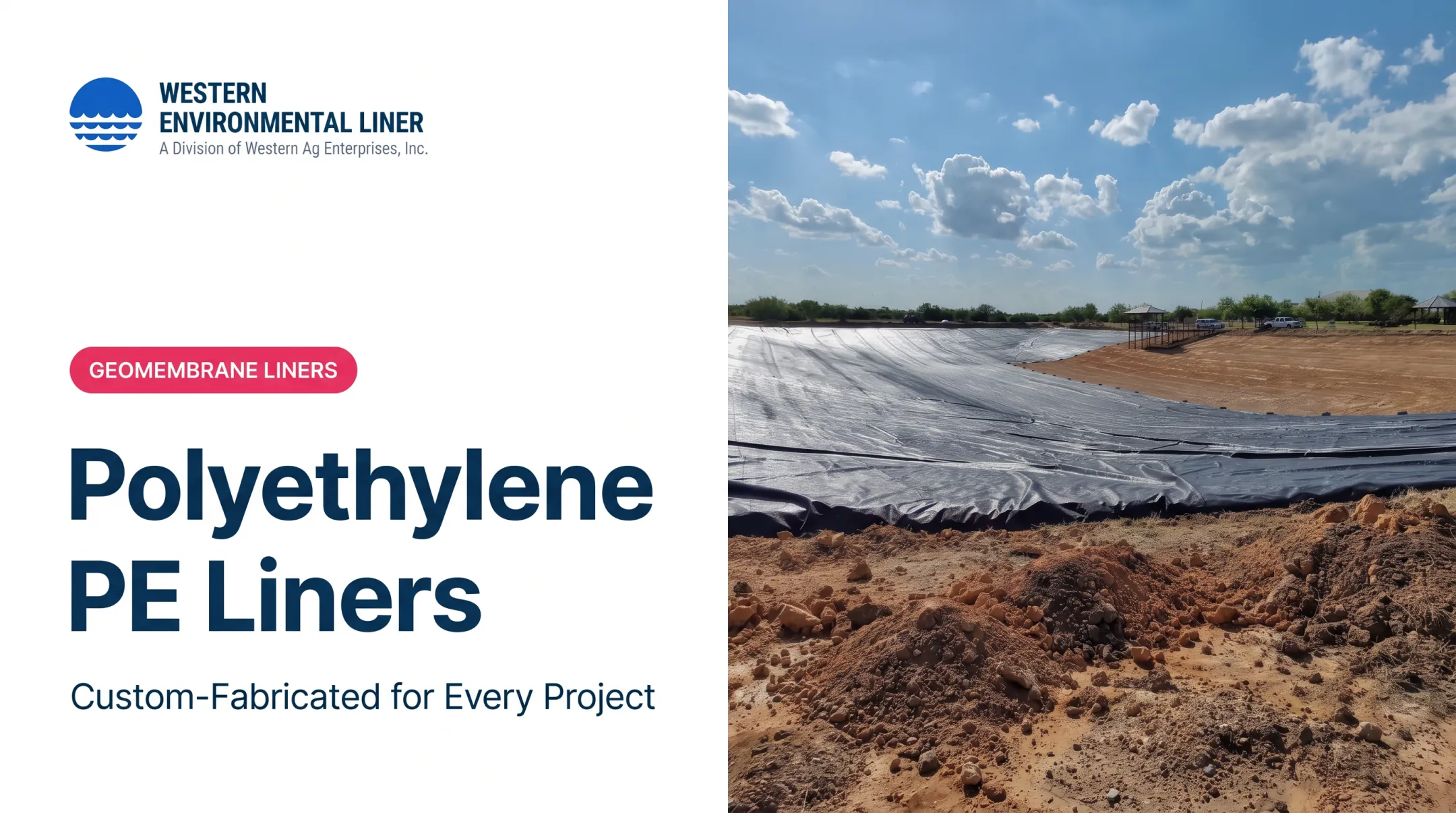
For brine pond projects, Western Environmental Liner offers Aqua 40 coextruded polyethylene as a candidate. It combines reinforcement with coextrusion, giving high tear and puncture resistance plus UV and weathering resistance. The company lists a 20 to 25 year UV and weathering warranty depending on application and region.
Treat that as a starting point. Confirm the final choice against your brine analysis, temperature profile, pond design, installation method, and any engineering or regulatory requirements.
Designing the Complete Brine Pond Liner System
Match geometry to purpose
Shallow, broad ponds favor evaporation and mineral recovery. Deeper ponds with less surface area suit projects that need to limit evaporation. A South Florida desalination study identified concentrate flow, net evaporation, and rainfall as sizing constraints.
Design must also cover capacity, freeboard, inflow, precipitation, wind-driven waves, and overflow routes. Brine concentration shifts as volume drops. The Paradox concept allows for maximum brine level, 6 inches of precipitation, and 2 feet of freeboard.

Prepare the subgrade
The lined area should be flat, smooth, and dry, free of rocks, rubble, roots, vegetation, debris, voids, and protrusions. Western Environmental Liner's guidance:
- If the subgrade can't meet spec, place at least 6 inches of compacted bedding above the highest obstruction
- Use at least 4 inches of compacted backfill where animal puncture isn't a concern, and 12 inches or more where wildlife traffic is
- Add geotextile where subgrade, groundwater, or operations create puncture or abrasion risk
Earthwork and subgrade engineering fall outside Western Environmental Liner's scope. Have a qualified engineer own them.
Single or double containment
Project risk, liquid characteristics, permit conditions, environmental sensitivity, and owner requirements drive this choice. Rules vary by facility type.
New Mexico requires primary and secondary liners with leak detection for surface waste-management evaporation and storage ponds. Texas has its own produced-water recycling pit and brine-pit rules. The federal rule at 40 CFR 264.221 covers regulated hazardous-waste impoundments and is not a blanket brine-pond rule.
A double liner only works with a functional leak-detection layer: drainage paths, accessible monitoring points, and a maintenance plan that accounts for salt deposits or blockage.
Anchoring, slopes, penetrations, and uplift
- Anchor trenches or other edge restraint hold the liner in place. Western Environmental Liner suggests at least 1 ft by 1 ft, with a 3:1 slope detail
- Perimeter trenches run 6 to 30 inches wide and 4 to 24 inches deep, depending on pond size and slope
- Custom pipe boots are prefabricated to each pipe's outside diameter
- Review groundwater uplift, gas or vapor pressure, drainage, and empty-pond conditions so the liner never carries unsupported loading
Environmental protection and closure
Plan for:
- Wildlife deterrence where applicable
- Storm and spill containment
- Inspection access
- Remaining-liquid removal and salt stabilization
- Final cover, plus site remediation or repurposing
New Mexico's rule, for example, requires closure within six months after use ends.
Confirm federal, state, local, and industry requirements with qualified engineers and the relevant authorities before construction.
Installation, Testing, and Long-Term Maintenance
Reduce field risk through fabrication
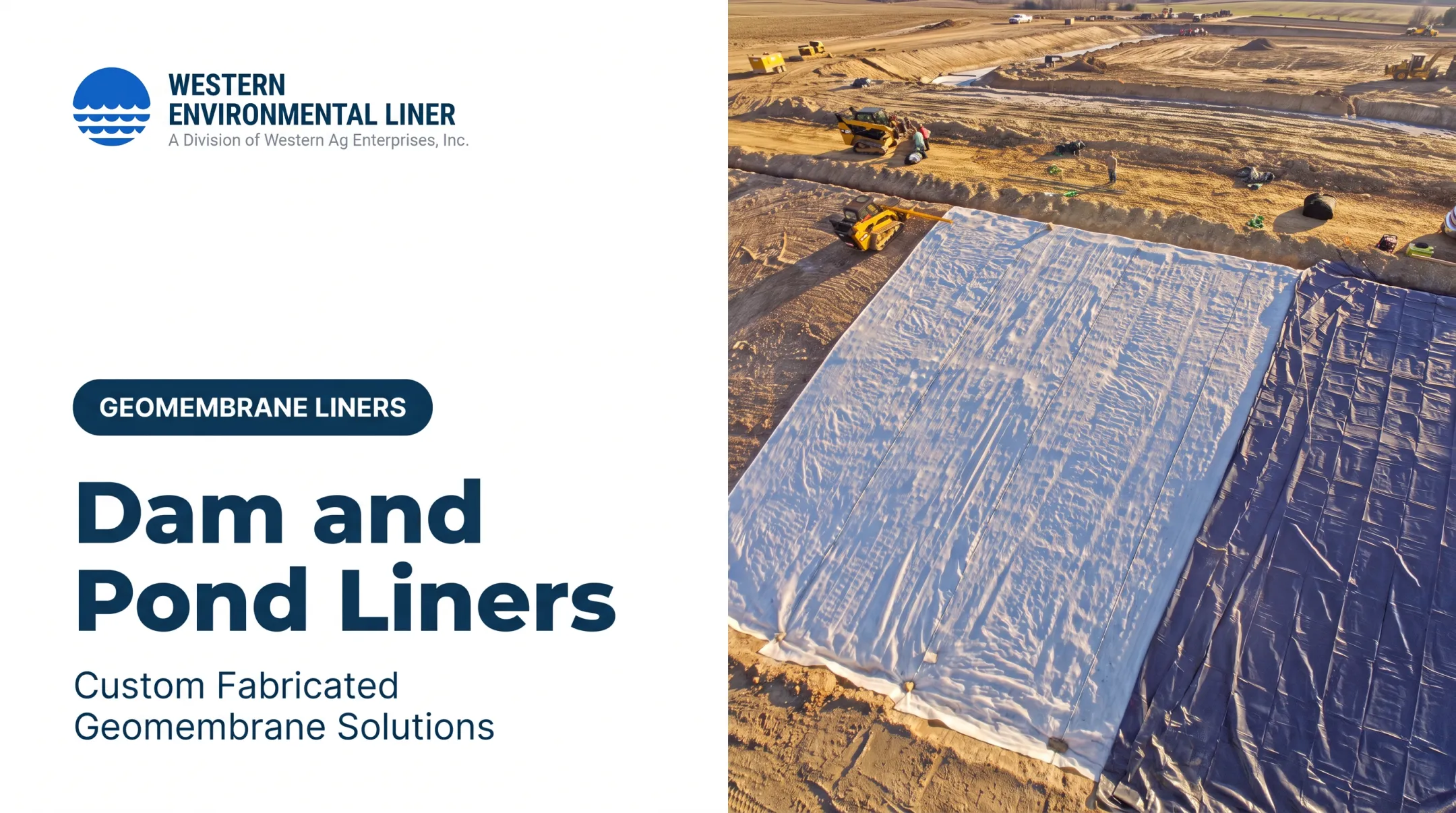
Factory-fabricated panels cut field seams, simplify layout, improve dimensional consistency, and make panel identification easier. Prefabrication is credited with fewer field seams in lithium-brine applications, though no universal failure-reduction figure is published.
Western Environmental Liner fabricates custom liners in Tolleson, AZ; Romulus, NY; and Great Bend, KS. Panels run up to 300' x 300', and one-piece liners reach 150,000 square feet.
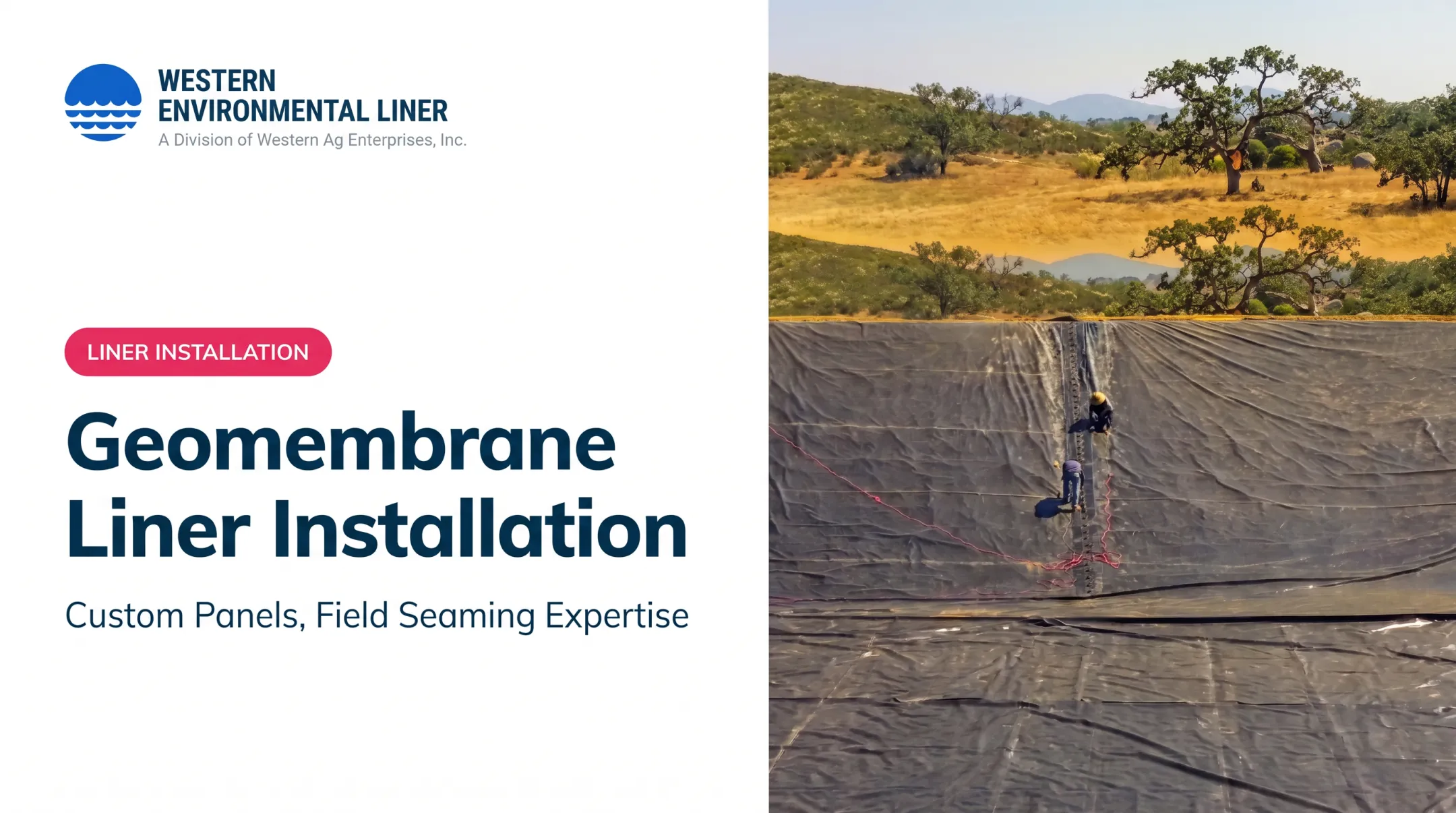
Supervisors can direct field seaming, pipe sealing, and concrete attachment. Technical support is available on site or by phone and email.
Control field welding and seam quality
Require:
- Trial welds and documented welding parameters
- Peel and shear testing
- Seam mapping and repair records
- Retesting of repaired areas
Match each test to its purpose. ASTM D6392 covers destructive peel and shear for nonreinforced thermo-fusion seams; D7747 covers reinforced seams. D5820 checks air-channel continuity on dual seams but does not replace strength testing.
Seam quality is only part of integrity. Electrical leak-location surveys (ASTM D7002 for exposed liners, D7007 for covered ones) find sheet defects as well as seam defects, so specify them where the design calls for it.

Inspect before and after filling
Inspect for:
- Punctures, abrasion, and incomplete welds
- Wrinkles that affect drainage and exposed edges
- Pipe-connection defects and construction-traffic damage
Record panel numbers, seam locations, repairs, test results, and as-built changes. That record supports future maintenance and warranty claims.
Plan leak detection and monitoring
Water level changes can come from rainfall, inflow, outflow, and evaporation, not only leaks. Track these separately, along with leak-detection zones, monitoring wells or sensors where specified, and groundwater comparisons.
Set a baseline monitoring record and a written response procedure for suspected leaks, abnormal level changes, uplift, or settlement.
Maintain the pond
Salt crust, sediment, shifting waterlines, inlet scour, pipe connections, anchor areas, and harvesting equipment all create damage risk. No universal cleaning interval exists, so set one for your site. Build a site plan that covers:
- Permitted equipment routes and protective measures
- Scheduled inspections and safe cleaning methods
- Documented repairs with retesting after each fix
Installer quality
Western Environmental Liner is an IAGI-certified installer with turnkey capabilities. When evaluating any installer, ask for:
- Quality-control plan and inspection scope
- Documentation process
- Warranty terms
- Who is responsible for material defects versus installation defects
Planning Specifications and Comparing Brine Pond Liner Quotes
What to provide before requesting a quote
- Pond drawings or dimensions, depths, slope ratios, and liner area
- Anchor details and subgrade conditions
- Brine analysis, plus operating and peak temperatures
- Expected service life, location, and delivery access
- Penetrations and installation timing
- Pond purpose: storage, evaporation, mineral recovery, produced water, desalination brine, or other
- Cleaning, maintenance, and upset conditions
Compare equivalent scopes
Ask for separate line items so bids are easy to compare:
- Geomembrane and factory fabrication
- Geotextile or protection layers
- Site preparation, installation, welding, and testing
- Leak detection, pipe details, and freight
- Repairs and commissioning
Then match scope to scope: same thickness, surface finish, panel layout, QC testing, installation assumptions, warranty coverage, and exclusions.
Verify the proposal with documents
Ask for:
- Product data sheet
- Chemical compatibility or aging information for the proposed formulation
- Batch documentation for delivered material
- Seam-testing records
- A written description of warranty limits
Read warranty conditions closely. One manufacturer's published warranty, for example, limits effluent to 104°F or less and pH 5 to 9 and excludes harmful chemicals. Have a qualified geosynthetics or civil engineer review the final specification before you order.
Request an evaluation from Western Environmental Liner
Send brine conditions, pond dimensions, site information, and installation requirements for a custom recommendation and free quote. Western Environmental Liner offers custom fabrication for projects over 10,000 square feet, on-site installation, and warranties of up to 20 years when those terms fit the quoted project.
Frequently Asked Questions
What's the best thing to line a pond with?
It depends on liquid chemistry, temperature, pond size, subgrade, UV exposure, mechanical loads, and service life. For brine ponds, get a project-specific compatibility review rather than a generic pond liner.
What are brine ponds?
They're engineered basins that store, concentrate, evaporate, treat, or manage high-salinity water. Typical sources include mining, oil and gas, desalination, power generation, and chemical processing.
Is there a liquid pond liner?
Liquid-applied coatings exist, but they differ from factory-fabricated geomembrane sheets. Industrial brine ponds generally need a purpose-designed sheet system chosen for chemical compatibility and site conditions.
How do you choose a liner for a brine pond?
Start with brine analysis and operating temperature. Then weigh pond geometry, subgrade movement, UV exposure, equipment activity, thickness, protection layers, seam method, and project requirements.
Do brine ponds need a double liner?
It depends on project risk, liquid characteristics, environmental sensitivity, permit conditions, and engineer or owner specifications. A double liner needs a working leak-detection layer to be useful.
How do you prevent leaks in a brine pond liner?
Prepare the subgrade well, add protective underlayment, and select a compatible material. Control factory and field seam quality, detail penetrations carefully, run leak-location testing where specified, and monitor regularly.