
Introduction
Leave an HDPE product in direct sun for years and its strength, flexibility, and containment performance can change. That makes UV resistance a performance-defining property for anything used outdoors.
HDPE is not immune to sunlight. Outdoor durability depends on the resin formulation, stabilizer and pigment system, thickness, manufacturing quality, exposure, and mechanical stress. A 2003 weathering study found that unstabilized HDPE degraded outdoors, while stabilized specimens held their properties.
This article defines HDPE UV resistance, explains the technical properties and operating envelope, shows how to verify performance, and connects selection to outdoor liner projects.
Key Takeaways
- HDPE resists UV reasonably well, but long-term durability depends on the full formulation and product design.
- UV resistance means retaining strength, elongation, and containment performance, not blocking all UV.
- Temperature, thickness, pigment, stabilizers, stress, and installation all shape service life.
- Ask for test methods, thickness, and documentation instead of accepting "UV resistant" claims.
What HDPE UV Resistance Represents in Plastics
HDPE UV resistance is the ability of a product to keep specified physical and functional properties after UV and related outdoor exposure. It describes the finished product, not a value shared by every HDPE resin, pipe, sheet, net, or geomembrane.
It works as a design constraint. The material must retain enough strength, elongation, and integrity for the expected exposure period and loads.
| Property | What research shows |
|---|---|
| Tensile strength | UV and condensation exposure reduced tensile resistance in a tested 1.0 mm HDPE geomembrane |
| Elongation | NIST found faster elongation loss at higher UV intensity and temperature |
| Impact | Unstabilized outdoor HDPE lost impact resistance abruptly in the 2003 study |
| HP-OIT | GM13 uses retained high-pressure oxidative induction time as its UV criterion |
How UV Exposure Affects HDPE
UV energy starts photo-oxidation: free radicals form, react with oxygen, and break polymer chains. NIST research links falling molar mass to embrittlement and surface cracking.
UV resistance is not UV blocking. Carbon black screens the polymer, and GM13 requires 2.0-3.0% content plus acceptable dispersion. Antioxidants and stabilizers still protect the material over time. GM13 judges UV performance by retained HP-OIT, not optical transmission.
Factors That Influence UV Resistance in Real-World Operation
Formulation factors:
- Resin grade and stabilizer package
- Carbon black content and dispersion
- Antioxidants (carbon black and antioxidants can interact synergistically or antagonistically)
- Virgin versus recycled content: GM13 requires virgin resin, allows at most 10% similar-HDPE rework, and bars post-consumer resin
- Thickness and geometry
Field factors:
- Latitude, altitude, season, and clouds change ground-level UV
- Heat compounds UV: a 2024 study found more advanced oxidation after sequential UV and heat than heat alone
- Folds, welds, and contraction stress concentrate cracking
- Thickness variation and manufacturing consistency widen the gap between nominal and actual performance
Operating Range and Key Technical Properties of HDPE UV Resistance
HDPE has no single outdoor lifespan or fixed "UV range." Performance sits inside a site-specific envelope defined by exposure intensity, temperature, duration, construction, and the property retention you require.
Nominal Outdoor Exposure Conditions
A published value applies only to stated conditions. Confirm the full exposure envelope before you rely on any published figure:
- Continuous vs. intermittent exposure, shade, cover, burial, or submersion
- Thickness, formulation, color, loading, orientation, and climate
Typical life guidance shows why those conditions matter:
- U.S. Bureau of Reclamation: about 30 years for geomembranes formulated for exposure, with some installations lasting longer
- Portugal field study: 12 years of mechanical retention with reduced OIT
- Midwest wastewater pond liner (0.75 mm, installed 1993): end of life at about 15 years, with cracks at welds and folds
Allowable Tolerance and Boundary Limits
The boundary is where a required property drops below the project specification. Color change alone is not that point.
Separate short-term exposure, storage and handling, seasonal exposure, and continuous service. Use product-specific data. Our own guidance for liner storage is simple: keep rolls dry and out of direct sun.
Safe Operating Margin and Technical Properties
Designers keep a margin between site exposure and rated limits, especially where UV, heat, tensile stress, abrasion, or chemicals compound.
For smooth 1.50 mm HDPE, GM13 Revision 19 lists:
| Property | Minimum |
|---|---|
| Tensile yield / break | 22 / 40 kN/m |
| Yield / break elongation | 12% / 700% |
| Tear / puncture | 187 / 480 N |
| Stress-crack resistance | 500 hours |
| Carbon black | 2.0-3.0% |
| UV resistance | 50% HP-OIT retained after 1,600 hours |

These are qualification values, not service-temperature limits or retention limits after aging. Also watch weld integrity, flexibility, and carbon-black dispersion (ASTM D5596 calls for 9 of 10 views in Category 1 or 2).
Thickness variation, batch consistency, and stabilizer distribution all affect confidence in published numbers.
How HDPE UV Resistance Is Specified, Measured, and Validated
A credible claim names the product, test method, exposure conditions, measured property, acceptance criterion, and intended application.
Specification and Documentation
Request these before buying:
- Technical datasheet with thickness and color specifications
- Formulation information where available
- Weathering test reports and quality-control records
- Installation requirements, seam records, and the CQA report
- Warranty terms
Keep rated, tested, guaranteed, and predicted values apart. A warranty is not a lab result, and neither is a service-life prediction. GM13 dropped its recommended warranty in Revision 8, and a Wisconsin NRCS specification asks for a two-year workmanship guarantee, not a predicted lifetime.
Manufacturer data is often typical rather than guaranteed. Western Environmental Liner's Aqua series sheets report more than 90% strength retention for Aqua 20 after 2,000 hours of accelerated UV weathering, and describe those figures as typical values rather than limiting specifications.
Measurement and Laboratory Validation
The right method depends on product and claim:
- ASTM D7238: geomembrane exposure with UVA-340 lamps, heat, and condensation
- ASTM G154 and D4329: fluorescent UV exposure
- ASTM G155 and ISO 4892-2: xenon arc
- ISO 4892-3: fluorescent UV
GM13 uses D7238 with 1,600 hours, cycling 20 hours of UV at 75°C and 4 hours of condensation at 60°C. Retained HP-OIT (ASTM D5885) is the measure; standard OIT is not recommended here because its high test temperature can mislead.

Compare properties before and after exposure, and choose the ones that matter for your application.
Field Relevance and Verification
ASTM G151 says lab exposure is not a total simulation of outdoor use and does not recommend fixed hours-to-years conversions. Irradiance varies widely across the U.S., so compare the test conditions with your site.
Ask suppliers how lab results support your design life, inspection plan, and replacement strategy.
Implications of Operating Outside the Recommended Range and Common Misinterpretations
Excessive or poorly characterized UV exposure can damage HDPE in several ways:
- Chalking and discoloration
- Embrittlement and cracking
- Lower tensile and elongation performance
- Seam vulnerability and eventual loss of containment
Visible change alone does not prove failure.
Common mistakes:
- Assuming all HDPE products perform alike
- Treating "UV resistant" as "UV proof"
- Converting accelerated-test hours directly to years
- Judging by color alone: white HDPE ran about 38–41°F cooler in one field study, yet a 2025 textured-sheet study showed the greatest OIT loss in a white/black formulation
- Ignoring thickness and stress
- Applying lab results without regard to installation and climate
Evaluating the Whole Liner System
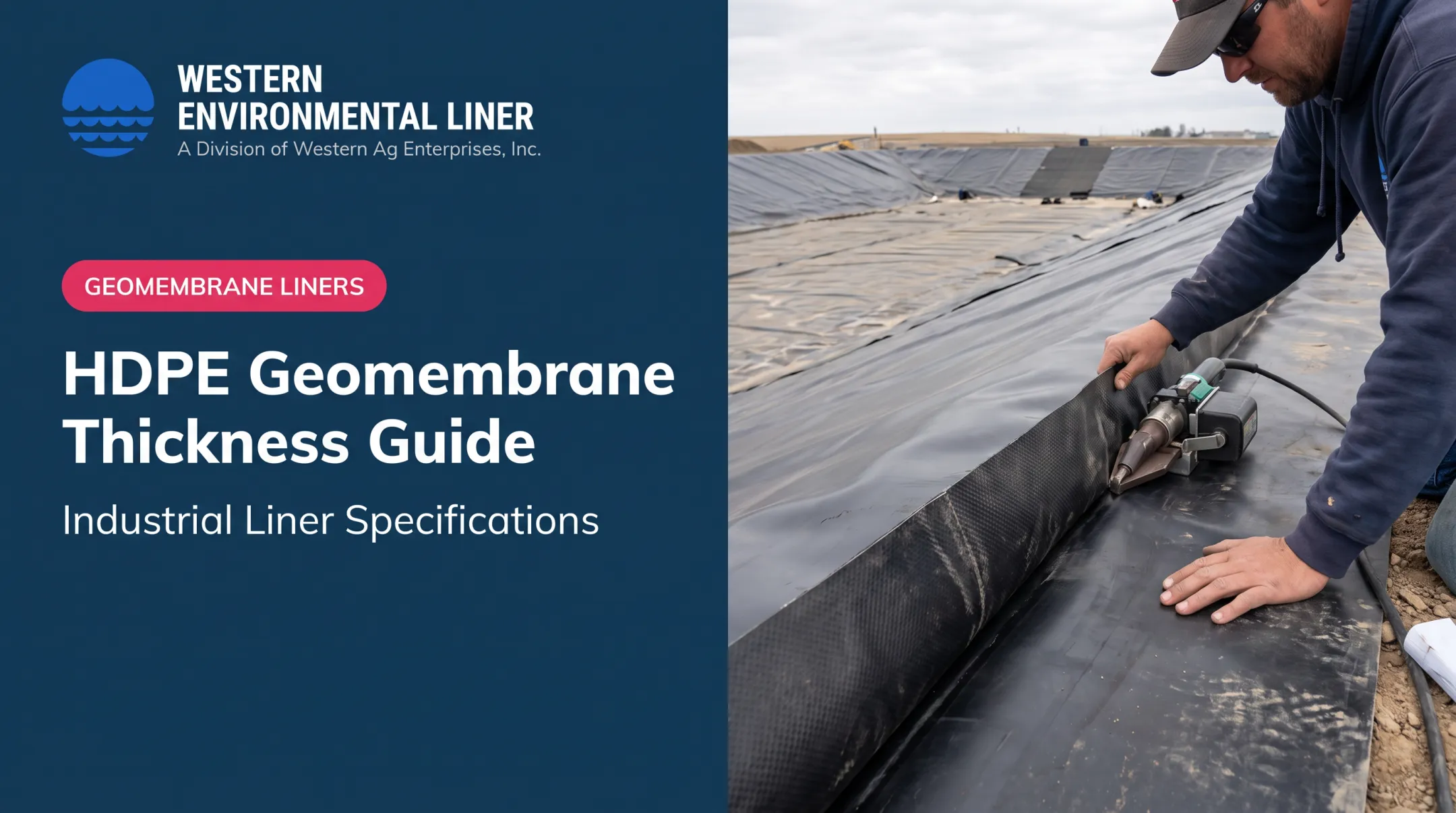
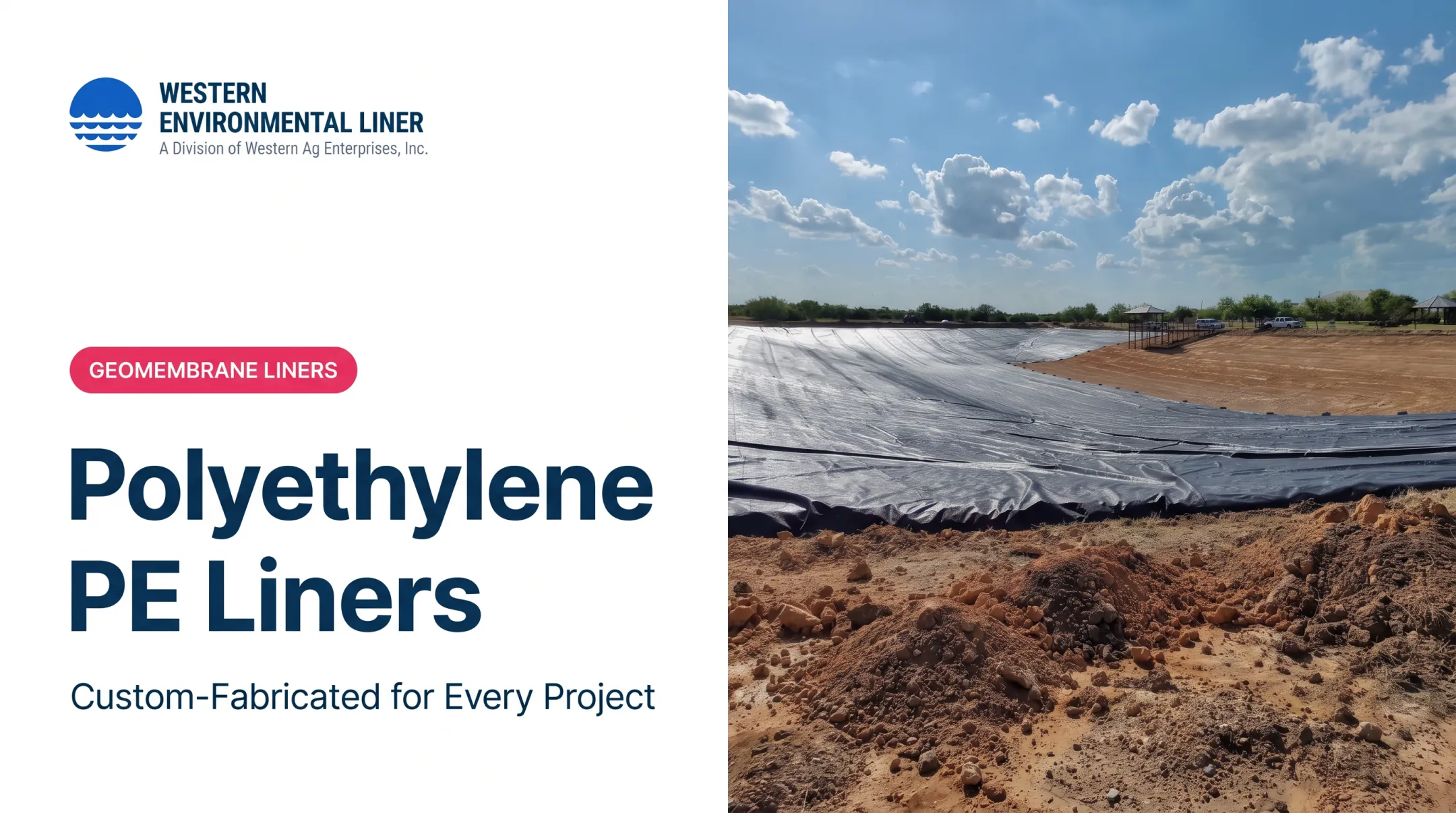
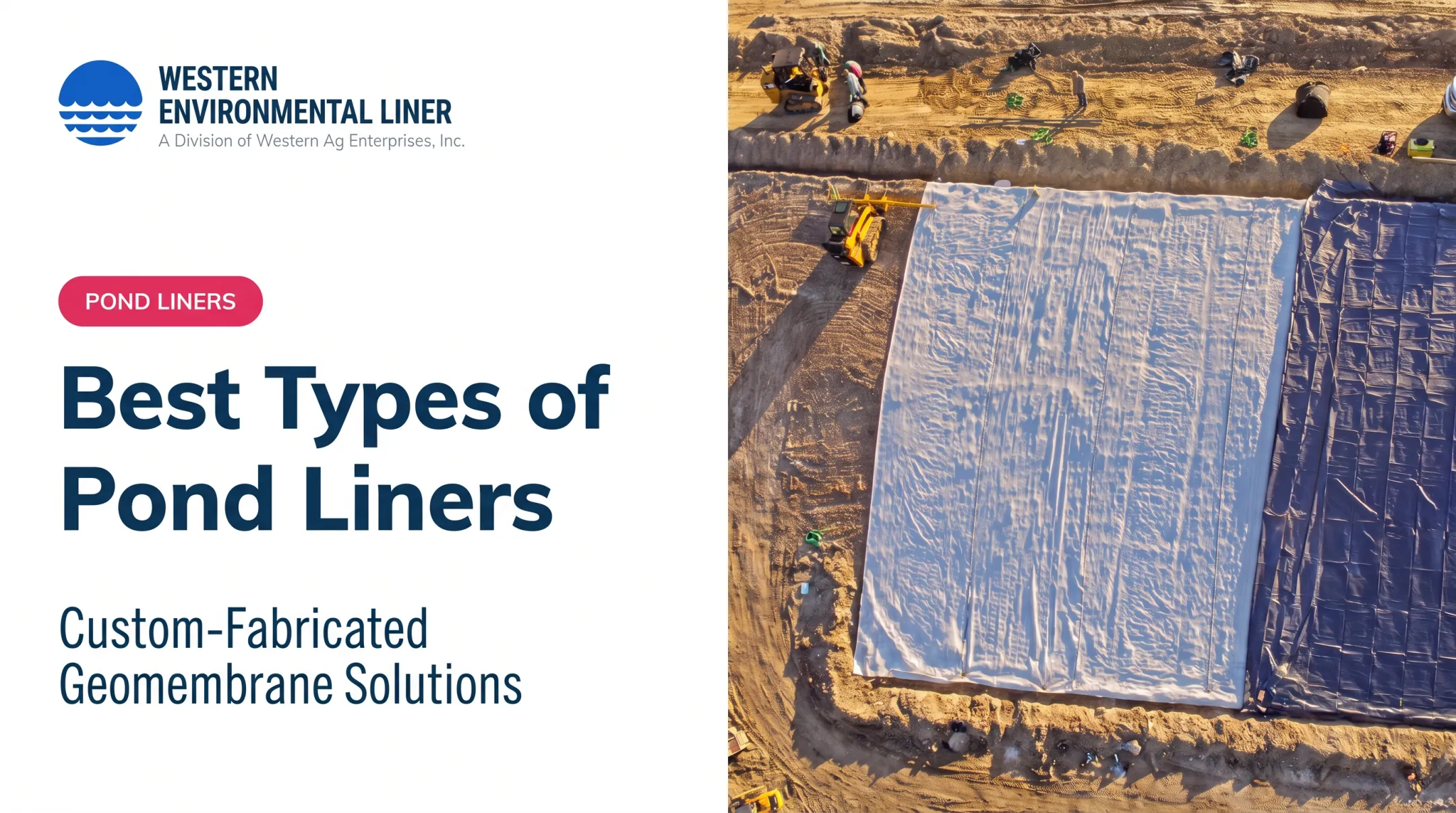
For a pond, lagoon, canal, or containment liner, evaluate the entire system: formulation, thickness, factory fabrication, field welding, subgrade, anchoring, exposure, and inspection. The failure case above came from contraction stress plus surface oxidation at folds and welds, not the sheet alone.

Western Environmental Liner fabricates custom panels up to 300' x 300', offers factory-welded panels, and provides turnkey installation through an IAGI-certified crew. Subgrade, earthwork, and engineering design remain the owner's responsibility. Manufacturer claims never replace project-specific engineering or product documentation.
Conclusion
HDPE UV resistance is a governing design parameter. Performance depends on formulation, construction, exposure, stress, and installation.
Specify from evidence, build in safety margins, and apply engineering judgment when choosing HDPE for long-term outdoor use.
Frequently Asked Questions
Does HDPE have good UV resistance?
Generally, yes, but durability outdoors depends on the formulation, stabilizers or pigments, thickness, exposure, and verified testing.
How does UV exposure damage HDPE?
Photo-oxidation breaks polymer chains. Over time that causes surface degradation, embrittlement, cracking, and lost mechanical properties.
Do all HDPE products have the same UV resistance?
No. Resin grade, additives, color, thickness, manufacturing quality, stress, and exposure all create large differences between products.
How long does HDPE last outdoors?
There is no universal figure. It depends on product testing, site exposure, loads, installation, and the end-of-life criteria you set.
How is UV resistance tested in HDPE plastics?
Samples go through controlled UV, heat, and condensation, then properties are compared with original values. Results need application-specific interpretation.
Is black HDPE more UV resistant than other colors?
Carbon black helps protect the polymer, but color alone proves nothing. Ask for carbon-black content, dispersion results, and weathering data.