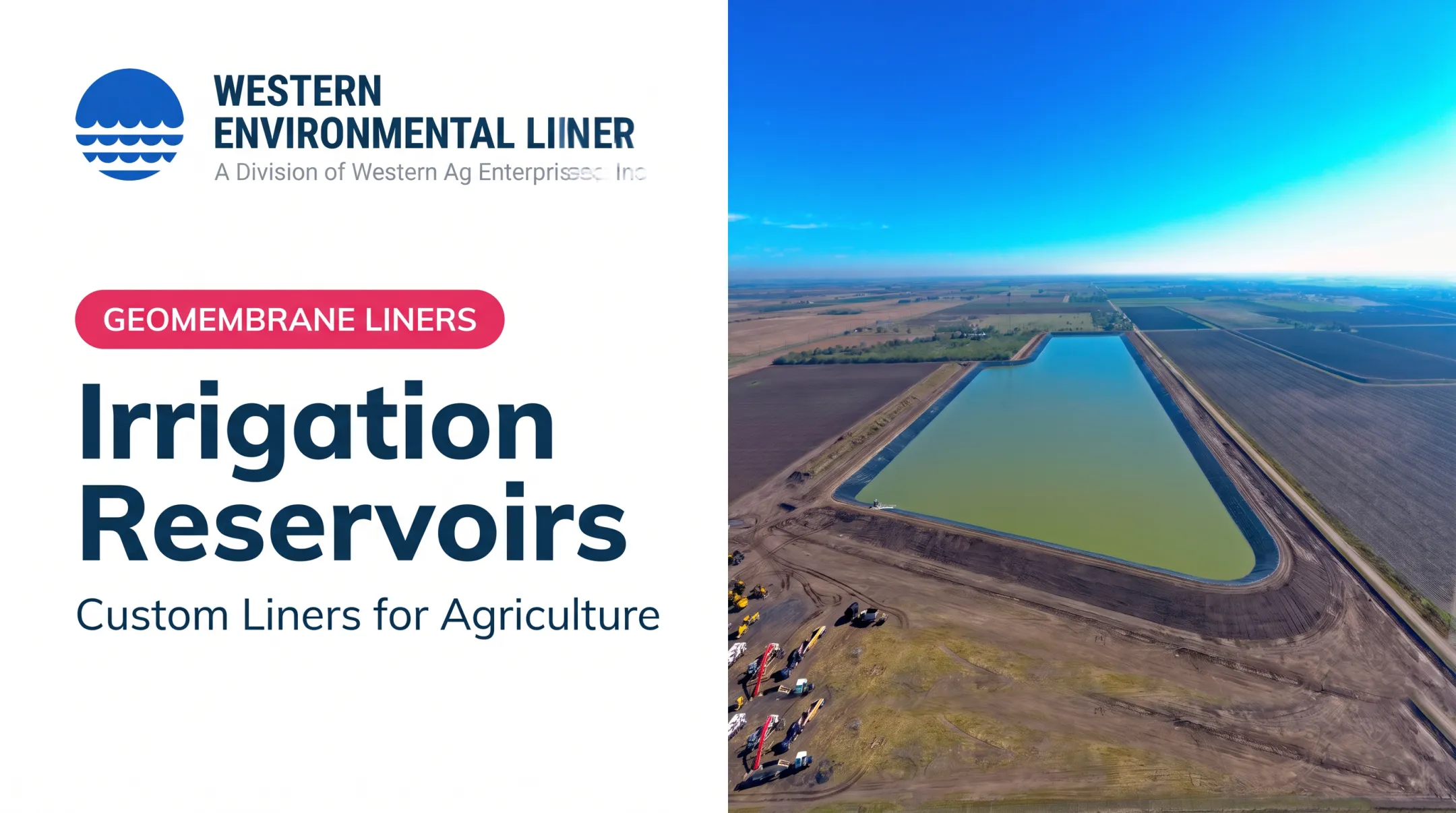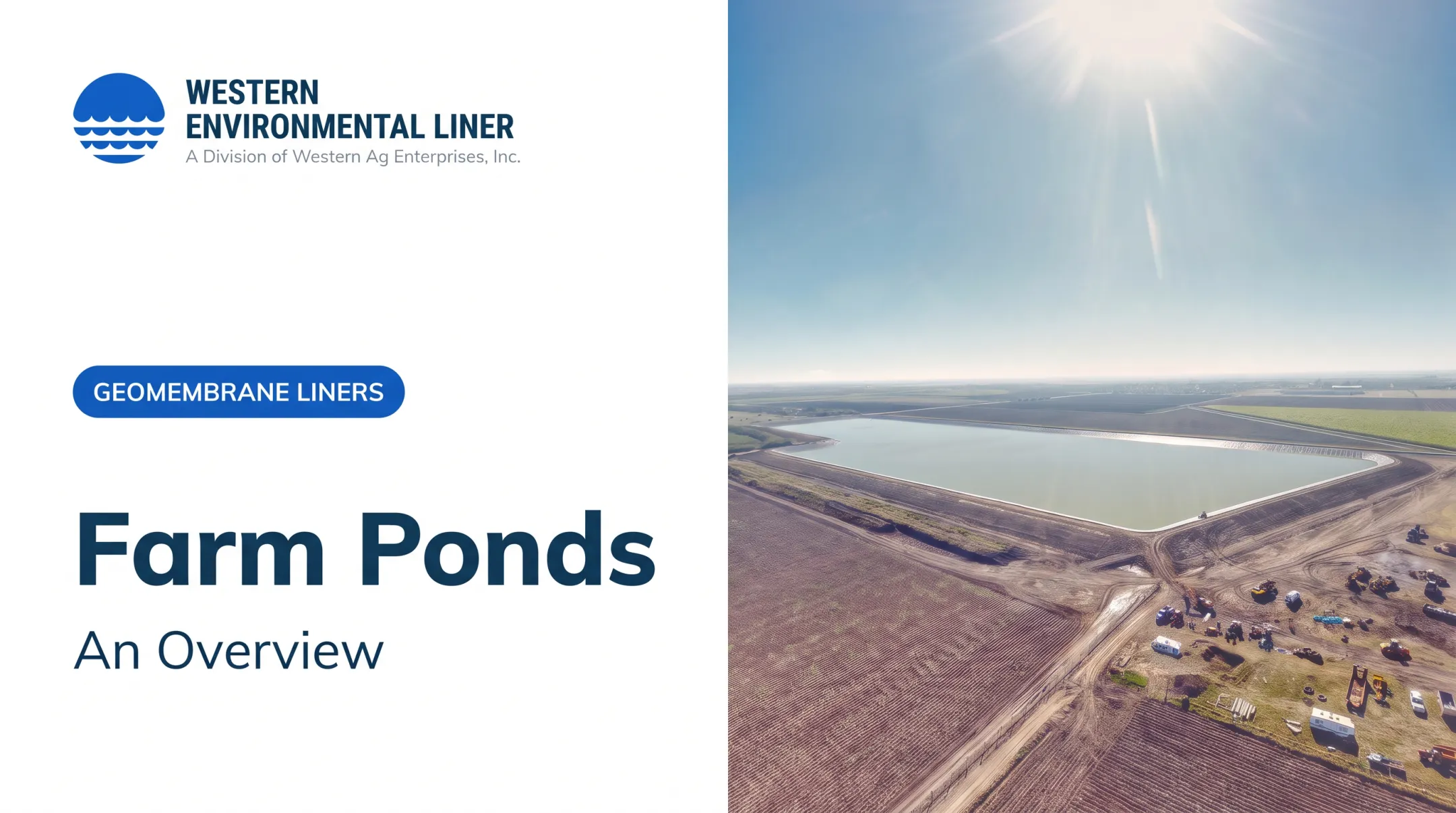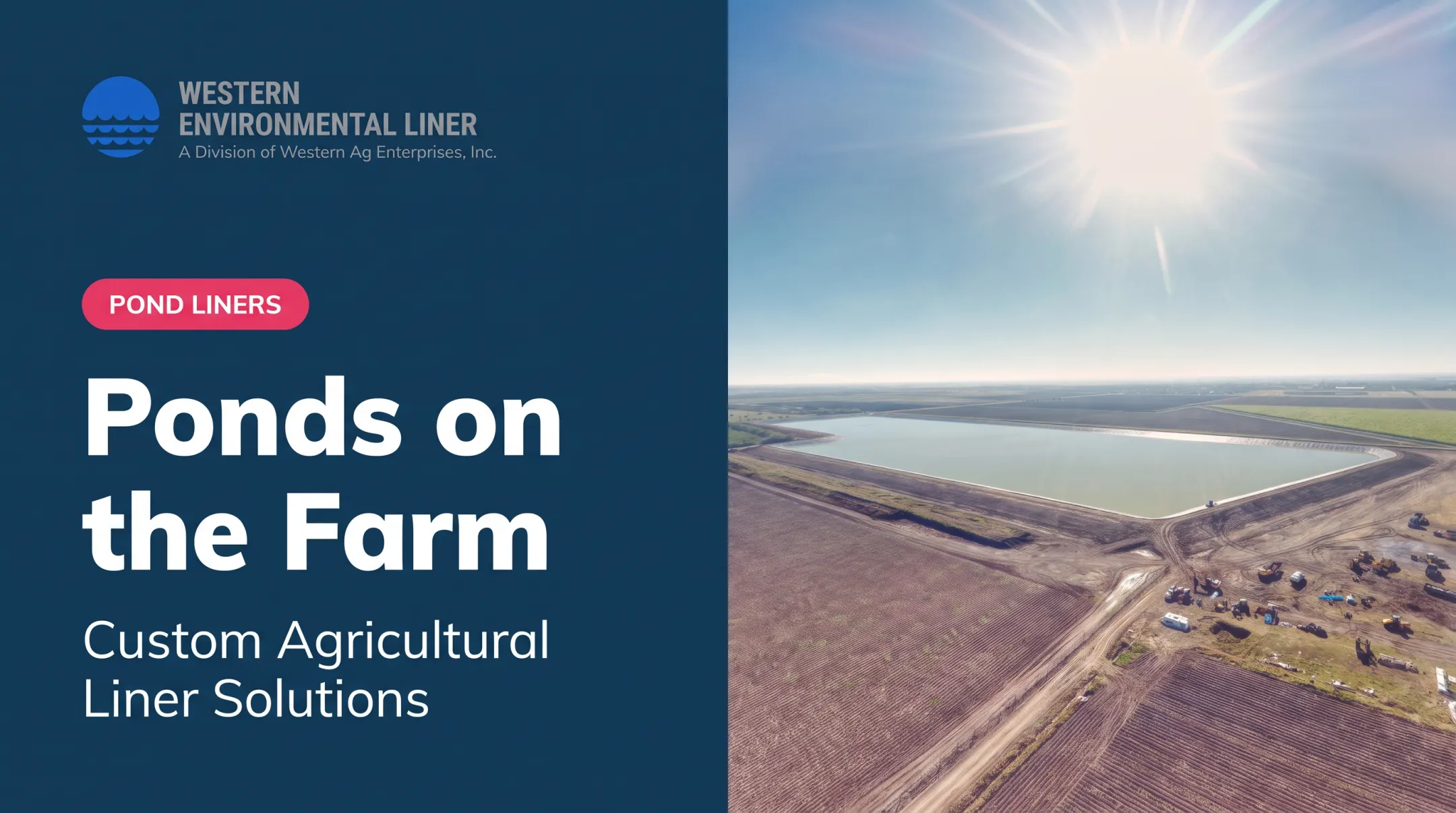

Even a well-dug pond fails if the soil is too permeable or the spillway is undersized. One national guideline can't tell you how big yours should be, either. NC State's worked example, for instance, lands near 27 acre-feet for 40 acres of corn, and that number won't transfer to your farm.
This guide covers what irrigation ponds do, how to plan and size one, the components that matter, liner selection, construction, and maintenance.
Key Takeaways
- A farm irrigation pond is a planned storage system, not a hole that fills with runoff.
- Size it from crop demand, inflow, evaporation, seepage, and sediment.
- Pumps, intakes, spillways, and sediment control matter as much as the basin.
- A geomembrane liner can cut seepage when soils are too permeable.
- Test water and confirm permits before you build or irrigate.
What Is a Farm Irrigation Pond? Benefits, Uses, and Limits
What is an irrigation pond?
An irrigation pond is a constructed water body that captures, stores, and supplies water for agricultural use. The Natural Resources Conservation Service (NRCS) describes it as an impoundment built by an embankment, an excavated dugout, or both.
Water can come from permitted runoff, streams, wells, or irrigation return flows. The source shapes the design, the water quality, and your compliance obligations.
How farms use irrigation ponds
Crop irrigation is the main job. Related uses include:
- Livestock watering through properly designed trough systems
- Nursery irrigation and some aquaculture
- Buffering operations during dry stretches
- Recovering irrigation spills and tailwater
Storing water for later is different from letting animals or equipment into the pond. Controlled access protects banks, water quality, and pumps.
When ponds are lined and managed for reuse, the gains can be large. A UC report on Altman Specialty Plants describes lined ponds of 10 and 27 acre-feet in California, with sand filtration before storage. First-year reuse reached roughly 429 acre-feet, about 37% of nursery water use. That is one site's result, not a guarantee.
Benefits and limitations
Benefits:
- Storage flexibility for dry periods
- Less dependence on one supply
- Runoff capture for later use
- Better drought planning
Limitations:
- Evaporation, seepage, and sediment buildup
- Algae and debris
- Fluctuating water levels
- Pump maintenance
- Water that must be tested before it goes on crops
Planning a Farm Irrigation Pond
Define water demand and operating goals
Crop type, irrigated acreage, irrigation method, seasonal schedule, livestock or nursery needs, and backup supply all drive the design. Skip the universal rule of thumb.
NC State's method is a good starting point: crop water use equals the crop coefficient times reference evapotranspiration. Gross irrigation need is that figure minus effective rainfall, divided by irrigation efficiency.
Your county extension office can supply local crop-use and rainfall data.
Evaluate topography, soil, and access
Check these before anyone starts excavating:
- Slope, drainage patterns, and watershed area
- Soil permeability, groundwater, and bedrock
- Flood risk, nearby structures, and utilities
- Equipment access for construction and maintenance
Place the inlet, outlet, emergency spillway, pump intake, and access roads on paper first. Moving them later is expensive.
Estimate storage capacity
Compare expected inflow against crop demand, then add the losses. NRCS standards call for allowances for evaporation, seepage, and sediment storage.
Evaporation varies widely: Oklahoma State estimates 28.1 to 44.4 inches from May through October for shallow water bodies, depending on region.
Add drought reserves and freeboard. NRCS requires at least 1 foot between the design high-water level and the settled embankment top.

Bring in an engineer, pond designer, or hydrologist for large embankments, complex drainage, or uncertain water supply.
Identify and evaluate water sources
Compare runoff, stream withdrawals, wells, and return flows on reliability, quality, pumping needs, and seasonal availability. Don't design around an assumed source. Confirm its legal availability and expected flow first.
Confirm permits, water rights, and safety requirements
Call your state, county, conservation district, and water-resource offices before you build or withdraw. Rules vary, and they cover different things:
- Federal: The Corps' farm-pond exemption under Section 404 has purpose and size limits. Agricultural use alone doesn't qualify you.
- New York: Dam permits depend on height and capacity, and a pond created by a dam needs a licensed engineer.
- North Carolina: Dam approval applies at 25 feet and 50 acre-feet, or to any high-hazard dam.
- Texas: Livestock exemptions don't cover crop irrigation, which needs a water right.
Also ask about wetland and stream disturbance, erosion control, spillways, fencing, and worker safety.
Essential Irrigation Pond Components and Liner Selection
Plan water collection, overflow, and sediment control
Inlets, diversion channels, silt traps, outlets, and emergency spillways control runoff and high-water events. NRCS requires sediment storage for the design life or a plan for periodic cleanout.
Route overflow away from embankments, buildings, roads, and erodible fields. A spillway that dumps against your own dam defeats its purpose.
Choose the pump, intake, and filtration
Pump selection turns on required flow, total lift, distance to the field, irrigation method, power, and operating schedule. NDSU also lists suction conditions and pipe size.
Protect the intake with a screen and keep the pump area accessible. Surface water rich in organic matter often needs media filtration ahead of screen filters, since algae can clog screens quickly and drip emitters are vulnerable.
Manage pond water quality
Test for what matters to your use: sediment, pH, salinity, minerals, nutrients, pathogens, and contaminants. Oregon State's screening puts total dissolved solids under 500 ppm as no problem, 500 to 2,000 ppm as an increasing problem, and above 2,000 ppm as severe. Normal pH runs 6.5 to 8.0.

Produce growers face another layer. The FDA's 2024 pre-harvest water rule requires systems-based assessments, generally annually, and its harvest and post-harvest uses are stricter.
Controls include:
- Vegetated buffers around the perimeter
- Runoff controls and aeration
- Algae management (check herbicide labels for irrigation waiting periods)
- Fencing out livestock
Decide whether the pond needs a liner
| Option | Best when | Watch for |
|---|---|---|
| Unlined | Soils are tight enough for acceptable seepage | Seepage you can't see |
| Compacted clay or bentonite | Suitable soil and good compaction equipment | Clay can be permeable unless carefully compacted |
| Geomembrane | Soils are porous or seepage must be minimal | Subgrade quality and installation |
For compacted soil, NRCS Standard 520 sets minimum thicknesses of 12 inches for depths up to 16 feet, 18 inches up to 24 feet, and 24 inches up to 30 feet. Geomembranes fall under Standard 521.
A liner doesn't replace good excavation, compaction, drainage, anchoring, or slope design.
Select and design the geomembrane liner
Match material to sunlight, water chemistry, subgrade movement, puncture risk, pond shape, and expected service life. Properties vary by product and thickness, so compare specific data sheets rather than material labels. NRCS 521 clear-water minimums include 30 mil HDPE, 30 mil LLDPE, 30 mil PVC, 45 mil EPDM, and 36 mil reinforced polypropylene.
Western Environmental Liner fabricates custom irrigation pond liners in reinforced polyethylene and reinforced polypropylene. Factory-welded panels reach 300' x 300', and one-piece liners are available to 150,000 square feet.
The company also provides technical support on slopes, anchoring, and subgrade, plus on-site installation. Confirm current materials, warranty terms, and project-size limits when you request a quote.
Details that prevent leaks:
- Geotextile underlayment (4 to 32 oz) under the liner, or above it when backfilling with sharp aggregate
- An earthen anchor trench at least 1 foot deep and 1 foot wide
- Custom pipe boots sized to each penetration
- Protective cover where wildlife or traffic could cause punctures
Building and Maintaining the Pond
Prepare the excavation and subgrade
Clear vegetation, set aside topsoil, shape slopes, and remove rocks, roots, and debris. Compact the subgrade and fix soft spots before lining.
NRCS 521 calls for a smooth, firm foundation with no standing water, mud, or frozen ground. Inspect for smoothness, drainage problems, and settlement risk. Western Environmental Liner notes that uneven earthwork can cause punctures or tears over time. The company does not do earthwork or subgrade engineering.
Install and protect the liner
- Place underlayment where required.
- Spot, unroll, and unfold the liner panels.
- Join seams if the liner is multi-piece.
- Seal penetrations with pipe boots.
- Anchor the edges, laying the liner relaxed and compacting backfill carefully.
- Protect it from construction traffic and sharp materials.
Factory welding under controlled conditions produces the most reliable seams, which is why large prefabricated panels cut field-weld risk. Where field seams exist, test them. ASTM D5820 covers air-channel testing and D5641 covers vacuum-box testing. Document tests, repairs, penetrations, and anchor points.

Fill and commission the pond
Fill in stages while you watch the liner, embankment, pump, and intake. Confirm the inlet and spillway work as designed and check water quality. Never draw the water below the pump's safe operating level.
Watch for settlement, wet spots, erosion, or unexplained water loss during the first fill.
Establish a maintenance schedule
Routine checks:
- Water level, liner edges, and exposed seams
- Embankments, spillways, and inlets
- Pump screens, filters, fences, and vegetation
Seasonal tasks:
- Remove debris and manage sediment
- Control algae and woody growth (NRCS says keep woody vegetation off embankments and spillways)
- Inspect for erosion after major storms
- Winterize equipment and review water quality
Prevent and respond to common problems
Problems that hurt irrigation reliability include:
- Seepage and falling water levels
- Clogged intakes and sedimentation
- Algae and embankment erosion
- Liner damage
NRCS ties the main failure mechanisms to porous foundations, unprotected slope erosion, and undersized spillways.
Document symptoms before repairing. Call a qualified pond, earthwork, hydraulic, or liner professional for structural damage, significant leakage, contaminated water, or an inaccessible liner.
If you're planning a lined irrigation pond, request a project evaluation or liner quote from Western Environmental Liner to discuss materials, custom fabrication, and installation.
Frequently Asked Questions
What is an irrigation pond?
It's a planned agricultural reservoir that stores water for crop irrigation and related farm uses. Its water source and design must meet applicable requirements.
How big should a farm irrigation pond be?
Size depends on crop demand, irrigated area, inflow, rainfall, evaporation, seepage, sediment storage, drought reserves, and your irrigation schedule. No universal acreage rule exists.
Do farm irrigation ponds need a liner?
It depends on soil permeability, acceptable seepage, and project goals. A geomembrane is one option alongside properly designed compacted soil or bentonite treatment.
What permits are needed to build or use a farm irrigation pond?
Requirements vary by state and locality. They can involve dams, water withdrawals, water rights, wetlands, streams, drainage, embankments, and erosion control.
How do you keep a farm irrigation pond from losing water?
Evaluate seepage first, then use a liner or soil treatment. Inspect for leaks, control erosion and vegetation, and manage operating levels. Evaporation is a separate loss that liners don't stop.
Can pond water be used for crop irrigation?
Yes, when it's tested and managed for your crops and equipment, with filtration or treatment added as needed. Produce growers must also meet FDA agricultural water requirements.