
Introduction
A dairy has to handle manure, parlor wash water, rain, and contaminated runoff without letting any of it reach soil, groundwater, streams, or the neighbor's property. A lactating cow produces roughly 150 pounds of manure a day, and that's before wash water and rainfall enter the picture.
A runoff or manure lagoon is one piece of that system. It stores and partly treats liquids, but it doesn't replace good collection, solids handling, land application, inspections, or regulatory planning.
This article covers how lagoons work, manure management practices, capacity and liner design, maintenance, environmental protection, and U.S. compliance.
Key Takeaways
- A lagoon performs well when capacity, containment, inflow control, and removal or reuse are planned together.
- Solids separation and weather-aware land application protect storage capacity and cut overflow risk.
- Liner choice, subgrade prep, installation quality, and inspections drive long-term containment.
- Standards, permits, and setbacks vary by state, so involve engineers and regulators early.
What Is a Dairy Farm Runoff Lagoon and How Does It Work?
A dairy farm runoff lagoon is an engineered basin (earthen, lined, or built with another approved containment system). It receives manure, wash water, precipitation, and other wastewater listed in the farm's waste management plan.
The Flow Path
Material usually moves from barns, milking areas, feed storage, and barnyards into collection channels. From there it passes through screens, separators, pumps, or settling areas before liquid reaches the main lagoon.
Inside the lagoon:
- Heavier solids settle into sludge
- Lighter material can form a surface crust
- Microorganisms break down part of the organic matter
Lagoon and Basin Types
| Component | What it does |
|---|---|
| Anaerobic lagoon | Oxygen-free biological breakdown partly stabilizes manure |
| Aerobic lagoon | Shallow, oxygen-dependent organisms, often a downstream cell |
| Mechanically aerated lagoon | Equipment adds oxygen and mixes contents |
| Facultative lagoon | Works with and without oxygen; most livestock treatment lagoons are this type |
| Settling basin | Separates solids physically; little biological treatment |
| Storage or retention pond | Holds material; the name doesn't guarantee treatment |
Many farms combine several of these rather than relying on one basin.
Reuse and Its Limits
Stabilized effluent and separated solids can serve as crop nutrients when the nutrient management plan allows it. Treatment still doesn't make the material safe for unrestricted discharge. Nutrients and bacteria remain, and discharge from a large CAFO needs NPDES authorization.

Manure Management From Collection to Beneficial Reuse
Keep Clean Water Out
Every gallon of clean stormwater that enters the system eats storage. Minnesota Extension points to berms, ditches, and gutters that keep upslope runoff away from manure-contaminated areas. Roof runoff diversions, protected feed areas, and well-graded barnyards help too.
Separate Solids Early
Separation, screening, settling, and periodic sludge removal preserve lagoon volume and make liquid easier to pump. Ohio State reports longer intervals between cleanouts, and NC State documents bedding, composting, and field application for the separated solids.
Skipping this step gets expensive. At FM Dairy in Missouri, a failed separator let manure solids and wood bedding into the lagoon. After about 20 years without effective solids removal, Missouri Extension describes solids islands that left the flush system nearly inoperable.
Plan Storage Around the Whole Year
Storage planning accounts for:
- Herd size, manure, and wash-water production
- Bedding and residual solids
- Precipitation minus evaporation
- Seasonal field conditions and crop nutrient demand
- Periods when land application is restricted
NRCS standards add a minimum treatment volume for treatment lagoons. No universal sizing formula exists, so use your state's adopted standards and an engineer.
Apply Responsibly
Land application should follow testing and weather. Under applicable federal Part 412 provisions, manure is tested for nitrogen and phosphorus at least annually and soil phosphorus at least every five years. Those results set application rates.
Also plan for:
- Crop nutrient needs and timing
- Setbacks (often 100 ft from specified waters, or a 35-ft vegetated buffer)
- Equipment calibration
- Records, kept five years for applicable CAFOs
- No application on frozen, saturated, or runoff-prone ground where rules prohibit it
Odor and Biological Balance
Overloading is the usual culprit behind odor. Oklahoma State names spoiled milk and afterbirth as organic loads that can overwhelm a lagoon, while nondegradable materials consume treatment volume.
Antimicrobials are a concern too. A 2005 laboratory study of swine lagoons found selected antibiotics significantly inhibited methane production. It wasn't a dairy field trial, but it's a reason to be deliberate about disinfectant and antibiotic discharge to the lagoon.
Dairy Lagoon Design: Capacity, Siting, Liners, and Safety Features
Site Assessment
NRCS Conservation Practice Standard 313 calls for investigating soils, seeps, groundwater, bedrock, sinkholes, karst, and nearby wells. Keep facilities outside the 100-year floodplain.
Designers also review topography, drainage, flood risk, prevailing winds, pumping access, and setbacks.
Capacity and Freeboard
Designers add up manure and wastewater inflow, rainfall, evaporation, treatment volume, sludge accumulation, and storm reserve. NRCS includes the 25-year, 24-hour storm plus freeboard.
- CPS 359 (treatment lagoons) requires at least 12 in of freeboard
- CPS 313 (storage) requires at least 6 in for vertical walls and 12 in for other facilities
- CPS 359 sets the bottom at least 2 ft above seasonal high groundwater, unless special design addresses buoyancy and seepage
Comparing Liner Options
| Liner | Agricultural specification |
|---|---|
| Compacted soil or clay (CPS 520) | Laboratory-verified seepage design; thickness starts at 12 in for storage depth of 16 ft or less and increases with depth |
| Concrete (CPS 522) | Reduced-seepage or liquid-tight design; engineered joints and sealed penetrations |
| Geomembrane (CPS 521) | Wastewater minimums: HDPE/LLDPE 60 mil, PVC 40 mil, EPDM/FPP 45 mil |
Some states tighten the federal baseline. Texas's 2024 permit requires hydraulic conductivity of 1 x 10^-7 cm/s or lower, at least 18 in of material, and Texas PE certification.
Material choice depends on waste chemistry, UV exposure, subgrade movement, puncture risk, geometry, and the engineer's specifications.
Installation Requirements
Under CPS 521, installation requires a smooth, firm subgrade free of sharp objects, standing water, mud, vegetation, and frozen material. Other requirements:
- Cushion angular stone with at least 10 oz/yd² nonwoven geotextile or 6 in of suitable soil
- Anchor against wind uplift; HDPE/LLDPE anchor trenches sit at least 24 hours before backfill
- Seal waste-storage penetrations watertight
- Specify seams, installer qualifications, and quality-control testing
- Install leak detection where foundation soils exceed 5 x 10^-5 cm/s permeability (Group I/II soils)
Document construction and inspect before commissioning.
Where Western Environmental Liner Fits
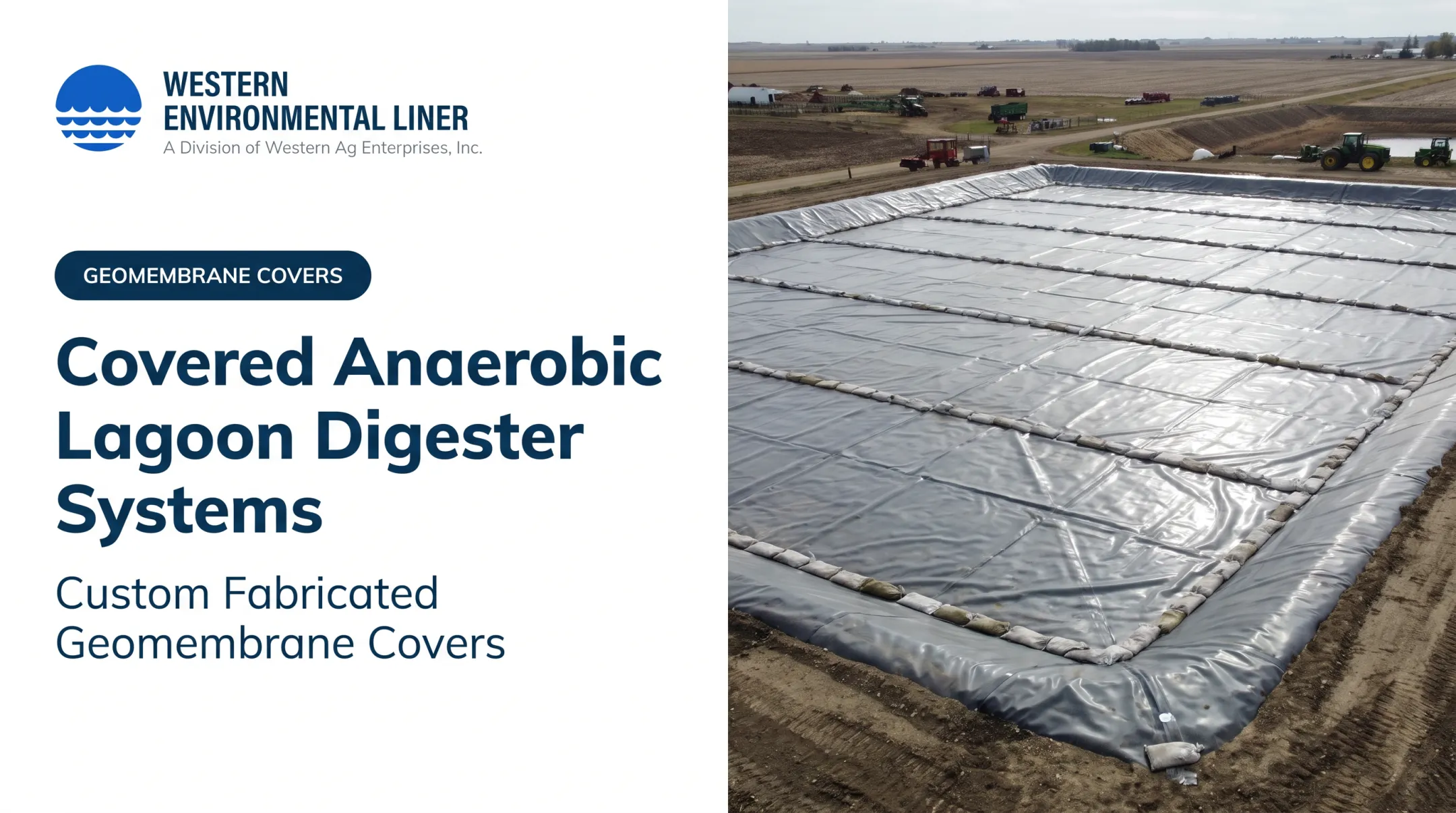
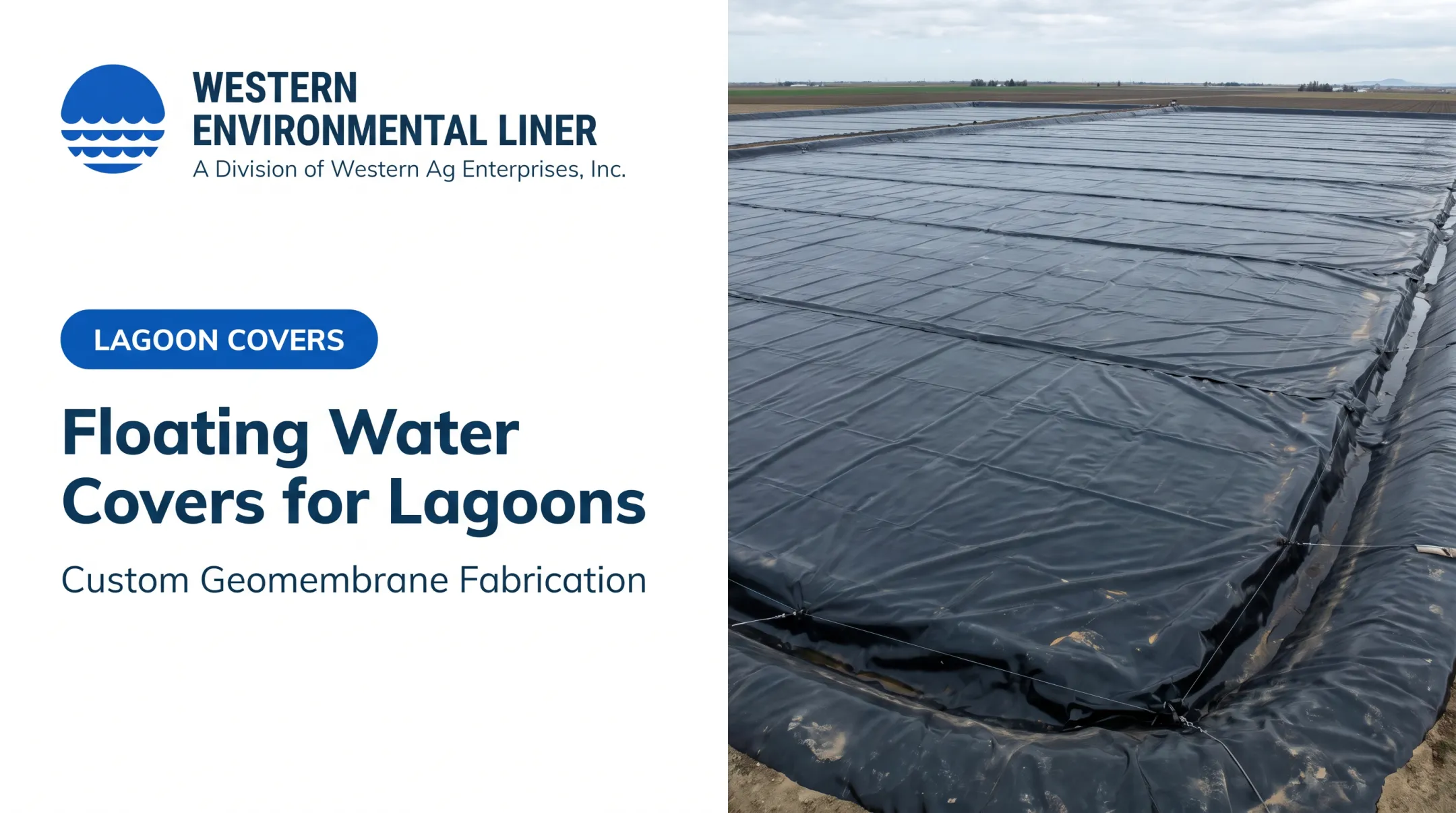
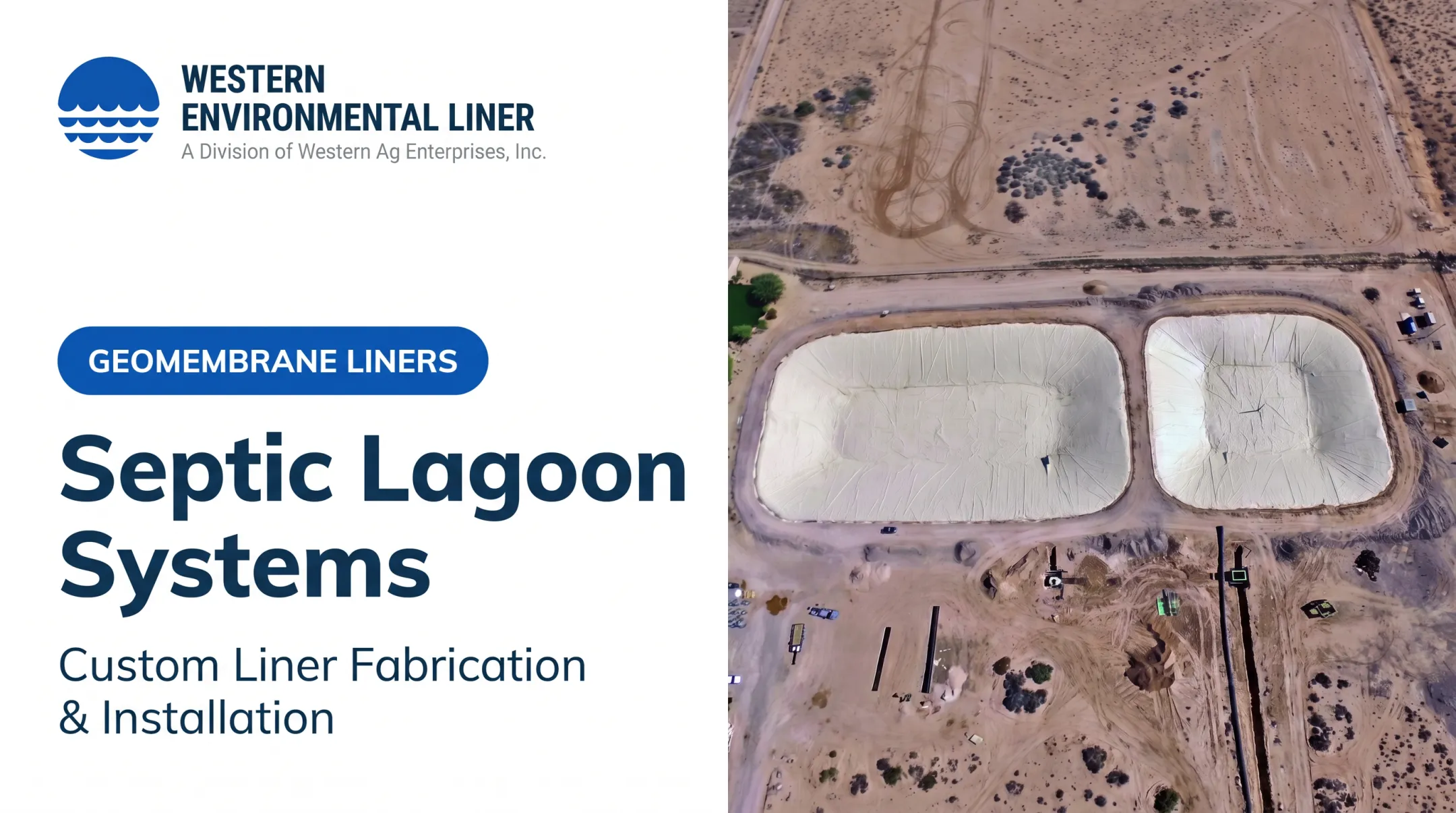
Western Environmental Liner manufactures custom geomembrane panels up to 300' x 300' at factories in Tolleson, Arizona; Romulus, New York; and Great Bend, Kansas. Factory-welded panels cut field seaming, and turnkey installation is available in all 50 states by IAGI-certified crews.

The most common lagoon recommendation is reinforced polypropylene (RPP) in 36 or 45 mil. The 45 mil version carries a 20-year UV and weathering warranty, and the 36 mil version 15 years. Reinforced polyethylene (RPE) is also offered.
Confirm that the material meets your state standard and your engineer's specification, and read the warranty terms against your waste conditions before ordering.
The company doesn't do excavation or subgrade engineering, so your engineer and earthwork contractor handle those. The team can help with liner selection and pipe penetrations.
Safety and Access
Key protections to build into the design:
- Perimeter fencing and warning signs (Washington's labor department recommends barriers and signs around uncovered lagoons)
- Livestock and wildlife exclusion
- Safe pump and pipe access
- Stable slopes
- A rescue plan and an emergency action plan where a breach could affect others
How to Treat, Operate, and Maintain a Dairy Runoff Lagoon
Treatment Options
| Method | Evidence and limits |
|---|---|
| Natural anaerobic digestion | Default for many lagoons; slow and weather-dependent |
| Aeration | Low-rate surface aeration can reduce odor; energy costs limit use |
| Covered digester | EPA notes slow conversion and climate sensitivity; digestate stays nutrient-rich |
| Additives | A 2017 USDA ARS dairy-slurry trial found two products did not reduce solids or gaseous emissions |
No single method fits every lagoon. Match it to your design and permit.
Inspection Routine
Check on a schedule set by your standard or permit:
- Liquid level, depth markers, and freeboard
- Embankment erosion, burrowing animals, and berm vegetation
- Seepage, ballooning, or exposed liner
- Inlets, outlets, pumps, pipes, and diversions
- Fences, signs, odors, and any sign of discharge
Agitation, Pumping, and Sludge Removal
Time pumping around weather and field conditions. Agitation and dredging can damage earthen liners, and Nebraska guidance says to stop or change the operation if the liner is disturbed.
Gas is the serious hazard. Wisconsin's 2008 review lists hydrogen sulfide toxicity, ammonia irritation, methane flammability, and oxygen displacement by CO2. Use maximum ventilation and test the atmosphere.
A 2007 incident recorded by OSHA shows the stakes: a farmer entered a covered manure pit after a pump clog and died, along with four rescuers. Never enter a pit or drained basin, or drive equipment into one, without professional confirmation.
Preventing Runoff and Meeting U.S. Environmental Requirements
Risks and Controls
Runoff, infiltration, and irrigation return flows carry nitrogen and phosphorus that can fuel algal blooms and hypoxia. Pathogens, ammonia, and odor raise additional water-quality and nuisance concerns.
- Containment and lined storage guard groundwater
- Vegetated buffers and clean-water diversion limit surface runoff
- Inspections catch problems early
- Tested, weather-aware application prevents field losses
Compliance Topics to Raise With Your State
Federal rules set a floor. Under 40 CFR 122.23, an operation with 700 mature dairy cows is a Large CAFO, and smaller operations can be designated. Existing-source rules prohibit production-area discharge except qualifying precipitation overflows, including 25-year, 24-hour containment.

Ask regulators about:
- Construction approval and engineer certification
- Nutrient management plans
- NPDES coverage where applicable
- Setbacks, stormwater, and groundwater protections
- Storage documentation and annual reports
- Emergency reporting: oral notice within 24 hours and a report within 5 days for noncompliance that may endanger health or the environment
State rules differ sharply. Examples include:
- Wisconsin: 180-day liquid-manure storage requirements
- Idaho: at least 180 days of holding capacity
- New York: no application on saturated or frozen-saturated ground
- California: 2026 order revises Central Valley dairy requirements
- Washington: Manure Pollution Prevention Plans and an Existing Lagoon Assessment Procedure
Emergency Response Plan
Write a plan for overflow, liner damage, pump failure, embankment erosion, or unexpected rain:
- Stop or isolate incoming flows where possible
- Protect downstream areas
- Call your engineer and the required agencies
- Document conditions
- Complete corrective inspections before normal operation resumes
Frequently Asked Questions
How does a dairy farm runoff (manure) lagoon work?
Manure and wash water are collected, separated, and sent to the lagoon. Solids settle, microbes break down organics, and the stored effluent and sludge are later reused or removed under the nutrient plan.
How do you treat a dairy farm runoff lagoon?
Options include natural biological treatment, solids removal, aeration, agitation, covered digestion, and nutrient-managed land application. The right choice depends on lagoon design and permit requirements.
How long after draining a lagoon will the bottom support equipment?
There's no universal timeframe. Soil type, weather, depth, sludge thickness, drainage, moisture, and equipment weight all matter. Get professional verification before anyone enters.
How long do dairy farm runoff lagoons last?
It depends on the component. Basin, liner, pipes, and pumps age differently, and no universal manure-lagoon lifespan exists. Design quality, materials, UV exposure, waste chemistry, and inspections drive longevity.
What type of liner is best for a dairy farm runoff lagoon?
The best liner depends on site conditions, waste characteristics, local standards, basin geometry, and engineering requirements. Have a qualified engineer and liner manufacturer confirm the material and installation specification.