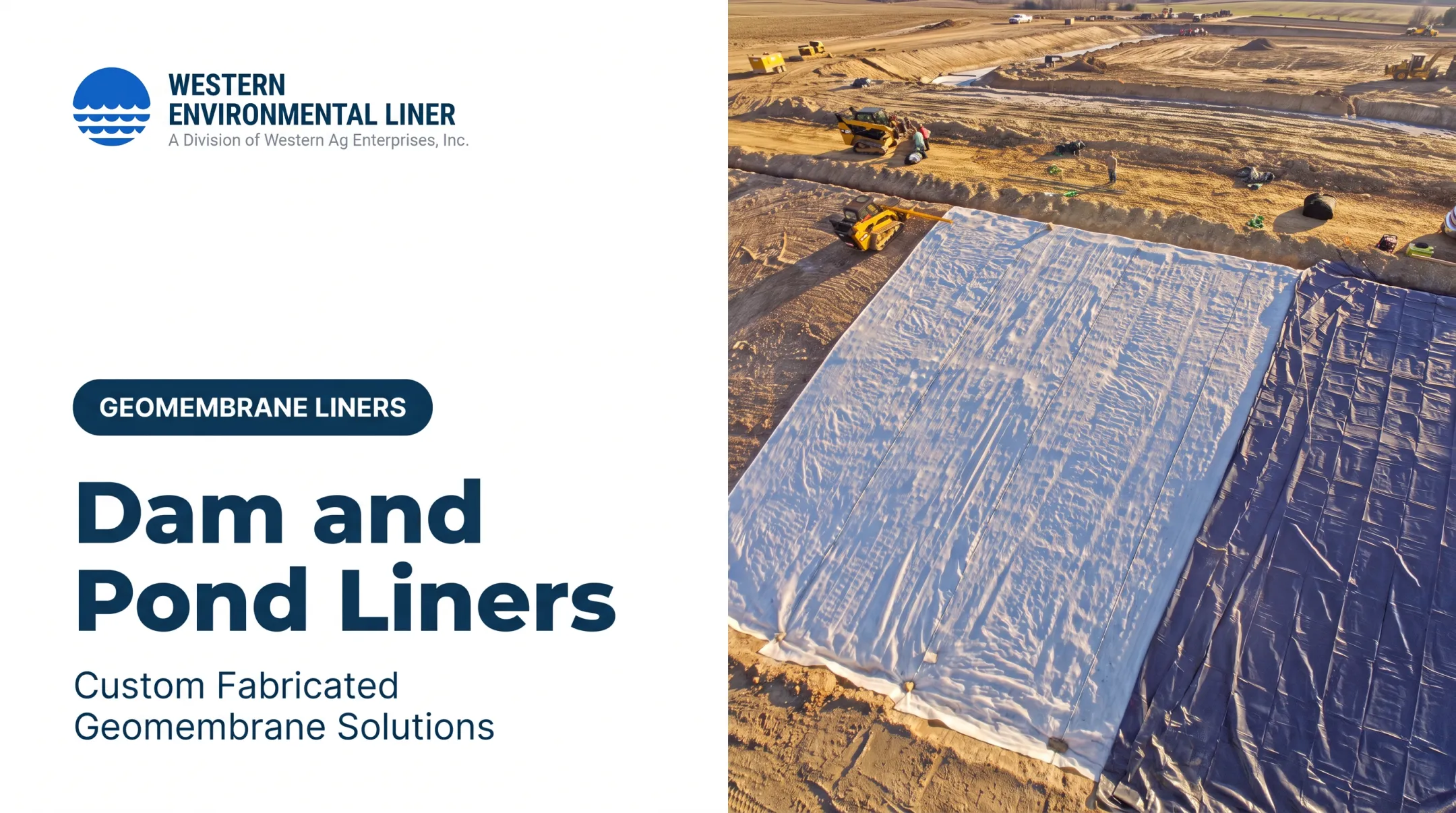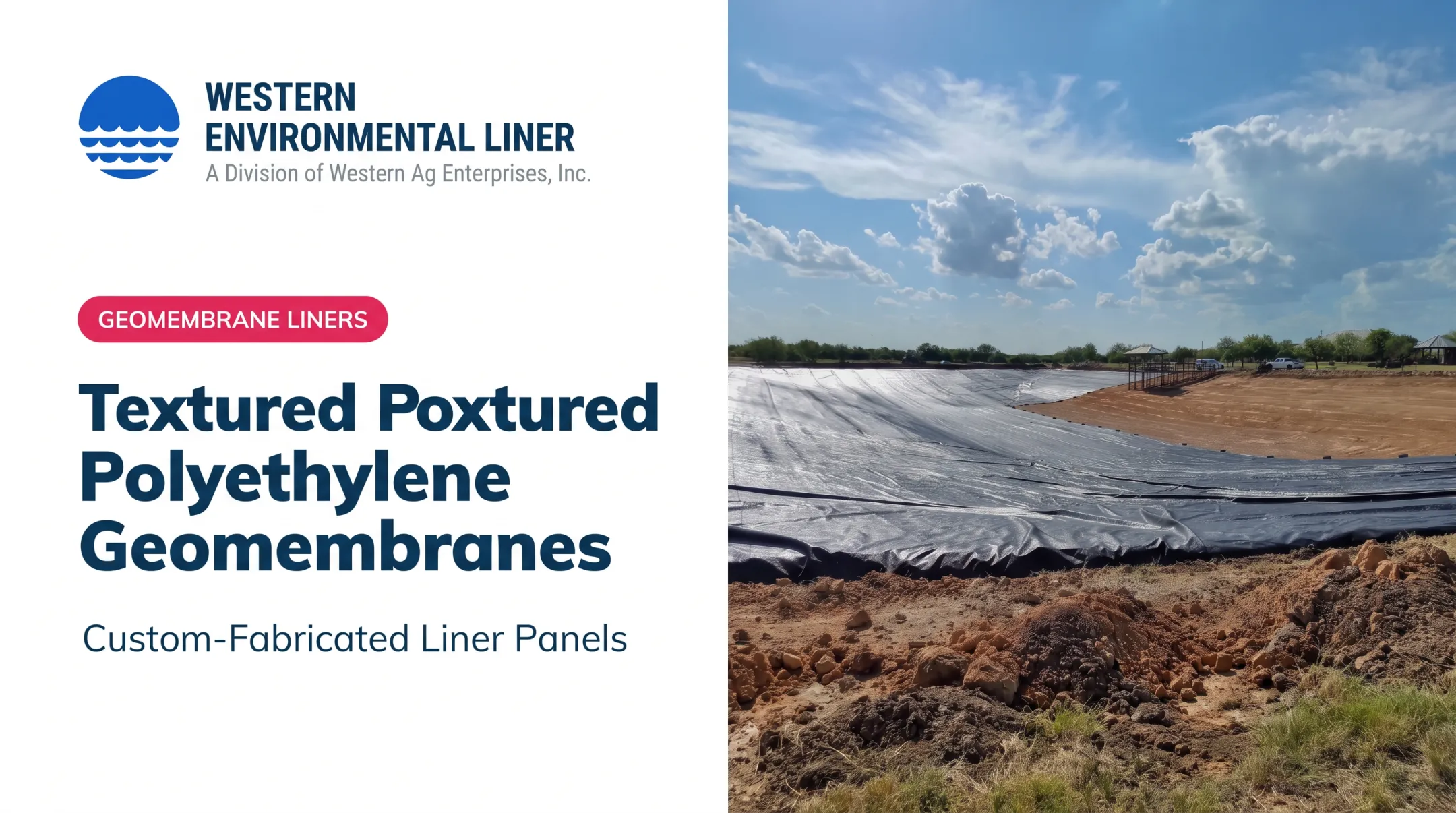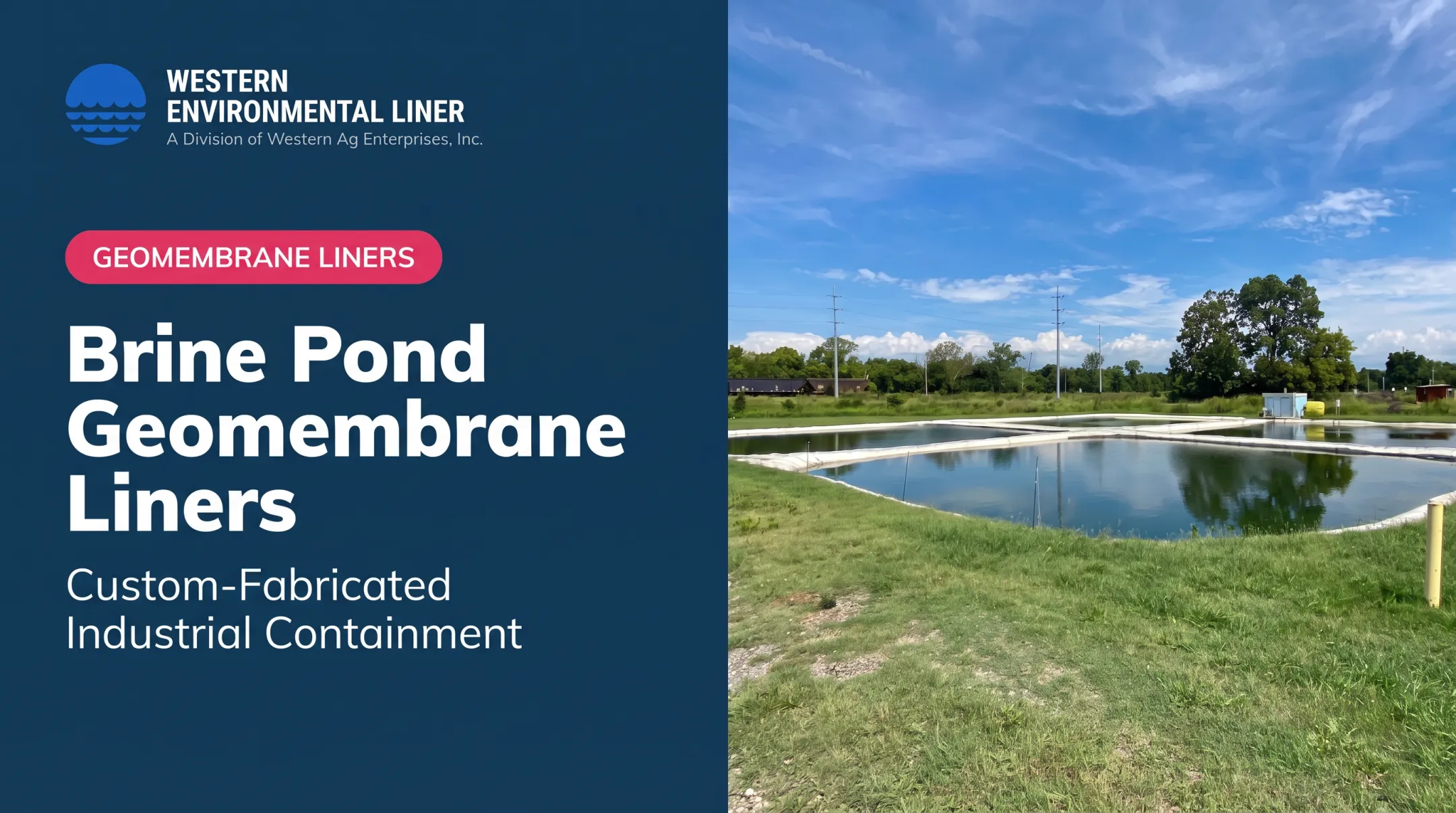

"PE liner" covers several constructions, though. This article focuses on geomembrane liners for ponds, lagoons, canals, pits, and stormwater systems, not packaging film or shipping-container liners. It covers types, properties, applications, thickness, fabrication, and installation, so you can specify the right liner for your site.
Key Takeaways
- PE liners are a family of geomembranes, and HDPE, LLDPE, and reinforced PE behave differently.
- Liquid, subgrade, exposure, and design life matter more than mil thickness alone.
- Factory panels, a clean subgrade, tested seams, and qualified installers drive long-term performance.
- Work from current data sheets and get a project-specific quote.
What Are Polyethylene (PE) Liners?
What a PE liner is
Polyethylene is a thermoplastic polymer. Manufacturers form it into geomembrane sheets and panels that create a continuous barrier between a contained liquid and the soil beneath. NRCS Code 521 covers geomembrane lining of water, wastewater, salt, and manure impoundments to address excessive seepage or contamination.
An engineered geomembrane is not a thin packaging film or a PE foam liner. Foam is a cellular cushioning material. Containment liners must be chosen for permeability, strength, exposure, chemical compatibility, and seam performance.
How PE liners are constructed
Construction varies with the strength and flexibility needed:
- Extruded or blown film, from molten compound through a sheet or circular die
- Co-extruded products with multiple layers
- Laminated layers
- Reinforced constructions with a polyethylene scrim
Factory-welded panels let fabricators build large custom liners with fewer field seams. Field seams, penetrations, corners, and transitions still affect final performance, so treat them as part of the design.
Performance characteristics to evaluate
Ask for data on these characteristics:
- Permeability
- Tensile and tear strength
- Puncture resistance
- UV stability and temperature performance
- Flexibility and stress-crack resistance
- Chemical compatibility
The Geosynthetic Research Institute (GRI) specifications show how much these vary by construction:
| Property | HDPE (GM13, 60 mil) | LLDPE (GM17, 60 mil) | Reinforced LLDPE (GM25, 45 mil) |
|---|---|---|---|
| Break elongation | 700% | 800% | 22% |
| Tear | 42 lb (D1004) | 33 lb (D1004) | 70 lb (D5884) |
| Index puncture | 108 lb | 84 lb | 85 lb |
| Stress cracking | 500 hours | Not listed | Not listed |

Reinforced tests use grab tensile and tongue tear, so they are not direct substitutes for sheet tests. Compare like with like. For example, Western Environmental Liner's Aqua 20 lists 171-lb puncture resistance (ASTM D4833); published values are typical data, not limiting specifications.
Read permeability figures carefully too. Published numbers are often vapor measurements, not liquid hydraulic conductivity or installed-system leakage.
Thickness is only one part of performance
Mil thickness alone says little. Resin formulation, reinforcement, panel construction, installation loads, site conditions, and the stored liquid all shape the right specification. Aqua 30, for instance, is stronger than 60-mil HDPE at about half the thickness because reinforcement does the work.
What a PE liner does not replace
A liner is a barrier. It does not replace stable excavation, subgrade preparation, drainage design, anchoring, cover systems, structural engineering, permits, or regulatory compliance.
Types of PE Liners and How They Differ
HDPE liners
High-density polyethylene is stiff and chemically resistant, with good UV performance when left uncovered. GM13 requires formulated sheet density of at least 0.940 g/cc. USBR guidance describes high resistance to acids, oils, and solvents.
That stiffness has costs. HDPE is harder to fold, transport, deploy, and weld around irregular shapes, especially in cold weather. Unsuitable resin can stress-crack, so confirm formulation and thickness for each liquid and site.
LDPE and LLDPE liners
LLDPE is more flexible and elongates further than HDPE, which helps where contour conformity or easy handling matters. Greater elongation also gives better puncture resistance in practice.
The tradeoffs are real. USBR notes lower chemical and UV resistance than HDPE, and GM17's index puncture and tear values run below HDPE's. Temperature, long-term loading, and availability matter too. Neither LDPE nor LLDPE suits every application.
Reinforced polyethylene (RPE) liners
RPE is a multilayer construction with a reinforcing scrim for strength-to-weight performance and tear resistance. Western Environmental Liner's Aqua series uses woven HDPE scrim coated with polyethylene, in thicknesses from 12 to 30 mil. It suits large custom liners, factory fabrication, and difficult site logistics.
Co-extruded and specialty constructions
Co-extruded or laminated liners combine layers with different jobs, such as reinforcement, UV resistance, color, or surface character. Aqua 30 pairs HDPE scrim with a 5.5-mil LDPE/LLDPE film, and Aqua 40 Coex is a 40-mil co-extruded option for higher-pressure uses. Review the layer structure in the technical documentation.
PE compared with other liner materials
| Material | Chemical resistance | Flexibility and UV | Seaming |
|---|---|---|---|
| HDPE | High | Stiff, especially cold; good exposed performance | Thermal |
| LLDPE | Lower than HDPE | More flexible | Thermal |
| PVC | Plasticizer loss is a main aging mechanism | Good elongation; most US products not formulated for exposure | Solvent, adhesive, heat |
| Flexible PP | Susceptible to organic acids | Flexible; sharp bends may crack | Thermal |
| EPDM | Oil and fuel suitability not established | Excellent weathering; flexible when cold | Special cements |
The best material depends on the liquid, temperature, subgrade, geometry, regulations, and budget. Match the polymer to those constraints rather than defaulting to one PE grade.
Benefits and Applications of PE Liners
Key benefits for containment projects
A properly designed PE liner limits seepage and separates stored liquids from soil. In the USBR Ochoco Canal demonstration, an LLDPE section showed 99% measured effectiveness against a 90% estimate of long-term effectiveness. Short-term field results and long-term estimates are not the same thing, so treat both on their own terms.
Durability depends on formulation and exposure. GSI's modeling puts covered HDPE half-life at 446 years at 20°C (68°F) but 69 years at 40°C (104°F), so one lifespan figure rarely fits every site. Reinforced constructions can simplify handling on some geometries, but site preparation and installation quality still decide results.

Water, agricultural, and aquaculture applications
- Irrigation reservoirs, farm and stock ponds
- Fish farms, hatcheries, and nursery basins
- Golf-course lakes and decorative water features
Sensitive uses need proof. NSF/ANSI/CAN 61 addresses drinking-water contact, and aquaculture literature recommends toxicity screening. Western Environmental Liner states most of its liners are fish-friendly and NSF 61 certified, but confirm the specific product, additives, and approvals before ordering.
Municipal and environmental applications
Common uses include:
- Stormwater retention ponds and wastewater lagoons
- Canals and remediation cells
- Landfill-related containment
These projects call for engineered design and quality assurance. Requirements are often prescriptive: 40 CFR 258.40 sets a composite option with 60-mil HDPE over at least 2 ft of low-permeability soil for municipal landfills.
Industrial and energy applications
Typical settings include:
- Frac pits and pads
- Secondary containment and brine storage
- Industrial lagoons
These sites add chemical exposure, puncture risk, and traffic. Texas requires at least 60-mil HDPE or 30-mil other synthetic liner for lined permitted oilfield pits, unless a permit provides otherwise. Western Environmental Liner lists Aqua 24 for frac pad liners and Aqua 30 for secondary containment.
Lifecycle and installation value
Larger factory panels mean fewer field seams, which can cut deployment time and seam exposure. Savings are project-dependent, not guaranteed. Ask suppliers:
- Is the material compatible with my liquid, and what testing shows it?
- What are the fabrication tolerances?
- How are seams tested and documented?
- What do the warranty terms cover, and for how long?
- What does installation scope include?
- What repair support is available?
How to Choose and Specify a PE Liner
Start with project conditions
Document before you call anyone:
- Dimensions, depth, and slopes
- Liquid type, concentration, and operating temperature
- Storage duration and UV exposure
- Groundwater and subgrade composition
- Traffic or equipment exposure
- Required design life
Match material, thickness, and construction
Let these factors guide the choice among HDPE, LLDPE, and RPE:
- Liquid chemistry and temperature
- Rock or debris risk on the subgrade
- Slope, anchoring, and loads
- Seam method and applicable regulations
Application matters: NRCS Code 521 sets minimums of 30 mil HDPE/LLDPE for clear water and 60 mil for wastewater.
Check compatibility with EPA Method 9090A, which calls for immersion of at least 120 days. Compatibility charts only screen because they omit mixture effects. Use current data sheets and engineering guidance, not price, color, or nominal mils alone.
Consider custom fabrication and installation support
Western Environmental Liner fabricates custom reinforced polyethylene geomembranes, with factory-welded panels up to 300′ × 300′ and one-piece liners up to 150,000 square feet. Custom fabrication starts at projects over 10,000 square feet.
Factories operate in Tolleson, Arizona; Romulus, New York; and Great Bend, Kansas. The company is an IAGI-certified installer, offers warranty coverage of up to 20 years, and provides on-site technical support on slope ratios and anchoring. It does not do excavation or subgrade engineering.
Request a quote that accounts for:
- Material, dimensions, and penetrations
- Anchoring and any underlayment
- Shipping, installation, and testing
PE Liner Installation and Quality Considerations
Prepare the subgrade and support system
The surface must be flat, smooth, dry, and free of rocks, roots, debris, and voids. Where obstructions remain, 6 inches of compacted bedding above the highest one is recommended.
NRCS also permits at least 10 oz/yd² nonwoven geotextile over sharp stones. Where wildlife traffic is a concern, use at least 12 inches of backfill.
Deploy panels and complete seams correctly
Plan panel layout around weather, slopes, anchor trenches, wrinkles, pipe boots, and corners before deployment. An earthen anchor trench should be at least 1 foot deep and wide. One-piece liners may need no field seaming except pipe-boot details.
Large or chemically demanding jobs warrant qualified installers who follow manufacturer procedures. GSI surveys of uncovered geomembranes found 22 leaks per hectare without quality assurance versus 4 with it. Those figures cover geomembranes generally, not PE alone.

Inspect, test, protect, and maintain the liner
Use visual inspection plus seam testing as specified:
- Vacuum chamber (ASTM D5641) and air-channel testing (D5820) for dual seams
- Spark testing (D6365) around pipes and tight corners
- Electrical leak location (D7007) under water or earthen cover
Document repairs and protect the liner during backfilling. After construction or severe weather, inspect again. Ongoing maintenance should catch problems before they become failures:
- Exposed damage and settlement
- Erosion and vegetation growth
- Unauthorized traffic on the liner
- Changes in the stored liquid
Frequently Asked Questions
What is a PE liner?
A PE liner is a polyethylene geomembrane that forms a low-permeability barrier for liquid containment. It differs from thin packaging films.
What is a PE foam liner?
PE foam is a closed-cell cushioning or insulating material. It is not the solid geomembrane used for liquid containment.
What is a HDPE lining?
It is a lining system made from a high-density polyethylene geomembrane. It offers durability and chemical resistance, but its stiffness complicates welding and installation.
Are PE liners suitable for ponds and liquid containment?
Yes, for many projects, when material, thickness, compatibility, subgrade, seams, and installation are properly specified.
How do I choose between HDPE and reinforced polyethylene liners?
HDPE is stiffer and chemically resistant. Reinforced PE is lighter and easier to fabricate in large panels. Site geometry and the stored liquid should decide.
What factors affect the thickness of a PE liner?
Liquid type, subgrade, slope, puncture and loading risks, UV exposure, design life, seam method, applicable codes, and overall construction all matter.