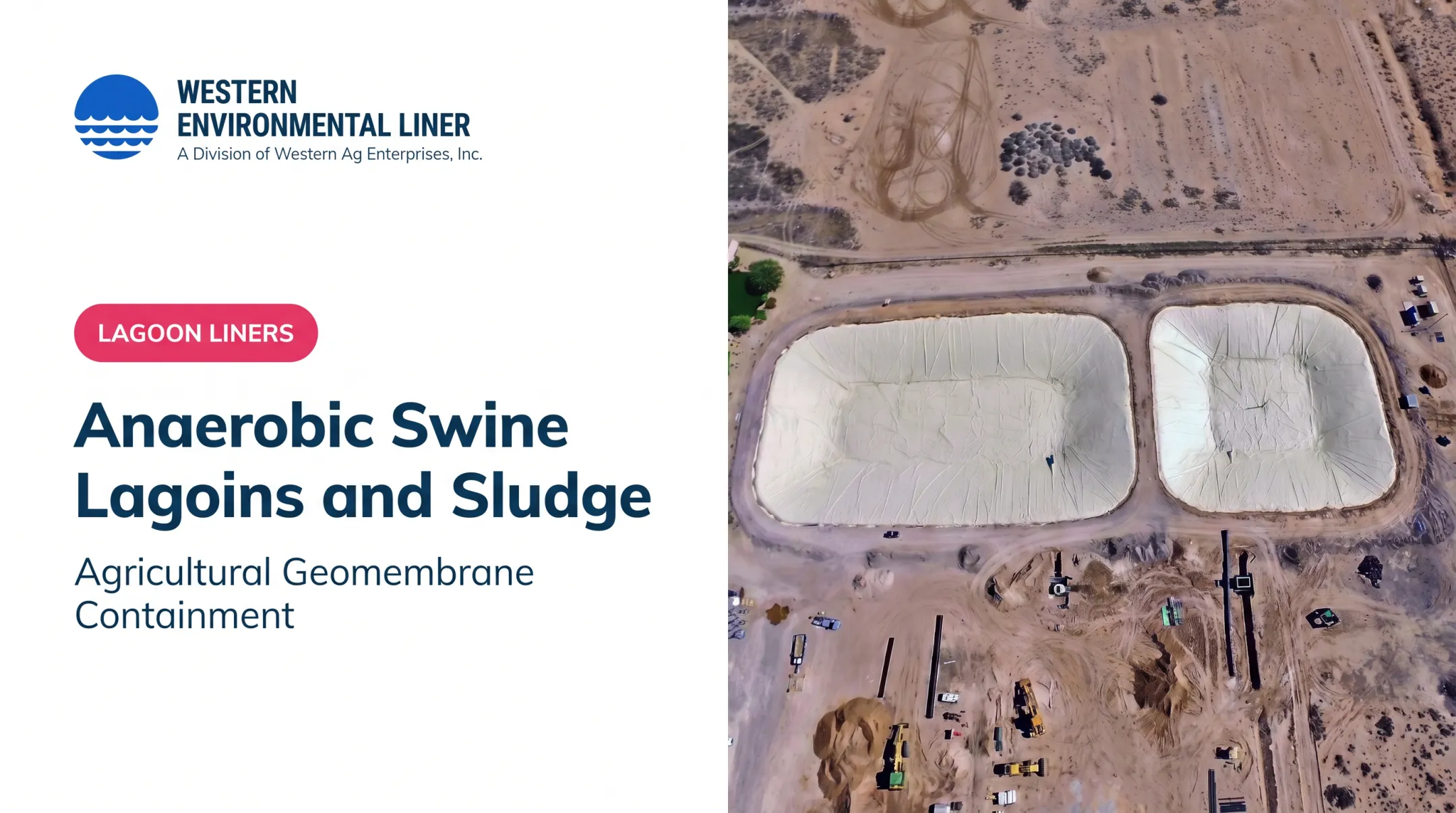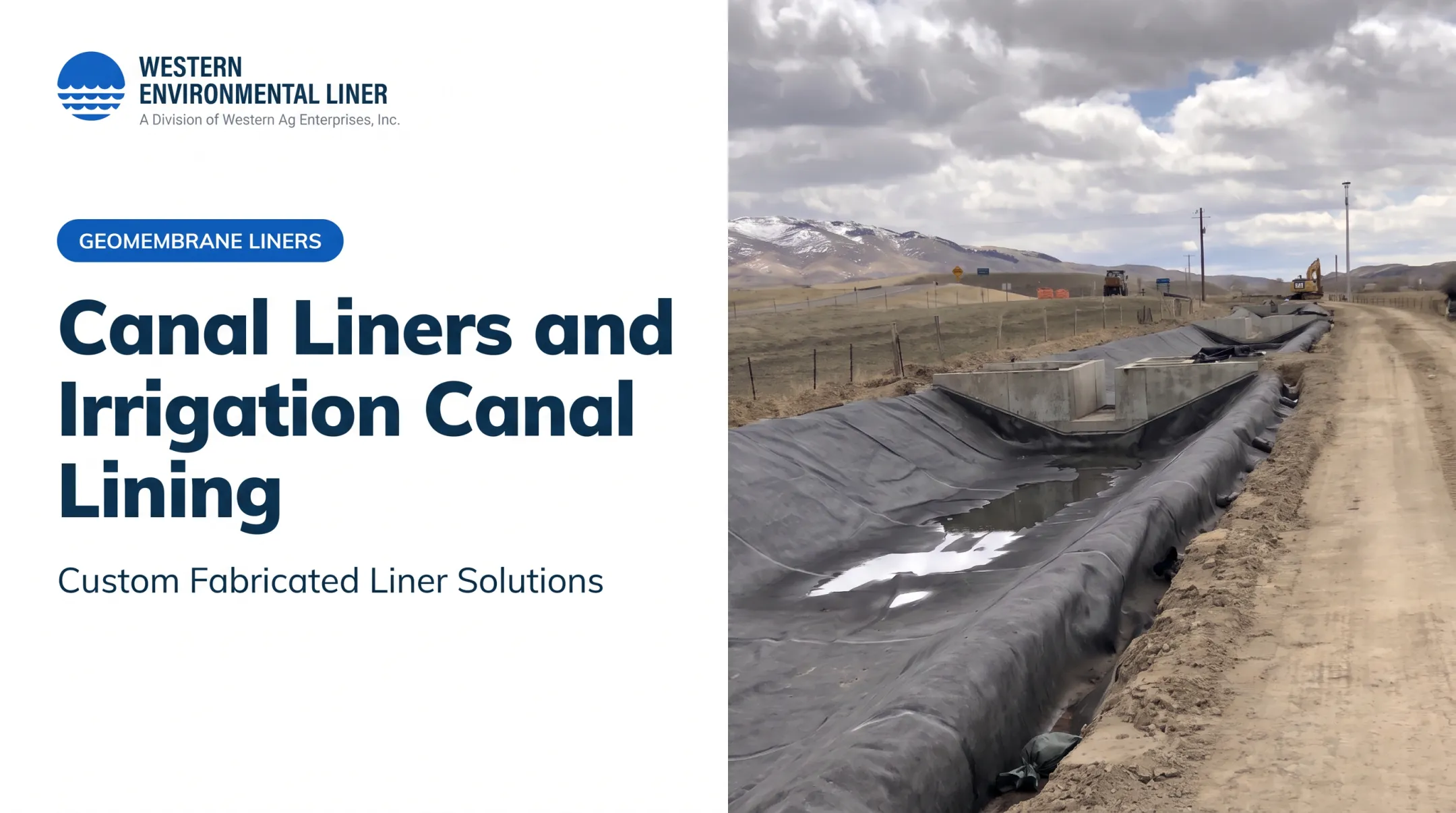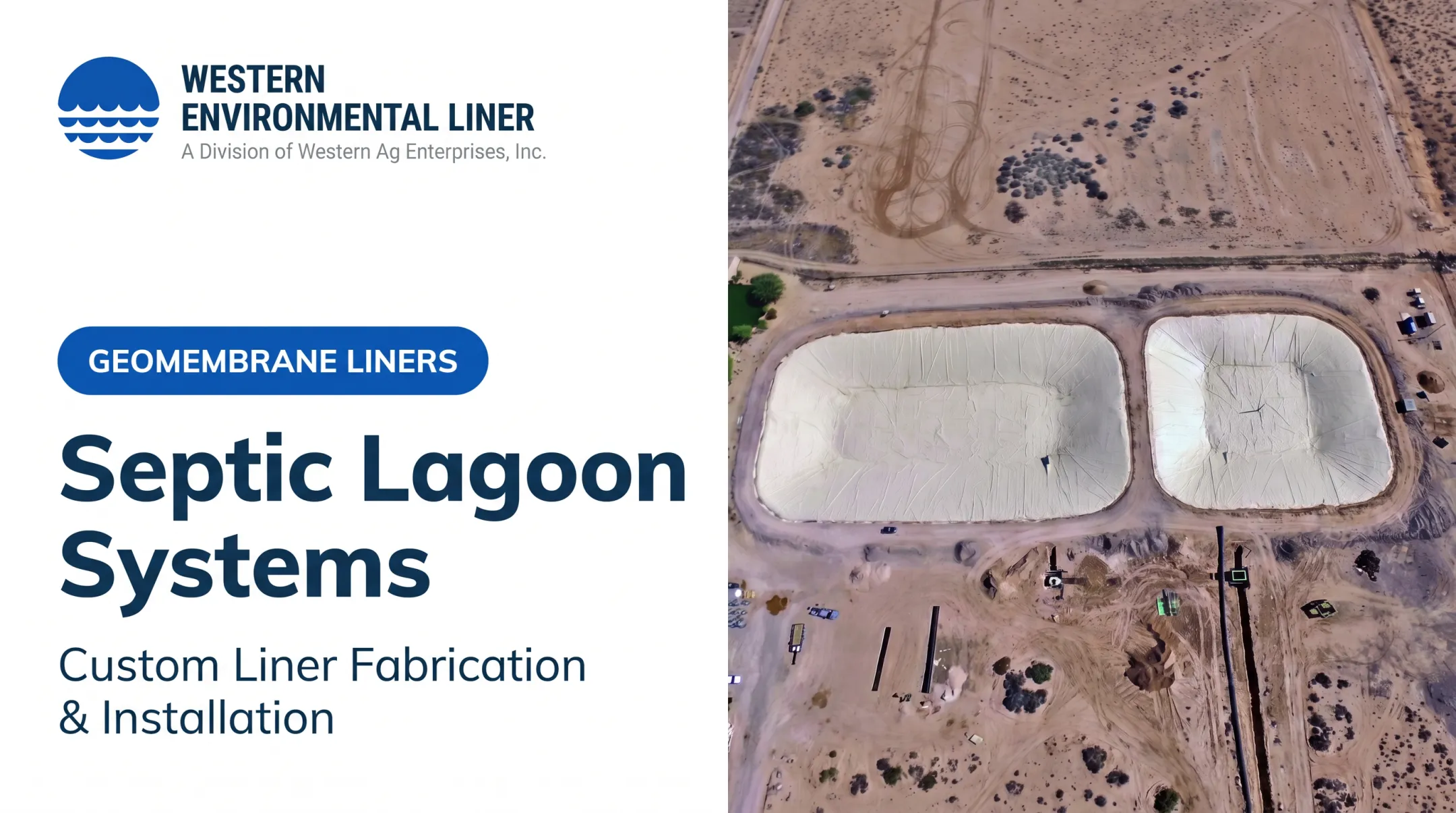

A floating water cover is a buoyant barrier placed directly on the liquid surface of a lagoon. It is not the geomembrane liner under the lagoon, which stops seepage. It is not a fixed roof spanning the lagoon on a structure, and it is not a temporary tarp tossed over the water.
This guide covers cover types, applications, selection criteria, installation planning, and maintenance for U.S. operators and contractors.
Key Takeaways
- Floating covers shield the liquid from sunlight, wind, wildlife, and open air.
- Results depend on liquid chemistry, geometry, wind exposure, and access needs.
- Geomembrane, modular, mesh, and specialty covers each fit different goals.
- A cover and a base liner solve different problems and may be designed together.
What Are Floating Water Covers for Lagoons?
A floating lagoon cover is a buoyant barrier on the surface of a wastewater, manure, digestate, industrial, produced-water, or stormwater lagoon. NRCS addresses these under its Roofs and Covers standard (Code 367).
That standard covers rigid, semirigid, and flexible covers and requires designs that handle changing liquid levels.
How Floating Lagoon Covers Work
Buoyancy lets the cover rise and fall with the liquid. How it behaves in wind depends on material, geometry, ballast, anchoring, seams, and perimeter details.
Cover designs fall into a few functional types:
- Continuous sheets that block most of the surface
- Shade systems that let water and gas pass through
- Arrays of small elements that cover a share of the surface
Not every floating cover is vapor-tight, and none should be assumed to eliminate evaporation. Insulated modules in Gering, Nebraska, for example, permit water and gas movement between casings.
Floating Covers Versus Lagoon Liners and Fixed Covers
A geomembrane liner keeps liquid from seeping through the floor and sidewalls. A floating cover protects the surface. Many projects need both, and the two should be specified together.
Know the category before requesting a quote:
- Floating cover: rests on and follows the liquid.
- Fixed or land-anchored roof: spans the lagoon on a structure.
- Suspended shade system: hangs above the water on supports.
- Temporary cover: short-term protection, not engineered for continuous exposure.
One wrinkle: a floating membrane attached to the embankment is still a floating cover. Perimeter attachment does not make it a roof.
Why Use a Floating Cover on a Lagoon?
Each benefit has limits. Evidence supports specific outcomes under specific conditions, not blanket promises.
Evaporation
A 2019 Water Resources Research laboratory study found polyethylene spheres suppressed evaporation by 70% at 91% coverage, and larger disks reached 80%. That was a small wind-tunnel basin, not a lagoon. A Swiss field trial reported 50% to 80% suppression, but lightweight disks blew away in wind while heavier balls stayed put.
Algae
Sunlight drives algae, so shading helps. EPA's lagoon troubleshooting guidance identifies floating polyester fabric that shades aerated lagoons to limit growth. Nutrients, temperature, mixing, and chemistry still matter.
Odor and Emissions
EPA lists engineered geotextiles among semi-permeable manure-storage covers linked to lower methane, ammonia, and odor. Nitrous oxide may increase. Sealed designs need vents, gas collection, and a regulatory review, because odor reduction, gas capture, and methane destruction are different outcomes.
Wildlife and Debris
Covers keep birds off the liquid and blown material out. The FAA lists floating bird balls as a barrier for ponds near airports. That helps lagoons near roads, homes, and airfields.
The Cost Side
No credible U.S. benchmark exists for average annual lagoon evaporation loss in dollars. EPA's cost tool gives a framework instead: 2021 vendor quotations for insulated covers ran $4.00 to $8.50 per square foot. Those assume a dry lagoon, 30-degree walls, little wind, and no extra O&M cost. Treat them as modeling inputs, not current bids.

Weigh that against what an uncovered lagoon demands: makeup water, algae treatment, odor complaints, inspection labor, and permit risk.
Types of Floating Covers for Lagoons
Geomembrane Floating Covers
NRCS lists HDPE, LLDPE, PVC, and reinforced flexible polypropylene among flexible-cover materials. Impermeable designs need gas handling and rainwater removal.
Reinforced polypropylene is one option. A 36 mil fusion-weldable, polyester-reinforced sheet specified for floating covers shows no cracks or loss of breaking strength after 10,080 kJ/m² of xenon-arc exposure. A polymer name alone does not prove compatibility, so verify:
- Chemical compatibility with your liquid
- UV resistance and seam quality
- Ballast, anchoring, and gas venting
- Rainwater management
Modular Floating Elements
Balls, disks, and hexagonal tiles adapt to irregular shapes and shifting levels. Trade-offs include:
- Wind displacement
- Partial coverage
- Weaker odor containment
- Equipment access and removal
The Swiss disk trial shows why weight matters.
Mesh, Shade, and Specialty Covers
Shade and specialty designs make sense when full sealing isn't the goal.
| Type | Strength | Limit |
|---|---|---|
| Floating polyester shade | Algae control in aerated lagoons | No verified evaporation figure |
| Insulated modules | Heat retention, odor, algae | Permeable; not gas-tight |
| Floating photovoltaics | Power plus shading | Water-quality effects uncertain |
At Ranchester, Wyoming, interconnected insulated modules use weighted, UV-protected skirting against wind uplift. Gering's operators replaced aging covers that had plant growth, ponding, and sagging. Manufacturers report both outcomes.
How to Choose the Right Floating Cover for a Lagoon
Start With the Primary Objective
Name the main goal first: evaporation, algae, odor, wildlife, heat retention, compliance, or a mix. Evaporation and algae may tolerate partial coverage. Gas containment needs an impermeable membrane plus collection. Match the cover type and supporting data to that goal.
Evaluate the Liquid and Operating Conditions
Assess pH, salinity, hydrocarbons, ammonia, hydrogen sulfide, solids, temperature, and level swings. Layfield's technical guidance points to ASTM D5747, ASTM D1693, and EPA 9090A for immersion and stress-cracking evaluation. No universal exposure limit applies across polymers, so demand compatibility data for your liquid.
Account for Geometry, Wind, and Equipment
Dimensions, slopes, corners, aerators, mixers, pumps, pipes, and walkways all affect the layout. Ask for site-specific wind and layout calculations, not generic product claims.
Plan for Compliance, Safety, and Access
- Air rules: 40 CFR 63.942 describes a floating membrane cover, including HDPE at least 2.5 mm thick, for facilities subject to that subpart. It is not a blanket rule.
- Wildlife: New Mexico's 19.15.17 NMAC requires produced-water pits to be screened, netted, or otherwise made safe for wildlife. It does not prescribe floating covers.
- Worker safety: OSHA warns that agitating manure can release hydrogen sulfide, methane, ammonia, and CO2, so plan gas monitoring and entry procedures. Odor control alone doesn't resolve these hazards.
Coordinate the Cover With the Containment System
A floating cover often sits on a lined lagoon, so cover and liner choices should work as one system. Western Environmental Liner is a custom geomembrane liner manufacturer and installer serving all 50 states, with factories in Tolleson, Arizona; Romulus, New York; and Great Bend, Kansas.
It provides liner fabrication and technical support for slope ratios, anchoring systems, and lagoon containment planning, and has worked with NRCS on local lagoon requirements. Its heat-seamed liners come in panels up to 300′ × 300′. Earthwork and engineering design of subgrades are outside its scope.

Before buying, get a written specification covering:
- Materials and seams
- Ballast or anchoring and perimeter details
- Penetrations
- Warranty terms
- Installation responsibilities
- Maintenance and end-of-life handling
Installing and Maintaining a Floating Lagoon Cover
Pre-Installation Planning
- Inspect the liner or subgrade, confirm stable slopes, and clear sharp objects
- Map penetrations and access routes
- Decide how gas, rainwater, inflow, outflow, and level changes will be handled
- Where the subgrade can't be flat and smooth, use a minimum of 6 inches of compacted bedding above the highest obstruction
Deployment and Site Coordination
Methods vary by cover type and can include factory panels, field welding, modular placement, perimeter anchoring, ballast, vents, and penetrations. Fusion-welded seams for 36 mil reinforced polypropylene run 30 lbf/in minimum and 60 lbf/in typical.
Wind and liquid conditions can demand a project-specific plan, so don't deploy on a breezy day without one. NRCS expects installer certification, maintenance instructions, and an operator O&M plan.

Inspection and Maintenance
One floating biogas-cover supplier specifies weekly checks. NRCS sets no universal interval, so follow your system's plan. A practical checklist:
- Inspect visually for tears, wear, and displaced modules.
- Clear debris.
- Check rope tension and perimeter anchors.
- Pump off rainwater after storms.
- Check vents and gas removal; large gas bubbles shouldn't accumulate.
- Watch level changes against design range.
Qualified personnel should handle seam and structural repairs with manufacturer-recommended methods such as thermoplastic welding. Log every inspection and repair. Warranty terms vary; one modular supplier states a 10-year limited warranty on its products.
Frequently Asked Questions
What are floating covers?
Floating covers are buoyant barriers placed on a liquid surface. Lagoon covers are engineered products, unlike horticultural row covers, pool covers, or subsurface geomembrane liners.
What are floating row covers made of?
Horticultural row covers are lightweight spunbond or netted polyethylene, polyester, or polypropylene fabrics. They are not the engineered covers used on lagoons.
When should you use floating row covers?
Growers use them to protect crops from insects, frost, wind, or sun. Lagoon operators should search for floating lagoon covers or geomembrane covers instead.
What are some effective pool covers that prevent evaporation?
Main pool categories are solid, solar, and safety covers. EPA reports solid covers cut pool evaporation by more than 90%. Lagoons also involve chemistry, emissions, wind, and access concerns.
How do you choose a floating cover for a lagoon?
Evaluate the liquid, your primary objective, geometry, wind, equipment, compliance needs, and the odor or vapor control required.
Do floating lagoon covers require maintenance?
Yes. Expect inspections, debris removal, perimeter checks, vent and rainwater-system checks, and repairs to seams, modules, or anchoring.