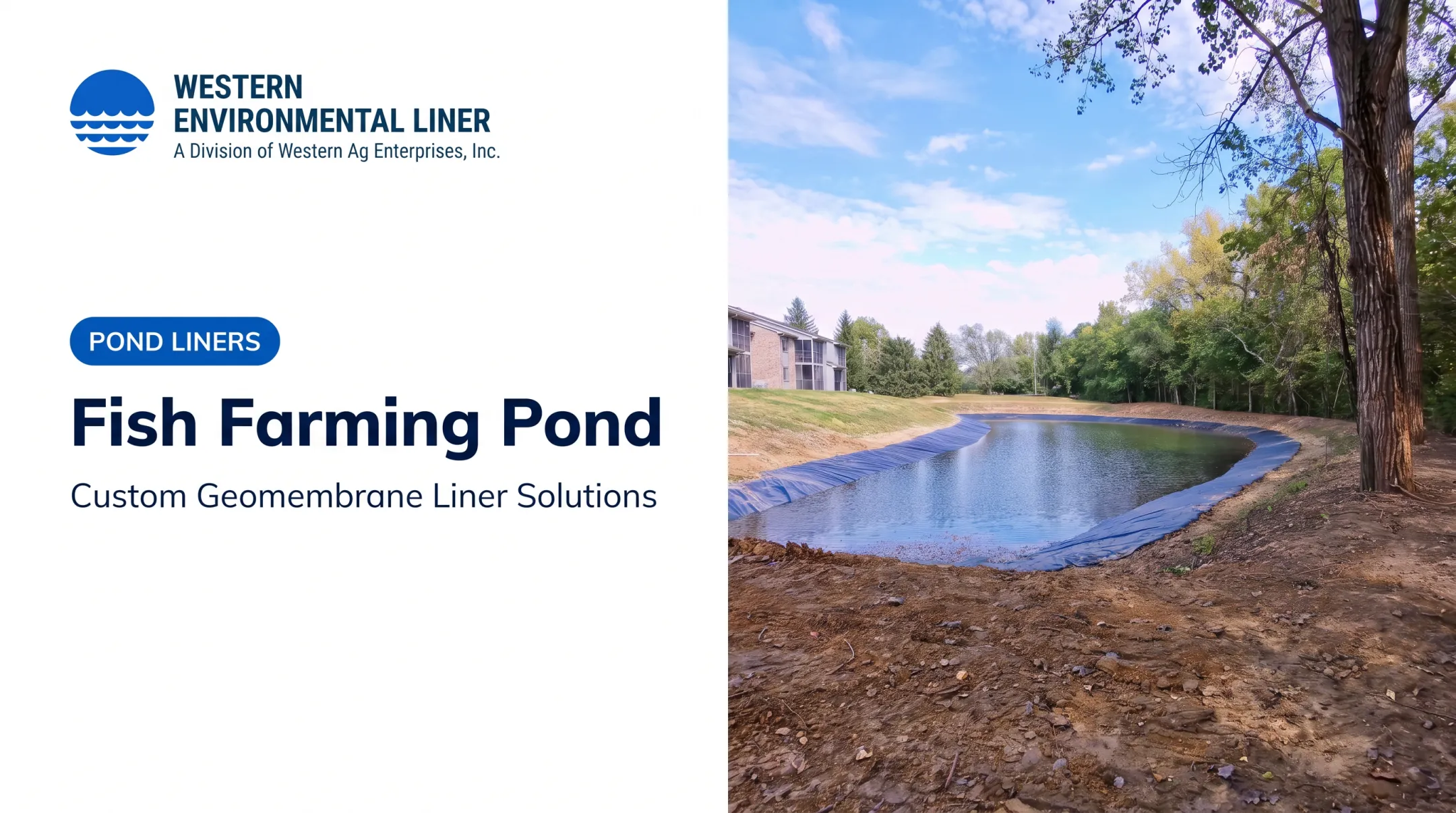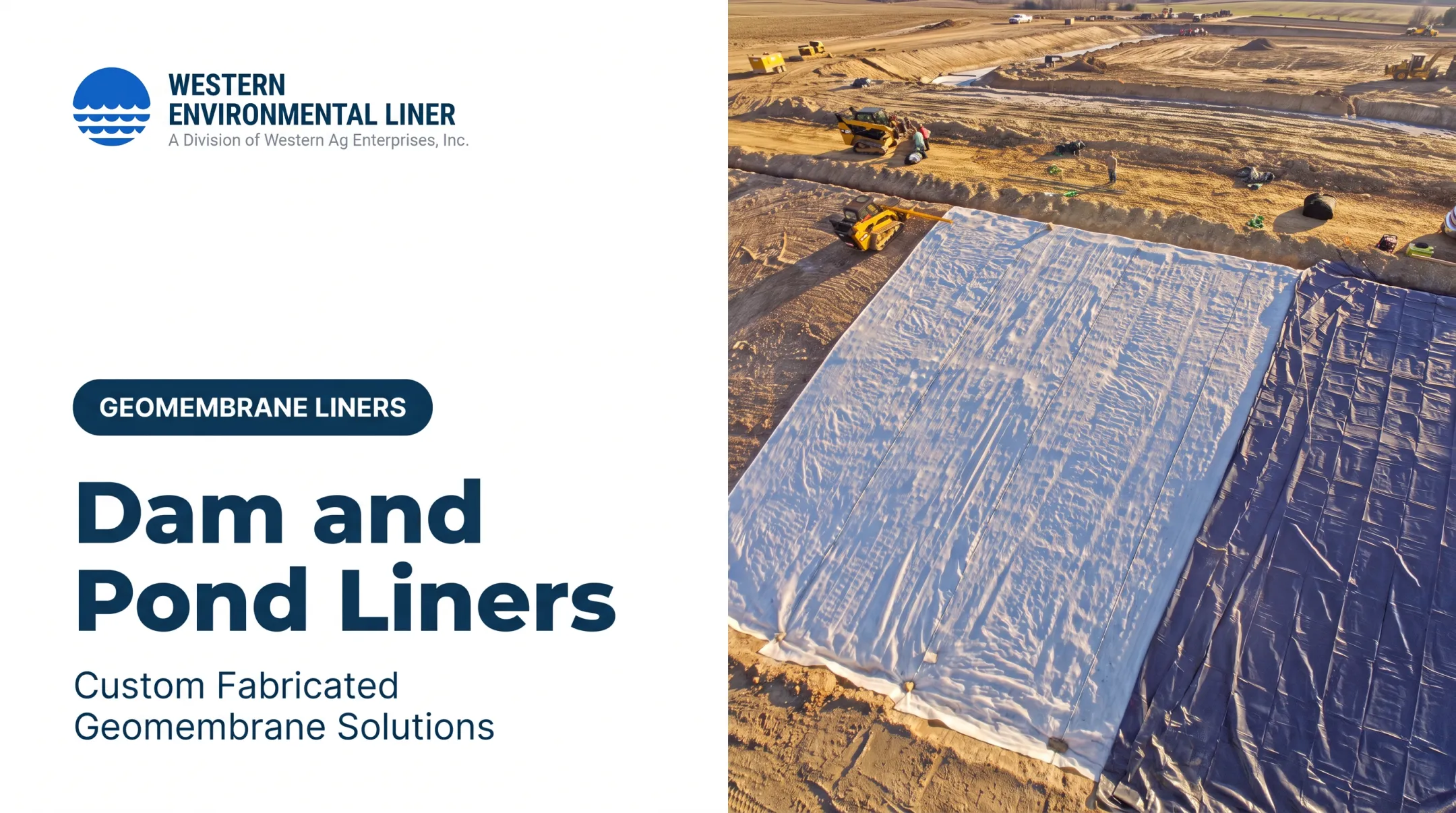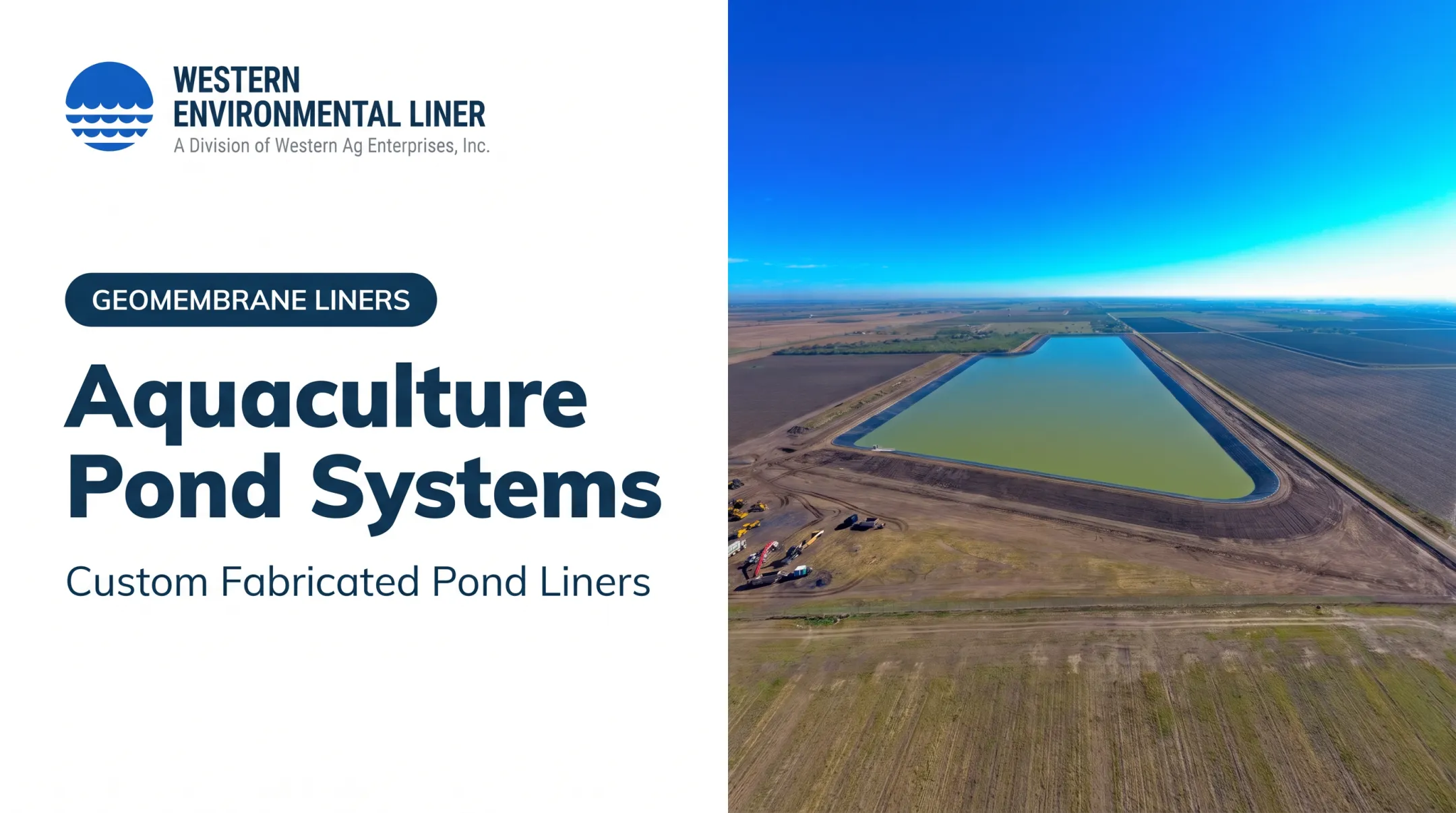

Operators usually look at liners because of seepage, sandy or acidic soil, erosion on the dikes, contamination worries, or ponds that are hard to clean between cycles. A liner can help with each of these. It also brings tradeoffs, and a bad installation can cancel every benefit.
This guide covers liner materials, aquaculture-specific selection criteria, installation requirements, limitations, and when custom fabrication or professional installation makes sense.
Key Takeaways
- The right liner depends on species, soil, water chemistry, climate, puncture risk, and budget.
- Seams, subgrade, penetrations, and anchoring matter as much as the material.
- RPE, RPP, PVC, and EPDM are not interchangeable.
- Large or irregular ponds often benefit from factory fabrication and professional installation.
What Is an Aquaculture Pond Liner?
What it does
An aquaculture pond liner is an impermeable geomembrane installed across the pond bottom and, where appropriate, the side slopes. It limits water exchange with the surrounding soil.
Related materials are easy to confuse with a liner:
- Geotextile: a permeable fabric that cushions the geomembrane. It is not the hydraulic barrier.
- Clay or compacted-earth seal: a soil-based alternative to a geomembrane.
- Cover: sits above the water surface and does not seal the pond bottom.
Where liners are used
Common uses include shrimp ponds, tilapia grow-out reservoirs, and hatchery ponds. Western Environmental Liner's Aqua Series also lists fish ponds, nursery ponds, irrigation ponds, and retention ponds. Needs differ by operation. A small hatchery basin, a large earthen grow-out pond, and an intensive shrimp farm each call for different liner details.
When lining makes sense
Lining may be justified by:
- Sandy soil that holds water poorly
- Acid-sulfate soil that drives pH down
- High groundwater or difficult drainage
- A need for easier cleaning between cycles
Not every pond needs one. The USDA's NRCS Aquaculture Pond standard makes lining conditional on seepage or nutrient-transport concerns and compatibility with the cultured organisms. Feasibility comes down to site engineering, operating goals, local requirements, and lifecycle cost.
Why Aquaculture Operations Use Pond Liners
Water retention
An impermeable liner reduces seepage and makes water volume more predictable. NRCS guidance on seepage control lists water conservation and groundwater protection as purposes. No universal savings percentage applies. Results depend on puncture prevention, seams, penetrations, and edge anchoring.
Water quality and soil separation
Separating pond water from soil can prevent acidification in acid-sulfate sites and limit salinization of neighboring land. A shrimp pond liner review in the Responsible Seafood Advocate describes both effects.
A liner won't prevent disease or replace water testing. It supports cleaner conditions when paired with filtration, aeration, biosecurity, and sound stocking.
Cleaning, drainage, and erosion
A smooth, graded liner moves sludge toward drains. The same review describes faster cleaning and preparation of plastic-lined shrimp ponds, with potential for more crop cycles. Treat those gains as indicative, since the review gives no benchmark that transfers directly to your farm.
Lining also limits dike erosion from waves and aerators. Protect the liner itself from aerators, pumps, screens, walkways, and vehicles.

Tradeoffs
- Higher upfront cost and heavy site-preparation labor
- Restricted heavy-equipment access after harvest
- Damage risk from sharp objects or settlement
- Changed nutrient and plankton dynamics
On that last point, phosphorus accumulation can intensify blooms and overnight oxygen depletion, and later-cycle shrimp ponds may need more mechanical aeration. Evaluate the whole production system. Lining alone does not guarantee better yields.
Aquaculture Pond Liner Materials
| Material | Notes |
|---|---|
| Reinforced polyethylene (RPE) | Woven HDPE scrim with LLDPE coating; Western's Aqua 30 is 30 mil nominal |
| HDPE | Stiffer, normally welded on site |
| LLDPE | More flexible, can be prefabricated into panels |
| Reinforced polypropylene (RPP) | Polyester or woven scrim; suited to hatcheries and smaller ponds |
| PVC | Flexible; product-specific aquaculture grades exist |
| EPDM | Highly conformable; offered at 45 and 60 mil |
Polyethylene options
Evaluate polyethylene liners on:
- Puncture resistance and tear strength
- UV performance and chemical compatibility
- Thickness, flexibility, and weldability
RPE is not automatically the same as reinforced LLDPE under the GRI-GM25 standard, so ask for the exact construction. Confirm the product is intended for aquatic use and check current manufacturer specifications rather than trusting a generic lifespan.
Reinforced polypropylene
RPP offers dimensional stability, lightweight construction, and custom shaping. Factory fabrication or box welding cuts field seams and fits corners and irregular features.
Penetrations and field connections still need careful detailing. Western Environmental Liner generally points to RPE for larger fish ponds (roughly 10,000 square feet or more) and RPP for smaller ones.
PVC, EPDM, and alternatives
Flexibility helps with irregular shapes. But NRCS states that PVC geomembranes are not recommended for aquatic production because stabilizers may leach.
Some manufacturers document fish-grade PVC with their own toxicity testing. Treat that as a formulation-specific claim, not an NRCS exception. EPDM carries its own product-specific test results.
Geotextile protection
A nonwoven geotextile beneath the liner shields it from rocks, roots, and uneven subgrade. Add protection above the liner in high-traffic or equipment areas.
Comparing materials responsibly
Compare data sheets against your project on:
- Species compatibility
- UV resistance, water chemistry, and temperature range
- Puncture and tear resistance
- Seam method and repairability
Never choose on price or nominal thickness alone. Get regulatory and manufacturer documentation for your species and water use.
How to Choose an Aquaculture Pond Liner
Start with species and system
Shrimp, tilapia, catfish, and hatchery operations differ in water chemistry, cleaning, drainage, and biosecurity needs. Document whether the pond is for grow-out, quarantine, broodstock, hatchery, holding, or wastewater before choosing.
Evaluate site and geometry
Assess soil, groundwater, slope stability, settlement risk, UV, rainfall, flooding, dimensions, side slopes, corners, drains, and water-level swings. NRCS requires drainage assessment where seasonal high groundwater sits within 2 ft of the liner. Steep slopes and irregular shapes affect flexibility, panel layout, and protection.
Set specifications before pricing
Lock in specs before you price materials:
- Thickness, puncture and tear resistance
- UV and chemical resistance, plus temperature range
- Seam strength and repair procedures
- Aquatic-compatibility documentation
Request data sheets, installation guidance, warranty terms, and aquaculture references.
Safety documents differ. A GeoGard technical sheet reports a pass on chronic toxicity screening. NSF/ANSI 61 covers drinking-water contaminants, which is a different endpoint.
Plan seams, penetrations, and anchoring
- Minimize unnecessary seams
- Engineer details for drains, pipes, aerators, and gates
- Specify the anchor trench
- Consider factory-fabricated large panels, accounting for transport, access, and handling
Weigh lifecycle cost
Compare the full stack, not just the liner roll price:
- Material, fabrication, and shipping
- Subgrade work and underlayment
- Installation, testing, and repair
- Downtime and eventual replacement
The lowest quote rarely wins.

Western Environmental Liner offers custom geomembrane manufacturing, panels up to 300' x 300', one-piece liners up to 150,000 square feet, technical support, and turnkey installation for U.S. containment projects. Earthwork and subgrade engineering are out of scope, so the site must be ready before liner work begins. Confirm IAGI-certified installation and warranty coverage for your specific aquaculture project.
Installation, Quality Assurance, and Maintenance
Prepare the pond
NRCS calls for a smooth, flat, unyielding subgrade free of sharp objects, standing water, mud, vegetation, and frozen material. Where sharp stones remain, use a nonwoven geotextile of 10 oz/yd² or heavier or at least 6 in of suitable soil. Review preparation before the liner ships. Fixing subgrade after placement is costly and can damage the material.
Anchor against wind uplift with a perimeter trench. Western Environmental Liner's guidance puts trenches at 6-30 in wide and 4-24 in deep, depending on pond size and slope.
Install and test seams
Handle panels carefully, protect them from wind, and detail pipe tie-ins, corners, and slope transitions. Custom pipe boots sized to each pipe help seal penetrations.
Document quality assurance. Common methods include:
- Pressurized air channel testing (ASTM D5820) for dual-track seams
- Vacuum chamber testing (ASTM D5641) for seam continuity
- Destructive peel and shear testing (ASTM D6392 for nonreinforced geomembranes)
IAGI's guide calls for full-length nondestructive seam testing before covering, plus repair and retesting of defects. Its Certified Welding Technician program recognizes installer skill.
Inspect and maintain
Inspect on a schedule set by operating conditions and manufacturer guidance. One manufacturer's EPDM guide, for example, lists annual checks. Focus on:
- Exposed liner, edges, and seams
- Drains and pipe connections
- Animal damage, erosion, and settlement
- Equipment contact
Repair with compatible materials and approved methods. Keep heavy equipment and dragged tools off the liner. Fill gradually, since one manufacturer specifies temporary anchoring where filling may move soil.

Frequently Asked Questions
What is an aquaculture pond?
A managed impoundment used to raise fish, shrimp, shellfish, or aquatic plants. Unlike a natural pond or water feature, it is built and operated for production.
What is the best liner for a fish pond?
It depends on species, pond size and shape, soil, water chemistry, UV exposure, puncture risk, installation method, and budget. Verify aquatic compatibility and manufacturer documentation.
Are pond liners safe for fish?
Safety depends on the specific material, additives, manufacturing quality, and installation products. Ask the manufacturer for current aquatic-compatibility documentation.
How thick should an aquaculture pond liner be?
No single answer fits. Published scopes run 30-120 mil for HDPE and 20-120 mil for LLDPE, and NRCS clear-water examples include 30 mil HDPE/LLDPE and 45 mil EPDM. Choose based on loads, subgrade, and engineered design.
How do you install a liner in an aquaculture pond?
Prepare the subgrade, add underlayment if needed, place panels, seam them, detail penetrations, anchor, inspect and test, then fill in a controlled way.
How long does an aquaculture pond liner last?
Service life depends on material, UV, water chemistry, damage, installation quality, and maintenance. Rely on manufacturer specifications and project-specific evidence rather than a fixed number.