
Mixing them up gets expensive. A pond lined with fabric alone leaks. A drainage trench wrapped in an impermeable sheet floods. And a good liner laid over a rough subgrade without protection can puncture. Research on geomembrane-lined ponds found that 63% of surveyed projects had up to 5 leaks per hectare, and 15% had more than 20.
This guide explains how each material works, where each belongs, and when to use both.
Key Takeaways
- Geotextiles are permeable fabrics for separation, filtration, drainage, reinforcement, and erosion control.
- Geomembranes are continuous, low-permeability sheets that contain liquids and gases.
- Choose a geotextile to manage water flow; choose a geomembrane to stop seepage.
- Many projects pair them, with the geotextile cushioning the liner.
Geotextile vs. Geomembrane: Quick Comparison
| Factor | Geotextile | Geomembrane |
|---|---|---|
| Water movement | Passes water at product-specific rates | Continuous barrier limiting liquid and gas movement |
| Primary job | Separation, filtration, drainage, reinforcement, erosion control, protection | Containment, seepage prevention, fluid isolation |
| Structure | Woven or nonwoven textile | Solid polymer sheet, reinforced or unreinforced |
| Typical uses | Roads, drainage, embankments, subgrades, liner cushioning | Ponds, reservoirs, canals, lagoons, frac pads, ditches |
Permeability and water movement
Geotextiles are tested for permittivity, which measures flow through the fabric. Western Environmental Liner's 8-oz nonwoven, for example, lists a typical permittivity of 1.35 sec⁻¹ and an apparent opening size of 0.180 mm. Those are typical values, so always check the data sheet for your product.
Geomembranes are rated differently. Aqua 30 coextruded polyethylene reports permeability of 2.06 × 10⁻¹² cm/sec. Don't compare these numbers directly with geotextile permittivity. They measure different things.
Material types
Two common geotextile constructions behave differently:
- Woven fabrics use interlaced strands and tend to be strong and stiff
- Nonwovens use bonded random fibers and are stretchier with better drainage
Woven does not mean waterproof, and strength alone does not prove filtration suitability.
Common geomembrane polymers include:
- HDPE: strong chemical resistance, performs well exposed, but relatively stiff
- LLDPE: more flexible, often preferred in cold climates, lower tensile strength
- Reinforced polyethylene and polypropylene: lightweight, scrim-reinforced, easy to prefabricate
Confirm chemical, temperature, UV, and flexibility needs against manufacturer data before choosing.
Cost and installation
Cheaper fabric isn't automatically better value.
For geotextiles, weigh:
- Roll handling, overlaps, and anchoring
- Later costs from soil mixing or erosion
For geomembranes, total cost includes:
- Subgrade preparation and protection layers
- Seaming or factory fabrication
- Testing, repairs, and leakage risk
Neither material is universally cheaper or more durable.
What Is a Geotextile?
A geotextile is a permeable, textile-type geosynthetic. Its porous structure lets water move through while managing how soil and aggregate interact.
Core functions
- Separation: keeps fine subgrade from mixing into granular base
- Filtration: passes water while retaining soil, limiting drainage plugging
- Drainage: carries water in the plane of the fabric and relieves pore pressure
- Reinforcement: adds tensile strength to soil
- Erosion control: limits particle movement from runoff and disturbance
Woven vs. nonwoven
Woven products are typically picked where tensile strength and separation matter. Nonwovens suit filtration, cushioning, and drainage. Monofilament wovens are a drainage exception. Rely on product data, not a blanket rule.
For nonwoven needs, Western Environmental Liner offers a needle-punched fabric made of 100% polypropylene staple fibers, available from 4 oz to 32 oz. The 8 oz weight is the most common. Factories can fabricate panels up to 300′ × 300′.
Use Cases of a Geotextile
Geotextiles show up wherever soil and water interact:
- Roads and access routes: separates soft subgrade from the stone base
- Drainage systems: keeps soil out of aggregate
- Embankments and slopes: controls sediment and surface erosion
- Liner systems: cushions a geomembrane against sharp subgrade or stone
- Dewatering: filters water from mud and sediment in tubes and bags
A highway department study from Alabama tested five geotextiles for silt fence use. Sediment retention averaged 97% for nonwovens and 91% for wovens. But the fabrics retained sand and were ineffective at removing silt and clay. Retention figures need that qualification.

Western Environmental Liner applies geotextile in stormwater treatment, sludge and waste lagoons, flowback cleanup, and sports-field drainage.
What Is a Geomembrane?
A geomembrane is a continuous, flexible synthetic sheet engineered to restrict the passage of liquids or gases. Its job is containment, not thickness for its own sake. A heavy fabric is still a fabric. Water goes through it.
What drives performance
Several factors control how well a geomembrane performs:
- Polymer type and thickness
- Reinforcement and surface texture
- Chemical compatibility
- UV exposure and temperature
- Seam integrity
Texturing improves sliding resistance on slopes, but interface strength still needs actual testing.
Thickness requirements also shift with the stored liquid. The USDA's NRCS pond standard sets minimums for HDPE of 30 mil for clear water and 60 mil for wastewater. These are practice criteria, not universal law, so check your local standard.

Examples from Western Environmental Liner's line:
- Aqua 24: 24 mil reinforced polyethylene for long-term non-hazardous containment
- XR-5 8130: 30 mil minimum, hydrocarbon-resistant, thermally welded
- Reinforced polypropylene: suited to waste as well as water
Use Cases of a Geomembrane
Geomembranes fit wherever liquid must stay put:
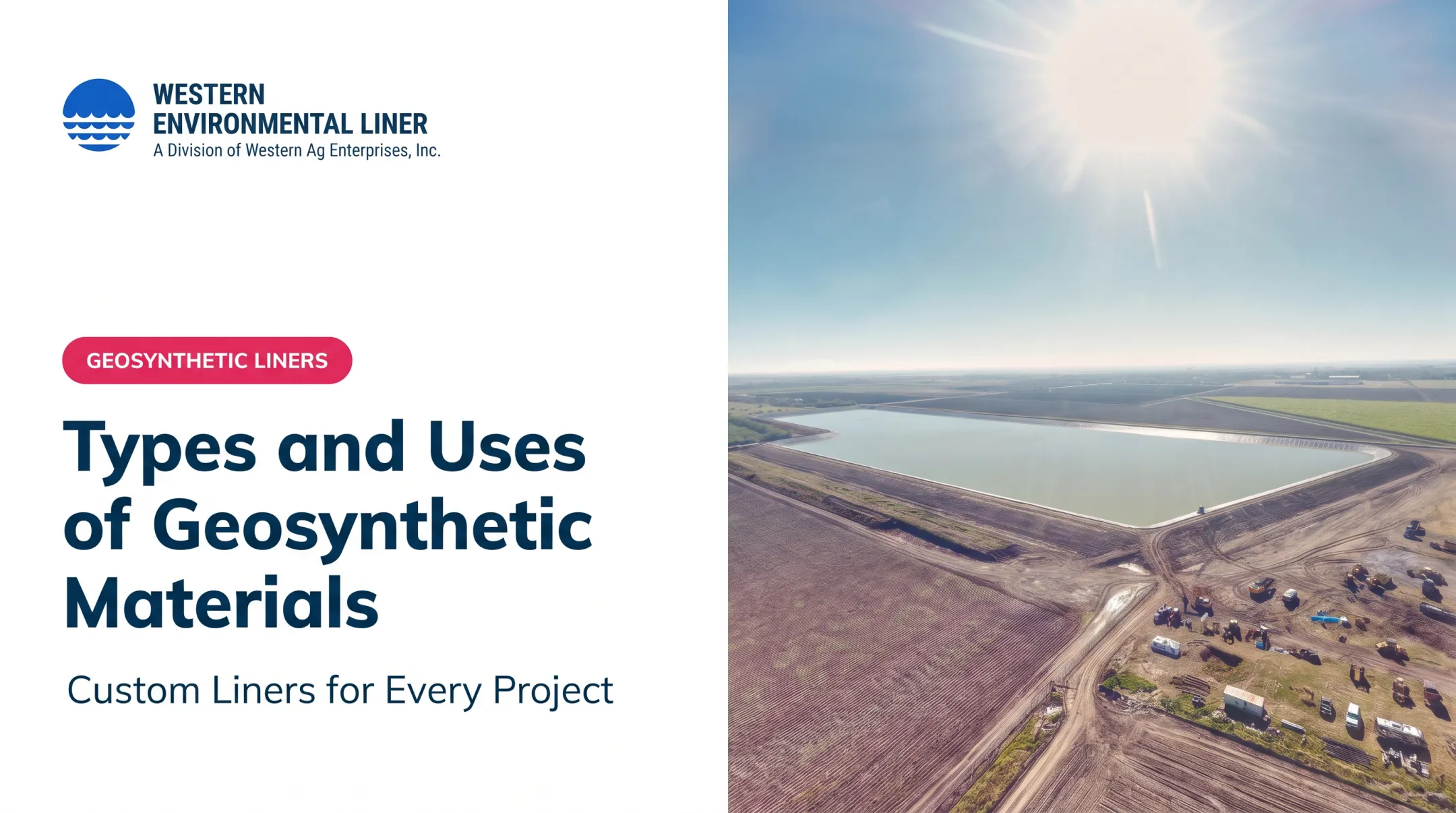
- Irrigation ponds, reservoirs, and stock ponds
- Waste and evaporation lagoons
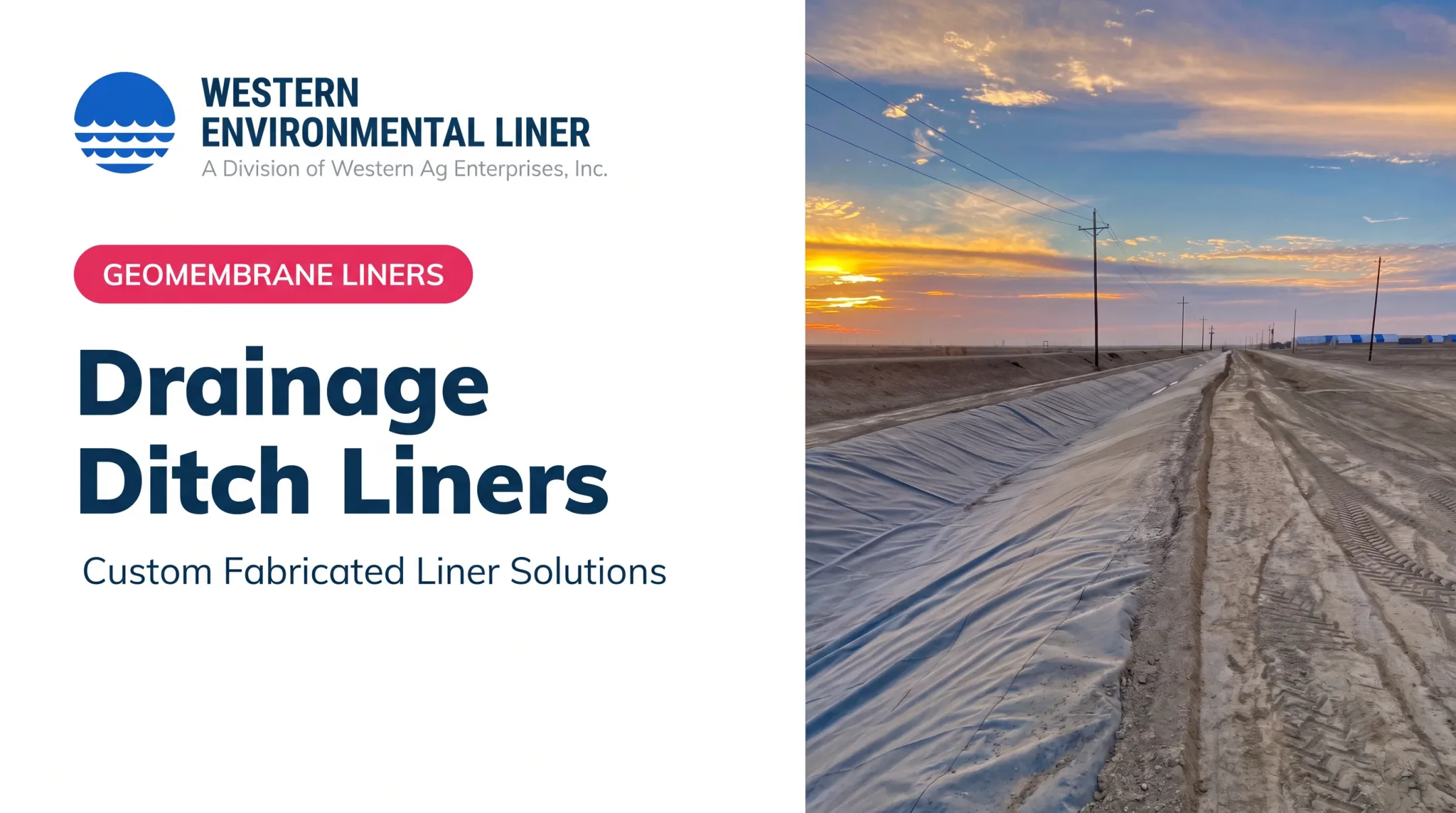
- Canals and ditches
- Frac pits, pads, and secondary containment
- Landfill covers and remediation sites
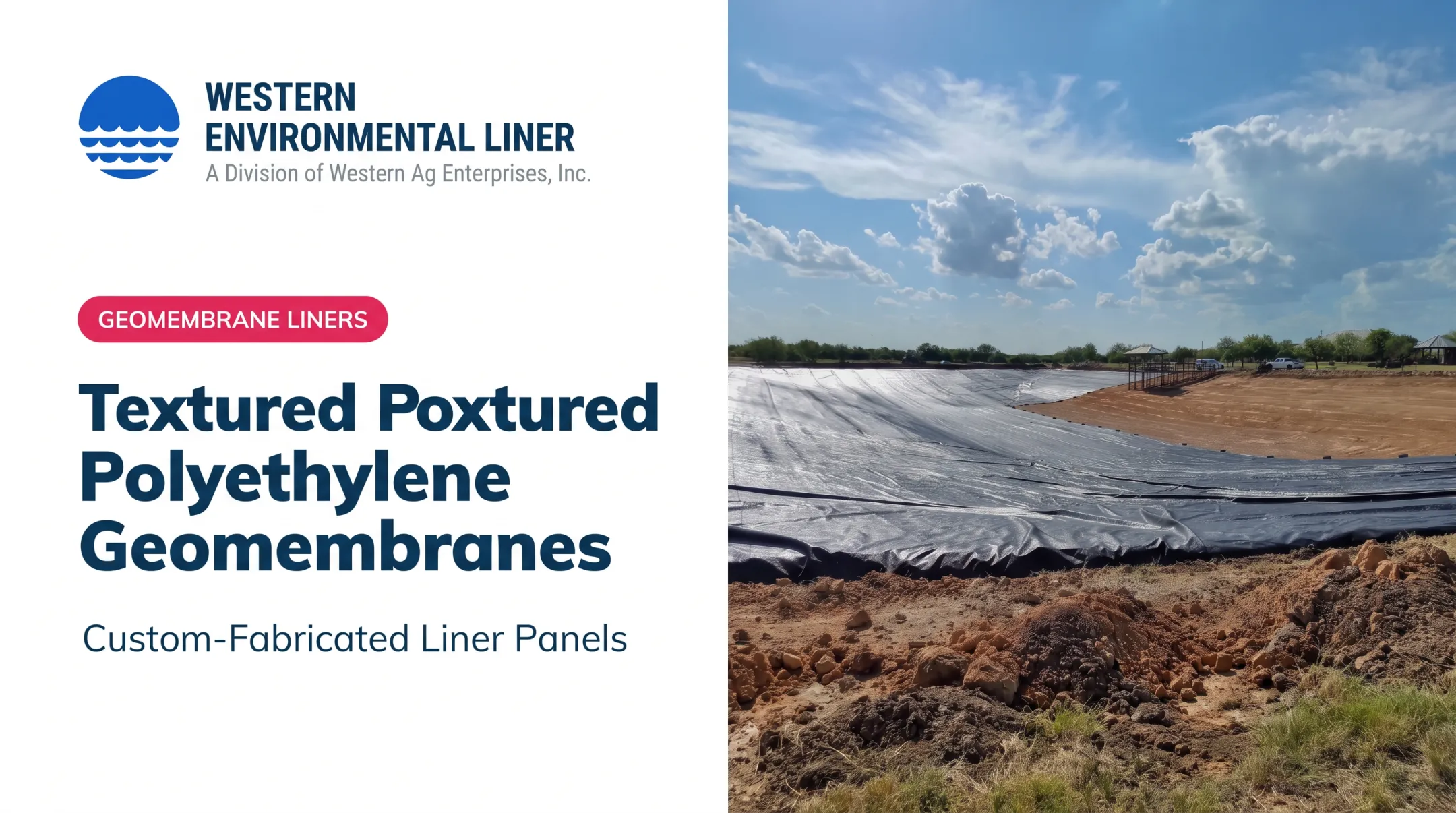
A permeable geotextile can't do these jobs because it never stops the flow. Bureau of Reclamation work estimates that exposed geomembranes cut canal seepage by about 90% as a category. That isn't a guarantee for any single polymer.
Regulation shapes the choice too. New Mexico requires 20-mil string-reinforced LLDPE or an approved equivalent for temporary oilfield pits. Multi-well fluid-management pits need primary and secondary liners.
Geotextile vs. Geomembrane: What Is Better?
Neither. The decision rule is simple:
- Need controlled water flow, filtration, separation, or erosion control? Use a geotextile.
- Need a low-permeability barrier for liquid or gas? Use a geomembrane.
Using both together
They often work as a system. Geotextile can sit under a liner, over it, or on both sides. Under the liner it protects against uneven earthwork. Over it, it shields against crushed rock.
NRCS calls for a nonwoven of 10 oz/yd² or heavier where sharp angular stones larger than 3/8 inch could damage a liner. The right setup still depends on design, and the textile doesn't replace interface testing.
Situational guidance
- Farms and ranches: liners for irrigation reservoirs and waste lagoons, with nonwoven cushion where stones are a risk
- Earthwork contractors: custom panels reduce field seaming; geotextile underlayment forgives imperfect grading
- Municipal and environmental: engineered liners and covers for stormwater, landfill cells, and contaminated sites
- Energy sites: pit classification and spill rules drive liner type
- Aquaculture and water features: fish-safe, UV-stable liners; check aquatic compatibility
Fluid chemistry, soil, slope, loading, exposure, regulations, and design life can all change the specification.
Real-World Examples and Case Studies
Washington hydropower flume
A manufacturer case from near Mount Rainier describes a deteriorated wooden flume leaking so badly that plant output fell from 26 MW to 8 MW. The fix was 80- and 100-mil HDPE over a high-strength geotextile. The manufacturer reports on-time, on-budget completion and tripled operating capacity. Seepage savings for the project are not published, and the ten-year life extension is a projection rather than a measured result.
Washington irrigation reservoir
At a Kamilche Valley resort, highly permeable soil couldn't hold the required reservoir volume. Reinforced polypropylene was chosen for heat-welded seams, puncture resistance, and low elongation in cold, wet conditions, with a nonwoven cushion fabric. Installation took 10 days with a 12-person crew in 2007. That 2007 timeline is historical and is not a current productivity benchmark.
Both cases show the same pattern: the geomembrane contained the water, and the geotextile protected it.

Western Environmental Liner offers custom fabrication, technical support on slopes, anchoring, and subgrade preparation, and IAGI-certified installation. Ask for a site-specific recommendation before you write specs.
Conclusion
A geotextile manages how soil and water interact. A geomembrane contains or isolates liquids and gases. The better choice depends on project conditions.
Before specifying, evaluate the site, fluid, subgrade, slope, exposure, installation method, and performance requirements. A qualified liner manufacturer or installer can confirm the design. Western Environmental Liner offers a free consultation before geotextile or geomembrane specifications are written.
Frequently Asked Questions
What is the difference between geotextile and geomembrane?
Geotextiles are permeable fabrics that manage soil and water through separation, filtration, and drainage. Geomembranes are continuous low-permeability sheets that contain liquids and gases.
Which geotextile is best?
Match the fabric to the job: woven types often fit separation and reinforcement, while nonwovens usually fit filtration, drainage, and cushioning. Compare tensile strength, puncture resistance, and filtration criteria to the project specs.
Does water pass through geotextile fabric?
Yes. Flow rate and filtration performance vary with fabric construction, pore structure, and the product specification.
What are geomembranes used for?
Ponds, reservoirs, canals, lagoons, frac pads, secondary containment, remediation, and other projects needing a low-permeability barrier.
What are examples of geotextiles?
Woven types, such as slit-film or monofilament, suit separation and strength. Nonwovens, such as needle-punched polypropylene, suit filtration, drainage, and liner cushioning.
How long does geo fabric last?
There is no universal lifespan. It depends on polymer, UV exposure, chemical contact, loading, installation, and burial. Many geotextiles degrade quickly in sunlight, so check the product durability data for your conditions.