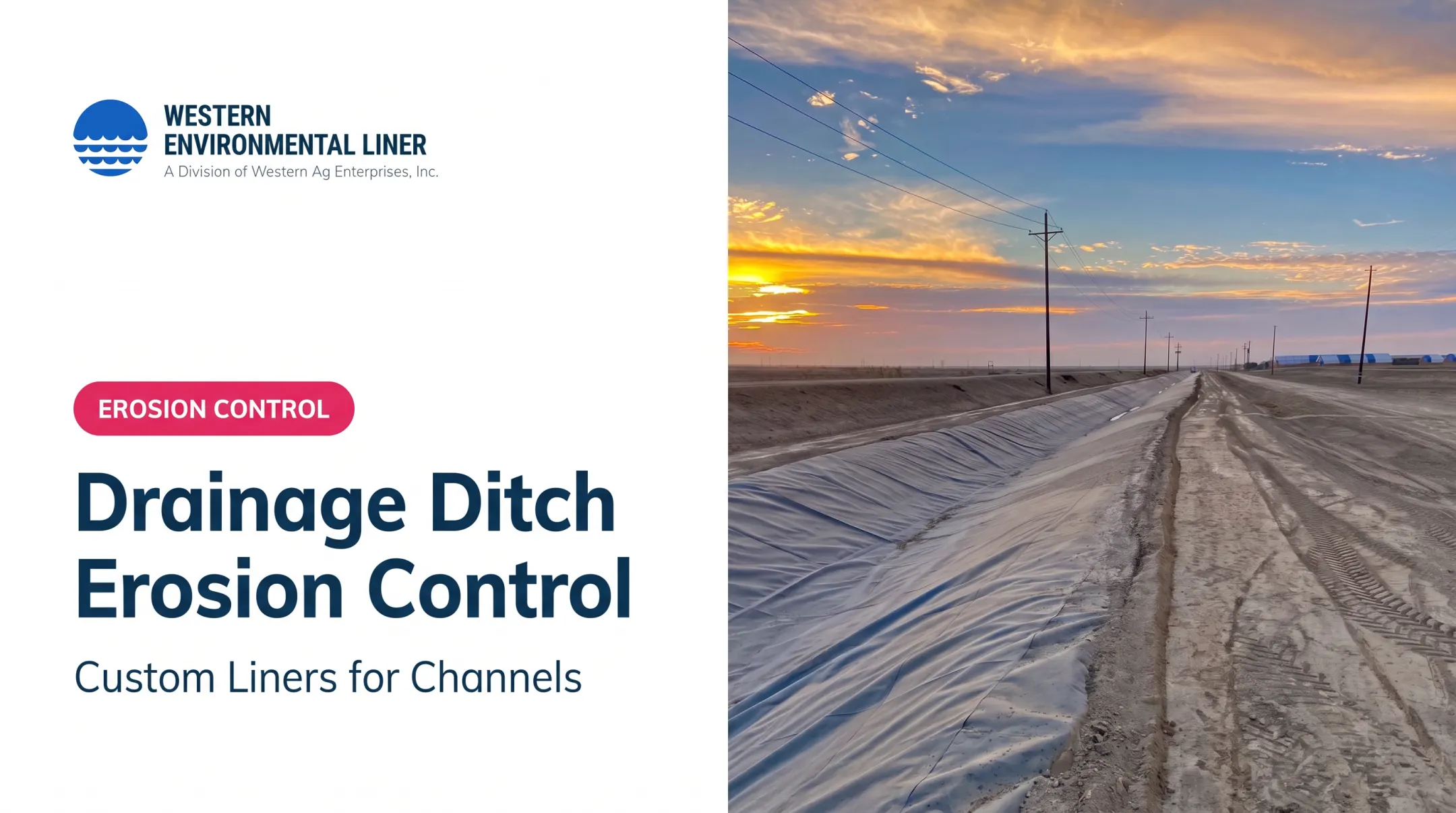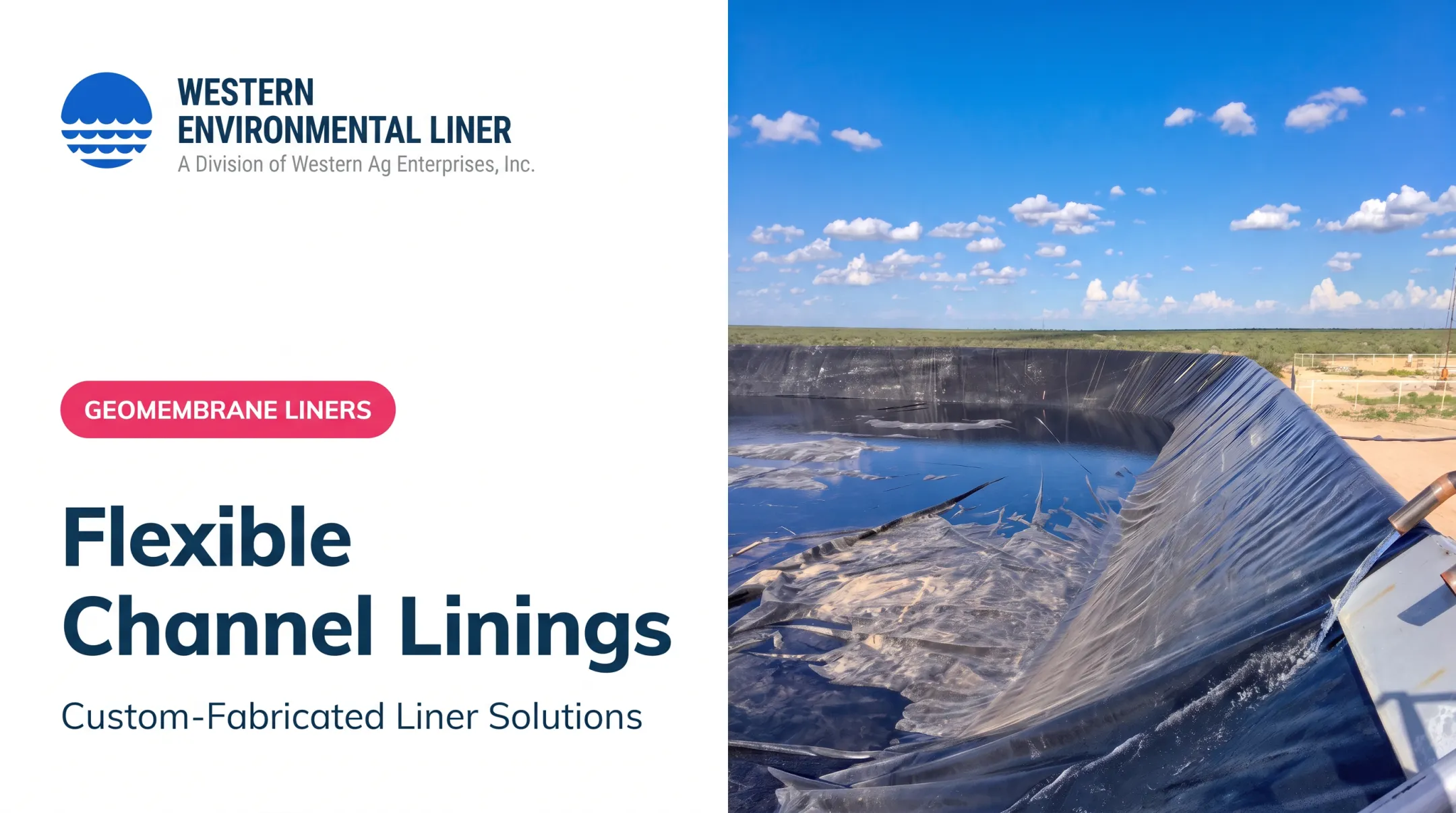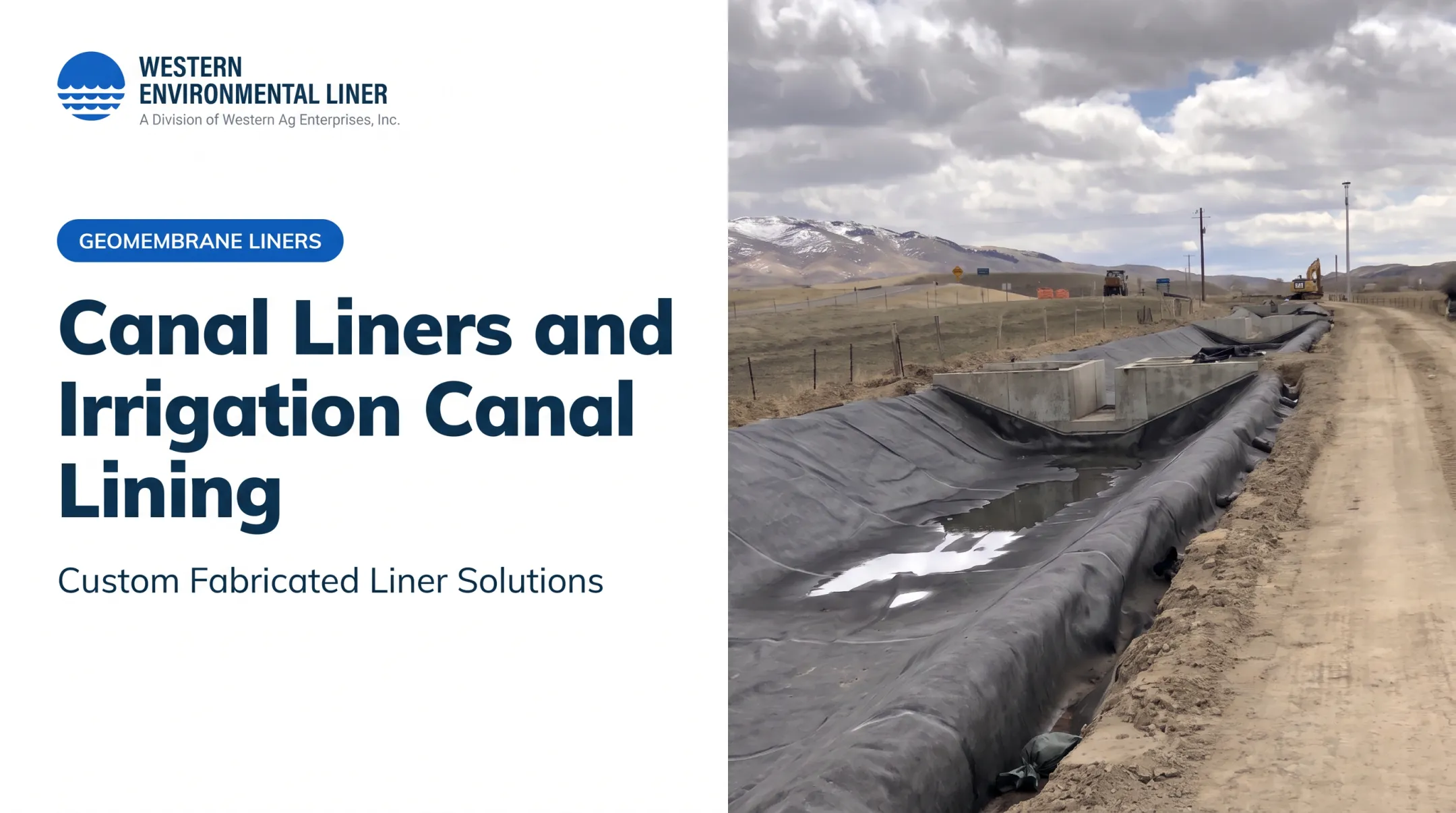

A liner fixes part of that problem, but only if you match it to the ditch. This guide explains what drainage ditch liners do, compares the common materials, separates open-ditch liners from French drain components, and walks through design and installation.
Key Takeaways
- The right liner depends on flow, geometry, soil movement, UV, chemicals and target service life.
- Flexible geomembranes conform to narrow, sloped or irregular ditches better than rigid concrete.
- No single material suits every ditch; confirm choices against project specifications.
- Subgrade prep, anchoring, seams and protection matter as much as the material.
- Factory-fabricated panels cut field seaming and simplify large projects.
What Are Drainage Ditch Liners?
What is a drainage ditch liner?
A drainage ditch liner is a barrier installed along the bottom and side slopes of an open channel. It controls seepage, protects soil, or contains potentially contaminated water.
Types differ in function:
- Geomembranes are essentially impermeable sheets used as liquid barriers, according to the NYSDOT Geotechnical Manual.
- Geotextiles are permeable fabrics that filter soil and debris. They are not barriers.
- Drainage composites are dimpled cores with fabric that convey water within their plane.
Ditches are usually narrower than canals, so liners are fabricated to fit tighter profiles.
Why are drainage ditches lined?
- Reduce water loss to seepage
- Limit erosion and keep banks from crumbling
- Preserve ditch geometry
- Cut weed and sediment maintenance
- Keep contaminated runoff out of soil and groundwater
Seepage figures vary widely by site. The U.S. Bureau of Reclamation reported 35%-50% losses in one fractured-rock canal setting, so treat that as a local result, not an average for ordinary ditches.
When is a liner not the only solution?
A liner cannot fix a ditch with too little slope or capacity, a poor outlet, sediment blockage or uncontrolled upstream flow. Capacity, shear and outlet scour are separate design questions. For high-flow, public, industrial or regulated projects, have an engineer review the whole drainage system.
Which Materials Are Used for Drainage Ditch Liners?
Concrete and preformed concrete
Concrete is strong and familiar. It also cracks when ground shifts, is heavy to handle and labor-intensive to place. The Bureau of Reclamation notes that leakage through cracks and joints can build water pressure under slabs, which then buckle or separate. Some specifications still call for concrete, so check yours.
HDPE geomembranes
HDPE (high-density polyethylene) offers chemical resistance, toughness and UV durability. GRI GM13 sets its manufacturing properties, including density of at least 0.940 g/mL. The tradeoffs: it stiffens in cold weather, struggles with tight corners, and needs compatible thermal welding.
PVC and EPDM
Both are more flexible and easier to handle than HDPE, but neither is universal.
- PVC: ASTM D7176 covers buried, nonreinforced PVC. Exposed life is far shorter; 20, 30 and 40 mil grades list 2 years exposed and 20 years buried.
- EPDM: GRI GM21 is the geomembrane specification. One manufacturer's EPDM stays flexible to -45°C but excludes hydrocarbon containment.
- Check the manufacturer's UV, temperature, chemical and water-contact limits.
Reinforced polyethylene and reinforced polypropylene
Reinforced polyethylene (RPE) balances strength, flexibility and puncture resistance. Western Environmental Liner's Aqua 30 lists 195-pound puncture resistance under ASTM D4833, and Aqua 24 is intended for long-term non-hazardous use from 4 to 20+ years.
Reinforced polypropylene (RPP) carries 15- and 20-year warranties, and its 36 mil version passes low-temperature flexibility testing at -40°F.
Compare values carefully. Different thicknesses and test methods prevent a simple ranking. GRI GM17 covers LLDPE and GM25 covers reinforced LLDPE; GM18 addresses reinforced polypropylene.

Alternative methods
| Method | What it does |
|---|---|
| Compacted clay | Seepage control |
| Bentonite/GCL | Seepage control; engineered cover needed |
| Riprap, vegetation | Erosion control only; allows infiltration |
| Shotcrete | Rigid lining; contraction cracking documented |
| Spray polyurea | Short-term field evidence only |
| Preformed plastic sections | Manufacturer claims "virtually leak free" |
How to Choose the Right Drainage Ditch Liner
Start with the ditch's function
Stormwater, irrigation, agricultural runoff, industrial drainage, leachate collection and contaminated-water containment all demand different things. Hydrocarbon exposure, for example, points to a material such as XR-5, while non-hazardous irrigation conveyance suits Aqua 24.
Evaluate hydraulic and site conditions
Use project-specific engineering data, not generic assumptions. Look at:
- Flow volume, velocity and peak storms
- Slope, hydraulic head and debris
- Freeze-thaw, groundwater and settlement
- Vehicle or equipment traffic
FHWA HEC-15 selects flexible linings by permissible shear rather than one velocity limit. Geosynthetic velocity limits come from the manufacturer.
Match properties to failure risk
Check puncture and tear resistance, seam strength, elongation, UV stability, temperature performance and chemical compatibility. For chemicals, EPA Method 9090A requires at least 120 days of exposure testing, so evaluate against your actual liquid. Product data are product-specific, not generic guarantees.
Account for geometry and protection
Width, depth, side slopes, curves, outlets and penetrations all affect fit. Geotextile underlayment (4 oz to 32 oz, with 8 oz the most common) can go under, over or on both sides of the liner. Rough subgrade calls for underlayment; sharp aggregate may need protection above.
Compare lifecycle cost and compliance
Price per square foot is only part of it. Factor in:
- Excavation and subgrade prep
- Fabrication, shipping and field welding
- Labor, repairs and warranty terms
- Permits
Unit prices differ too much by material and scope for a single comparison table to be useful. Reclamation's 2025 concrete-cloth study estimated $6.67/ft² for its scenario, excluding subgrade preparation. Get project quotes instead.

How Are Drainage Ditch Liners Installed?
Prepare and inspect the subgrade
- Dewater the work area.
- Remove roots and sharp objects.
- Smooth and compact base and slopes; correct unstable soil.
- Verify the final profile.
Measure, size and fabricate
Length, width, depth, slopes, curves, anchor trenches, terminations and pipe penetrations all set liner dimensions. Allow enough material for anchoring so the liner seats without folds or stress points.
Place and anchor
Deploy without dragging across sharp surfaces. Manage wrinkles and bridging, then secure in anchor trenches at the top of the ditch. IAGI guidelines call for panel relaxation before seaming.
Weld, seal and protect seams
Field seams, pipe boots and outlet connections are common leak points. Use methods compatible with the material, such as hot-wedge or extrusion welding for polyolefins (GRI GM19a). EPDM uses its own seam-tape systems.
Test seams as specified:
- Destructive: ASTM D6392 (nonreinforced) or D7747 (reinforced)
- Nondestructive: vacuum box (D5641) or air channel (D5820)
Professional or factory-fabricated installation
Factory-welded panels reduce field seaming. IAGI notes reductions of 80%–95% for materials in its guide, though not for every polymer.
Western Environmental Liner custom-fabricates liners for projects over 10,000 square feet and supplies one-piece liners up to 150,000 square feet. The company is an IAGI-certified installer and provides on-site installation, technical support, and warranties up to 20 years.
Confirm warranty terms for your specific project. Subgrade preparation and earthwork engineering sit outside its scope.
Inspect and maintain
Check the finished system regularly for:
- Exposed liner damage and punctures
- Displaced anchors
- Erosion at transitions
- Sediment, vegetation and outlet performance
- Unauthorized equipment access
Repair using the manufacturer's procedures, then retest and document.

Frequently Asked Questions
What to line a drainage ditch with?
Options include reinforced polyethylene, reinforced polypropylene, HDPE, PVC, EPDM or concrete. Flow rate, soil type, ditch geometry, UV exposure, chemicals and required impermeability drive the choice.
What liner to use for a French drain?
A French drain uses permeable geotextile and aggregate (often with perforated pipe) to collect and convey subsurface water. A geomembrane is an impermeable barrier, so choose based on filtration, drainage or seepage prevention.
Which is better, HDPE or EPDM?
Neither material fits every site. HDPE offers strong chemical resistance and fusion-welded seams but stiffens in cold weather. EPDM stays flexible and weather-resistant, yet uses tape seams and is not suited to hydrocarbons.
What is an HDPE liner?
An HDPE liner is a high-density polyethylene geomembrane. It is a durable, impermeable barrier for water, wastewater and containment, including canals and ditches.
What are HDPE liners used for?
Ponds, canals, ditches, animal-waste facilities, landfills, mining and secondary containment. Grade and design must match the application.
What are the four types of drainage?
One common vendor classification lists surface, subsurface, slope and downspout/gutter systems. Terminology varies by source; ditch lining mostly concerns surface and conveyance drainage.