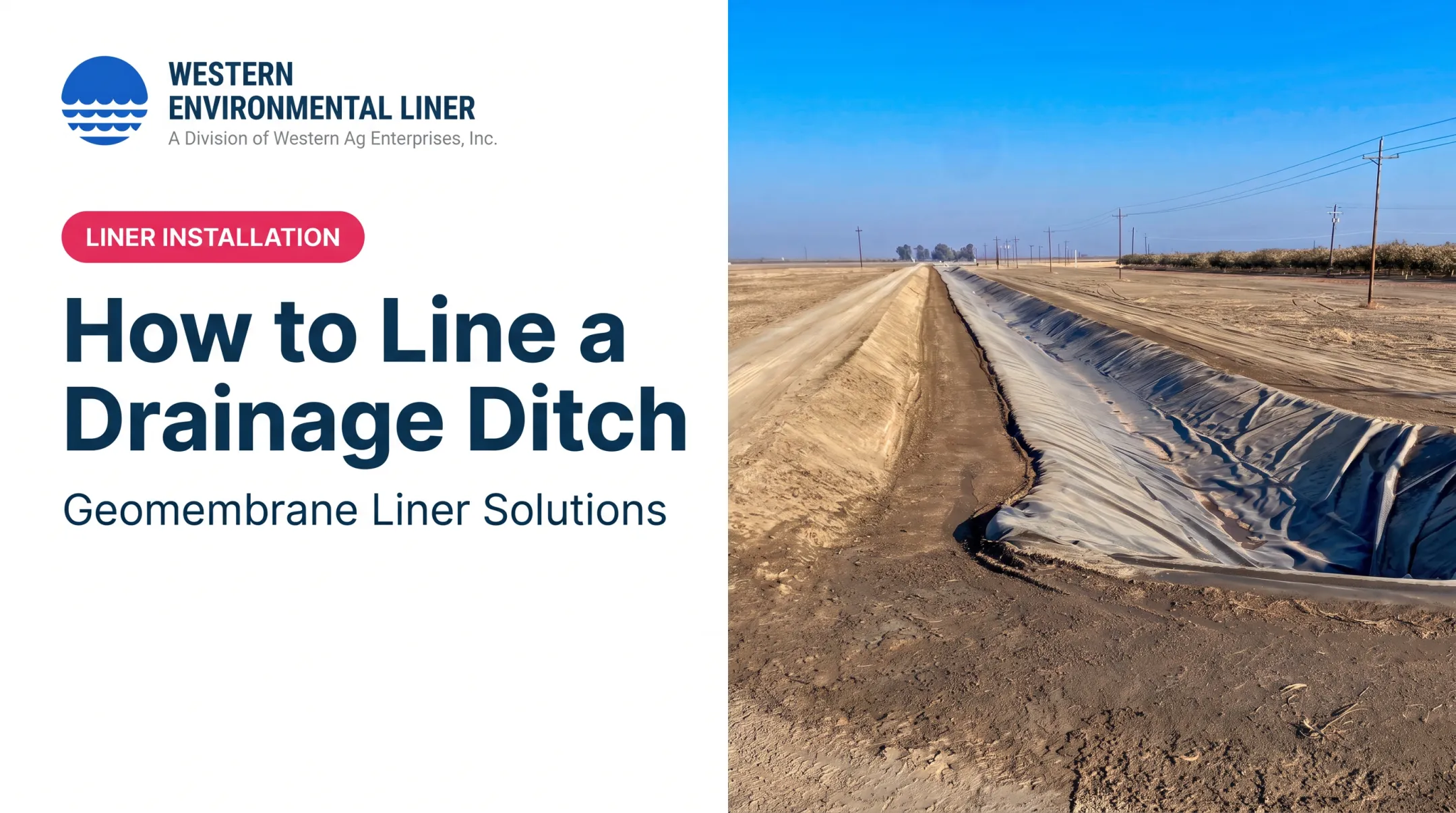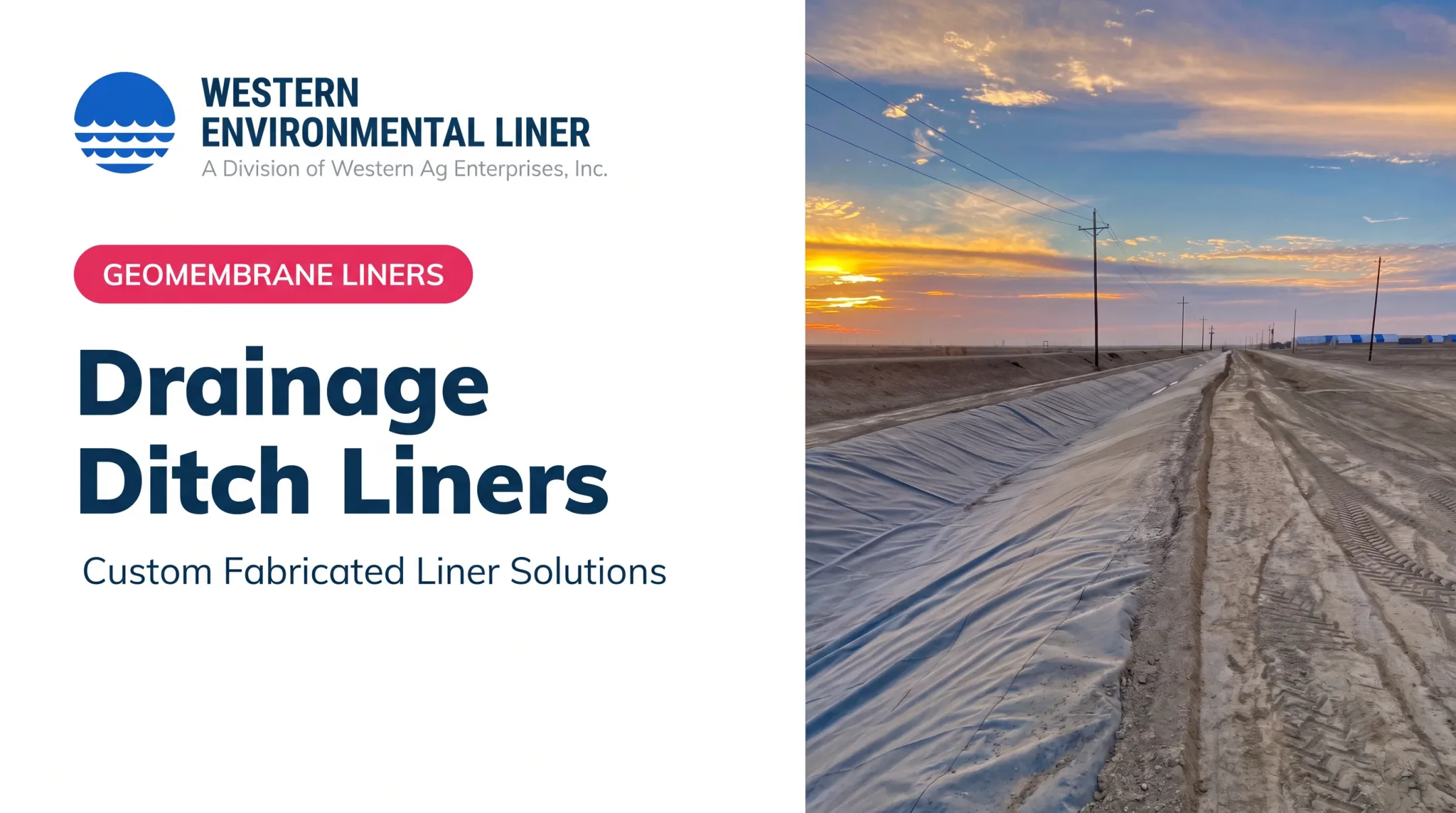

Canal lining answers this with an engineered layer along the bed and side slopes. This guide covers how lining works, the benefits and limits of each material, design factors, installation, and how US project owners can evaluate a liner supplier or installer.
Key Takeaways
- Lining limits seepage and stabilizes the channel, but results vary with soil, geometry, and condition.
- Concrete, clay, geomembrane, bituminous, masonry, and composite systems each carry different tradeoffs.
- Site conditions, subgrade, climate, and service life should drive material choice.
- Anchoring, seaming, drainage, and inspection matter as much as the liner material.
What Is Canal Lining?
Per NRCS Practice Standard 428, canal lining is impervious material or chemical treatment applied to a ditch, canal, or lateral. It forms a continuous layer across the bottom and slopes.
Primary goals include:
- Less water loss from seepage
- Less erosion and waterlogging
- Better conveyance and water quality
Irrigation canals are open channels that carry water by gravity from a source or reservoir to fields. The USBR describes a lateral as the channel that conveys water from a canal to a farm or other user. Smaller farm ditches are permanent earth channels that deliver supply water to one or more fields; NRCS covers those with capacities of 25 cfs or less.
Not all linings do the same job:
- Geomembranes are flexible barriers that primarily stop water movement.
- Concrete, shotcrete, and soil-cement add surface protection and structural resistance.
- Composite systems combine both functions, such as concrete over a membrane.
Lined vs. Unlined Canals
| Factor | Lined | Unlined |
|---|---|---|
| Seepage | Sharply reduced | Higher, soil-dependent |
| Bank erosion | Lower if designed well | Common |
| Upfront cost | Higher | Lower |
| Groundwater recharge | Reduced | Often beneficial |
An unlined reach can still be the right call. USDA's account of a 2019 irrigation-organization survey cites expense, beneficial groundwater recharge, and minimal losses in some soils. NRCS also warns that less seepage may harm wetlands and habitat.
Benefits of Irrigation Canal Lining
Less Seepage, Better Conservation
A low-permeability lining blocks water from escaping through fractured or porous soil.
In Oregon, a Reclamation demonstration on fractured volcanic basalt measured ponding losses of 0.91 ft³/ft²/day before lining and 0.01 after an LLDPE liner, a reported 99% reduction.

Savings depend on soil, geometry, water level, and liner condition, so no single percentage applies everywhere. Saved seepage is not always a basin-wide water saving when that water was recharging an aquifer.
Better Hydraulic Performance
Smoother surfaces reduce flow resistance. NRCS design values for Manning's n show the range:
- Concrete: 0.015
- Exposed geosynthetic: 0.011
- Covered geosynthetic: 0.025
- Earth canal (USBR, 1967): 0.025 for capacity below 100 cfs
These are material- and condition-specific, not guaranteed capacity gains.
Bank and Soil Protection
Lining protects canal banks and adjacent land by:
- Reducing erosion, sloughing, and sediment entry
- Limiting waterlogging next to the canal
Impermeability creates a risk, though. Groundwater above an emptied canal can lift and rupture a lining. Where high groundwater creates external pressure, USBR requires underdrains with suitable outlets. One-way flap valves relieve that pressure while blocking backflow.
Lower Maintenance and More Reliable Operations
A durable lining can reduce:
- Patching of eroded banks
- Sediment removal
- Vegetation control
- Seepage repairs
Reclamation's 10-year Oregon demonstration reported maintenance of $0.005-$0.010 per ft² per year. That is a historical project result, not a current allowance.
Reliable conveyance helps farms, irrigation districts, and municipal water managers. Lining does not replace sound hydraulic design, water controls, or inspection.
Types of Canal Liners and Canal Lining
Concrete and Cement-Based Lining
USBR classifies concrete and shotcrete as hard-surface linings. North Unit Canal in Oregon used a roller-compacted concrete invert (1998) and shotcrete side slopes (1999). Strengths are surface durability and structural protection.
Limits are real:
- Cracking from settlement, expansive soil, or hydrostatic loading
- Joint movement and complex repairs
- Freeze-thaw damage, which calls for air entrainment
- Need for proper reinforcement and curing
Cement choice is site-specific. ASTM C150 Types I, II, and V serve general use, moderate sulfate, and high sulfate exposure. USBR bases selection on sulfate levels in soil and water. Relevant references include ACI 350, ACI 506R for shotcrete, and ACI 305R and 306R for hot and cold weather placement.
Compacted Clay, Soil, and Masonry
NRCS 428 includes compacted clay, and USBR documents historical masonry at the Carlsbad Project in New Mexico. These can work where local materials and labor fit.
Clay stays permeable unless compacted very well, and quality control and repair differ from engineered products. Don't treat them as watertight.
Geomembrane Canal Liners
Common families include HDPE (GRI GM13), LLDPE (GM17), reinforced LLDPE (GM25), reinforced polypropylene, and reinforced CSPE (GM28).
Key selection factors:
- Permeability and chemical compatibility
- Tensile and puncture resistance
- Flexibility and temperature range
- UV exposure rating
- Seaming method
Field evidence varies by polymer. In Oregon, LLDPE and EPDM were in good condition after 17 years, while exposed PVC failed after 25 years. As a reference point, Western Environmental Liner's 36-mil reinforced polypropylene lists 110 lbf typical puncture resistance and a typical field-seam strength of 60 lbf/in.
Bituminous and Composite Systems
Oregon's bituminous geomembrane was in good condition after 16 years, but showed tears, holes, and alligator cracking. Concrete-faced membrane sections held up well after 25 years, though the 50-year service life is an estimate.
Geosynthetic cementitious composite mats (ASTM D8364) are another option. USBR's Sunnyside Canal test in Washington reported an 83% seepage reduction on a 50-foot section. Baseline and follow-up tests ran in different seasons, which limits how far you can lean on that figure. Long-term durability remains unproven in the field. Keep manufacturer claims separate from independent field data.

How to Compare the Options
No material wins everywhere. Weigh:
- Seepage-control needs and flow velocity
- Soil movement and slope geometry
- Climate and expected service life
- Construction access and repairability
- Local installation expertise
How to Choose and Design a Canal Lining System
Start With Site and Hydraulic Conditions
Record the canal’s physical and operating conditions before you choose a liner:
- Length, width, depth, and side slopes
- Flow rate, velocity, water-level swings, and freeboard
- Structures, penetrations, and shutdown windows
Then investigate the ground and exposure risks: soil permeability, groundwater, settlement, expansive soils, freeze-thaw, animal activity, vegetation, and slope stability.
Match Material Performance to the Project
Set material requirements from those site conditions:
- Permeability and thickness
- Tensile and puncture strength
- UV resistance and chemical compatibility
- Flexibility and expected service life
No universal thickness exists. GRI specifications are manufacturing standards, not canal thickness rules. A qualified engineer should set the specification from manufacturer data and US guidance such as NRCS 428.
Prepare the Subgrade and Detail the Edges
The IAGI 2014 guideline calls for a smooth, firm foundation free of sharp objects, standing water, mud, and vegetation. Oregon's PVC section suffered punctures from a rough subgrade despite a geotextile component.
Edge details often control long-term performance:
- Anchor trenches and cutoffs (NRCS requires them for covered linings)
- Ballast against wind uplift during installation
- Inlets, outlets, transitions, and penetrations
- Covered-lining side slopes no steeper than 3H:1V under NRCS
Plan Seaming and Quality Control
Factory-fabricated panels reduce field seams and field testing. IAGI recommends factory-seamed panels for that reason. Outdoor welds face uneven ground, wind, rain, and inconsistent power.
Match each test to its question:
- ASTM D6392 and D7747: destructive peel and shear strength
- ASTM D5820 and D7177: air-channel continuity (not strength)
- ASTM D5641: vacuum-chamber testing of seams and patches
Sample spacing is project-specific, set by the designer or CQA organization. Record seam locations, tests, and repairs.

Evaluate a Custom Liner and Installation Partner
Western Environmental Liner supplies custom geomembrane projects in reinforced polyethylene (Aqua series) and reinforced polypropylene. Panels are factory-welded, with technical support on anchoring, slope ratios, and subgrade preparation.
Custom fabrication covers jobs over 10,000 square feet, and one-piece liners reach 150,000 square feet. Those sizes will not suit every canal. Earthwork and subgrade engineering fall outside its scope, so owners still need a separate design and earthwork team.
Installation, Inspection, Maintenance, and Cost Considerations
Typical Installation Sequence
- Review survey and design; shut down and dewater the canal.
- Prepare and accept the subgrade.
- Establish anchorage.
- Deploy, align, and ballast panels.
- Seam, then nondestructively test field seams before covering.
- Repair and retest defects; record locations and results.
- Connect structures, inspect, and return to service.
The method statement should address weather, wind, water management, equipment access, worker safety, and protection from construction traffic.
Inspection, Repair, and Maintenance
NRCS calls for a site-specific inspection schedule. Check for:
- Exposed seams, wrinkles, and punctures
- Animal damage, erosion, and vegetation
- Sediment and debris
- Anchor areas and transitions
- Changes in seepage or flow behavior
Patch small defects following the manufacturer's procedure. Displaced or badly damaged sections warrant engineering review. USBR recommends photographing problem areas to monitor them.
Cost and Contractor Evaluation
Cost depends on several project factors:
- Canal dimensions, material, and thickness
- Subgrade work, drainage, access, and dewatering
- Seaming, protection, structures, and transport
- Testing, labor, permits, and maintenance
Avoid relying on old unit prices. North Unit's 1998-1999 bids averaged $2.00/ft² for concrete, and they reflect that era only.
Ask each contractor for:
- Comparable canal experience and references
- Liner specifications, welding procedures, and testing methods
- Safety planning and warranty terms
- Schedule, exclusions, and design coordination
IAGI's Certified Installer program evaluates company history, insurance, bonding, safety programs, and references. Western Environmental Liner holds that credential and provides turnkey installation, technical support, and free quotes. Its warranty on canal and ditch liners runs up to 20 years, so confirm exact terms for your material.
Frequently Asked Questions
What is canal lining and how is it used in irrigation?
Canal lining is an impervious layer placed along a canal's bed and side slopes. It limits seepage, improves conveyance, and protects the channel from erosion.
What are the benefits of canal lining?
Benefits include seepage control, steadier delivery, bank protection, and lower maintenance. Results and lifecycle savings depend on design and site conditions.
What is the difference between lined and unlined canals?
Lined canals leak less, resist erosion, and give better flow control, but cost more upfront. Unlined canals can suit soils with minimal losses or where recharge is wanted.
What are the different types of canal lining?
Options include concrete, compacted clay or soil, geomembrane, bituminous, masonry, and composite systems. The right choice depends on site and project requirements.
Which type of cement is best for canal lining?
No single type fits every canal. The specification depends on sulfate exposure, climate, structural design, reinforcement, curing, and applicable standards.
What are irrigation canals?
They are open channels carrying water from a source or storage to fields. Major canals feed laterals, which feed smaller farm ditches.