
Introduction
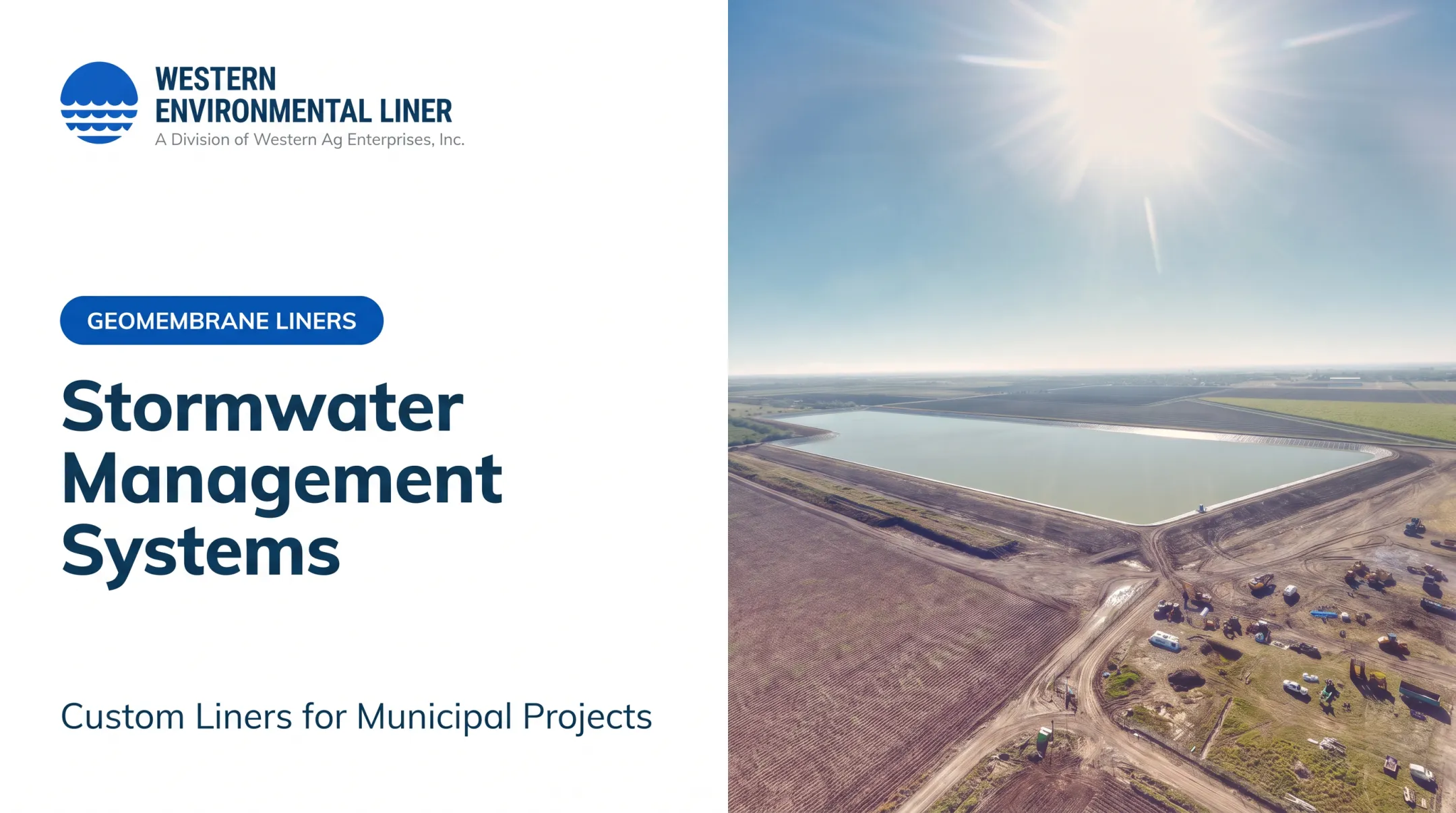
A stormwater pond is engineered infrastructure built to control runoff from developed land. Roofs, roads, and parking lots stop rain from soaking in, so runoff reaches streams fast and carries sediment, oil, metals, and nutrients with it. EPA's post-construction guidance documents this runoff pattern.
Municipalities, developers, contractors, property managers, and site owners share responsibility for these basins. This article covers pond types, how they operate, when a liner makes sense, maintenance, and permitting.
Key Takeaways
- Ponds slow runoff, store it, and let sediment settle before discharge.
- "Retention" and "detention" mean different things in different jurisdictions.
- Performance depends on inlets, outlets, spillways, embankments, storage volume, and upkeep.
- A liner is project-specific, driven by soil, groundwater, and seepage conditions.
What Is a Stormwater Management Pond?
A stormwater management pond is a constructed basin that receives runoff from roofs, roads, parking lots, and graded areas. Its job is to control both the quantity and the quality of water leaving a site. In parts of the Southwest, municipalities commonly require developers of shopping centers and subdivisions to include them.
Retention Basins, Wet Ponds, and Detention Basins
In common usage, a retention basin (wet pond) keeps a permanent pool. A detention basin holds runoff temporarily, then releases or infiltrates it, and often stays dry between storms.
Terms are not consistent across the US:
- EPA: wet ponds hold a permanent pool; dry detention has none.
- Minnesota: a wet pond combines a permanent pool with extended detention above it.
- Florida DEP: "dry retention" means an infiltration basin, and "wet detention" means a permanently wet pond.
So "retention" does not automatically mean "permanent water." Confirm definitions in your stormwater manual, permit, or engineering documents.
Who Uses Stormwater Ponds?
- Residential subdivisions and commercial developments
- Municipal drainage infrastructure
- Industrial sites and campuses
- Highways and transportation corridors
- Agricultural operations, where ponds are often under an acre and shallow
How Stormwater Management Ponds Work
Runoff Collection and Conveyance
Rain hits impervious surfaces and moves through swales, inlets, pipes, and culverts to the pond. Grading and conveyance layout decide how much water arrives, how fast, and how much sediment it carries. Poor conveyance design overloads a pond no matter how well the basin itself is built.
Storage, Flow Control, and Discharge
The basin stores inflow temporarily. An outlet structure, riser, or weir then releases water at a controlled rate. Reverse-slope outlets draw water from below floating debris. Required storage volumes and release rates depend on the site and the authority having jurisdiction.
Water-Quality Treatment
Slower flow lets sediment and attached pollutants settle. Vegetation and soil interfaces add some filtration and uptake. Published benchmarks vary:
| Source | TSS removal | Basis |
|---|---|---|
| Minnesota wet-pond table | 84% | Median value, Design Level 2 |
| EPA dry detention (quoting New Hampshire) | 80% | Assumed factor, not measured average |

Ponds are not a cure-all. EPA notes dry detention is ineffective for soluble pollutants, and deep, stratified wet ponds can export dissolved phosphorus.
Essential Pond Components
- Inlet protection: limits erosion where water enters.
- Sediment forebay: settles coarse sediment and concentrates cleanout.
- Permanent pool or storage area: provides treatment time and volume.
- Embankments and shoreline: must be stabilized.
- Outlet structure: controls discharge and pool level.
- Emergency spillway: passes storms beyond the design event.
- Vegetated buffer: Minnesota highly recommends 25 feet beyond maximum water level.
- Maintenance access: lets crews reach inlets, outlets, and forebays.
Heavy Rainfall and Failure Prevention
When inflow exceeds storage, water must have a safe path out. Philadelphia, for example, requires positive overflow through the 100-year, 24-hour storm in most cases. Without that route, water overtops the embankment, and earthen embankments resist erosion poorly.
Common causes of failure:
- Blocked outlets or damaged risers and pipes
- Storage filled with sediment
- Lost slope vegetation
- Compromised embankments
Retention vs. Detention Basins: What's the Difference?
Retention Basins
A wet retention basin keeps a permanent pool that settles pollutants and can support habitat. It also brings management concerns:
- Water-quality management and nutrient control
- Algae blooms tied to nutrient-rich runoff (Clemson)
- Mosquitoes at shallow edges
- Public safety around permanent water
- Sediment buildup over time
Detention Basins
A detention basin captures a storm surge and releases it at a manageable pace. Many sit dry between rains. EPA notes standing water beyond 3 days favors mosquitoes. Flatter side slopes help reduce safety risks.

Direct Comparison
| Factor | Wet pond | Dry detention |
|---|---|---|
| Purpose | Treatment plus rate control | Peak reduction, some settling |
| Water between storms | Yes | Generally no |
| Drainage area (EPA) | 10-20 acres in humid regions | 10-acre minimum |
| Groundwater | May intersect it | Base should stay above it |
| Sediment cleanout | Every 2-7 years or at 50% capacity loss | Forebay at 50% loss; whole pond at 25% |
Choosing the Appropriate Basin
The right choice depends on:
- Watershed size and rainfall patterns
- Soil permeability and groundwater depth
- Available land and downstream capacity
- Water-quality goals and public safety
- Local regulations
Bring in a qualified civil or stormwater engineer early.
Design and Liner Considerations
Site and Subgrade Assessment
Before choosing a construction approach, evaluate:
- Soil type and permeability
- Groundwater elevation
- Slope stability, settlement, and existing contamination
- Expected water levels and how the basin ties into surrounding drainage
When a Geomembrane Liner May Be Appropriate
Liners can:
- Limit seepage and hold a designed water level
- Protect groundwater
- Separate stormwater from unsuitable soils
Minnesota requires impermeable liners in active karst and flags high-infiltration soils, fractured bedrock, and contaminated ground. Hotspot ponds with seasonal groundwater within 3 feet of the bottom may also need lining.
A liner does not replace sound hydraulic and structural design. Many ponds never need one.
Selecting Liner Materials and Specifications
Match material to:
- UV exposure and temperature swings
- Puncture and tear demands
- Chemical compatibility and seam requirements
Minnesota's design levels set HDPE minimums at 60 mils (Level 1) and 40 mils (Level 2), but these are state criteria, not universal specs.
Western Environmental Liner offers reinforced polyethylene from 12 to 60 mils and reinforced polypropylene. Its 45-mil RPP lasts over 20 years when exposed in water applications. Always check your project specification first.
Installation and Quality Control
Leaks usually start with installation. Key steps:
- Prepare a smooth, dry subgrade and remove rocks and sharp objects.
- Cover unavoidable debris with puncture-resistant geotextile.
- Dig and backfill the anchor trench per project drawings.
- Lay out panels and make field seams.
- Test every field seam before covering, using nondestructive methods such as air-channel or vacuum-chamber testing.
- Run destructive peel and shear tests, then repair and retest defects.
- Record tests and panel and seam drawings.

Seam continuity and seam strength are separate checks. GRI-GM13 covers manufacturing quality, not installed seams.
Custom Liner and Installation Support
Western Environmental Liner, an Arizona-based manufacturer, fabricates custom geomembrane panels up to 300' x 300' and one-piece liners up to 150,000 square feet. Factory-welded panels reduce field-weld risk. The company is an IAGI-certified installer and offers turnkey installation and technical support on slopes, anchoring, and subgrade preparation.
It does not provide earthwork or engineering design. If your pond may need a liner, request project-specific guidance and a free quote.
Maintenance, Permits, and Compliance
Permitting and Regulatory Review
No single rule covers every pond. Requirements vary by state, municipality, watershed, project size, discharge point, and wetland involvement. Examples:
- Construction stormwater: EPA's NPDES program covers sites disturbing 1 acre or more, including smaller common-plan sites.
- Small MS4s: post-construction controls must have long-term operation and maintenance.
- Section 404: fill discharges into waters of the US, including wetlands, need authorization unless exempt.
- Dam safety: Virginia's definition, for example, starts at 25 feet high with 15 acre-feet of capacity. Other states differ.
Check current federal, state, and local rules before design.
Inspection and Maintenance Checklist
Inspect:
- Inlets, trash protection, and forebays
- Water levels and outlet structures
- Embankments, erosion, and vegetation
- Emergency spillways and access areas
- Exposed liner, if present
Philadelphia's example schedule calls for monthly inspections in year one, quarterly outlet checks, and checks after storms over 1 inch. Keep dated inspection and repair records.
Warning Signs That Require Assessment
Call a qualified professional if you see:
- Reduced storage capacity or blocked outlets
- Unexpected seepage or water levels that miss design intent
- Persistent turbidity or unusual odors
- Bank slumping, cracks, or erosion gullies
- Exposed liner or uncontrolled vegetation
Frequently Asked Questions
What is stormwater management?
It is the planned collection, storage, treatment, conveyance, and controlled release or infiltration of rainwater runoff.
What is a stormwater pond?
An engineered basin that manages runoff quantity and can help remove sediment and pollutants before downstream discharge.
Do retention ponds really work?
Yes, when correctly designed, maintained, and matched to site conditions. A 2020 North Carolina study found 99% median peak-flow reduction at two infiltrating wet ponds, though results are site-specific.
Do you need a permit for a retention pond?
It depends on the project and jurisdiction. Confirm requirements with local, state, and federal authorities.
What is the best treatment for water retention?
It depends on your water-balance and water-quality goals. Options include basin design, controlled outlets, infiltration, vegetation, sediment management, or a liner.
What are the different types of pond management?
Inspection and structural maintenance, sediment and debris control, vegetation management, water-quality monitoring, erosion control, and repairs or rehabilitation.