
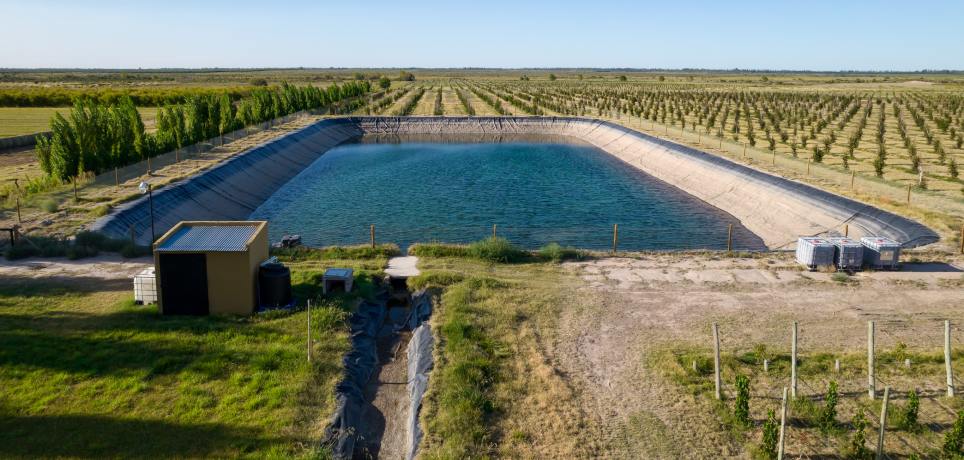
Choosing the best material for your irrigation pond liner cannot be done simply from the physical properties of the geomembrane material. Related factors will all play a large role in how long and how well your liner endures, factors such as the exposure to sun and heat and other environmental forces, how well the subgrade is prepared, and how skillfully the liner is installed. The material itself will also depend on the quality of the resins from which it is made, and the actual liner manufacture.
Western Environmental Liner can offer a liner guarantee up to 20 years in many cases, and a well planned, well executed and well maintained irrigation pond liner can last much longer.
Table of Contents
Pond Liner Material Types
Materials commonly cited for pond liners, with their theoretical longevity are these:
- HDPE (High-Density Polyethylene): 30-75 years.
- RPE (Reinforced Polyethylene): 20-40 years.
- RPP (Reinforced Polypropylene): 20-40 years.
- PVC (Polyvinyl Chloride): 10-30 years.
- EPDM (Ethylene Propylene Diene Monomer): 20-40 years.
Materials choice depends on use. An irrigation pond won’t contain toxic waste, and it may also water livestock or wildlife, or come to contain fish. To ensure water quality, materials choice turns away from EPDM and PVC, unless the user is certain of the source quality, since lower quality and toxicity are common in these materials. PVC is best for a more temporary or a smaller type of project, while EPDM is typically chosen for its lower cost. Neither material is very strong or wear-resistant. See our detailed examination of both materials here: Is a PVC Pond Liner Safe for Fish and Food?
HDPE is thick and strong, but also stiff and rigid. Very dense, it is well suited for toxic containment ponds, but hard to manage in other types of pond. RPE and RPP are three times as puncture-resistant at half the thickness of HDPE, with a flexibility that conforms well to field conditions, and they have a natural non-toxicity suitable for fish and wildlife. Premium liners made from virgin resins with consistent thickness and strong quality control generally outlast economy liners made from lower-grade or recycled materials.
Thickness in itself is not a principal criterion for materials choice in an irrigation pond liner: t weightier considerations include choosing a high-quality geomembrane designed for the application, and installing it correctly with appropriate protection and high-quality seam welding. These factors typically have a greater impact on longevity than simply selecting a thicker liner.
See our notes below on Installation to understand how we choose a liner material for optimal advantage in field conditions.
Also, feel free to contact us at Western Environmental Liner for an expert consultation at no charge, to find the best liner for your project. And for detailed guides to liner types and materials see our fuller explanations:
- Irrigation Pond Liners
- Key Features To Look For in a Durable Pond Liner
- What is the Best Pond Liner Thickness for Your Pond?
Exposure and Wear
Generally a pond liner doesn’t fail from simply aging, but is worn down by environmental factors. Ground can shift over time, no matter how well prepared. In some conditions, and underlayment may be useful to protect against abrasions from below the liner. Roots can grow over time and puncture a liner.
Sunlight and UV exposure are the greatest causes of a liner material degrading over time, and high-quality geomembranes contain carbon black and UV stabilizers that dramatically slow degradation. Burying the liner under soil or gravel increases its lifespan considerably. Keeping a pond full protects much of the liner from UV exposure. Repeatedly exposing and drying the same section around the shoreline often causes that area to age first. The banks of any pond are always a vulnerable area, and routine inspection and maintenance are optimal.
Constant expansion and contraction from hot days and cold nights slowly stresses the material. High-quality liners are formulated to tolerate these cycles.
Sharp rocks, livestock, heavy equipment, floating debris, and ice movement are among the physical assaults that can damage the pond liner. Suitable precautions and fencing to prevent intrusions from above will help, while ground preparations and installation become key for subsurface protections.
The most vulnerable aspect of the liner itself lies in the seams. The ideal seam is welded in the factory prior to field delivery, but there’s a limit to how large a sheet can physically be delivered to the field, and field welding is often required. Again, material choice in light of field conditions becomes a part of the project planning, as well as the installation skill available.
Ground Preparation
The subgrade is the bed upon which the success of the pond depends. Not surprisingly, the smoother this surface can be, the better the liner can conform. Rocks should be removed, and roots killed or removed if possible. Rocky or stony soil may become abrasive to the liner under the considerable weight of water, and a layer of soil may be useful in such a case.
Perfect excavation is not always possible, and installation must deal with any unconformities. As mentioned, an underlayment using a different material may be practicable to help preserve the top liner from abrasion or punctures. In the project planning, one consideration is the ability to drain the pond for maintenance, and this may or may not be possible.
Installation
Delivery to the site, and installation of the pond liner, are key elements dictating how long the liner may last. A material too light will not last as long as a heavier material, but sheets must be folded or rolled and delivered by truck to the pond location. HPDE, for example, cannot fold and must be rolled, which takes more space on the truck bed. These factors should be considered in the project planning stage.
Smoothing the liner on the pond bed is key: wrinkles turn into fault lines under weight. Anchoring the liner at the pond banks is important: securing the liner perimeter in a proper anchor trench prevents slumping, strain, and tearing along the embankment edges.
Factory seams are the safest best for a long lifespan, but seam welding in the field will hold up just as long if the crew is skilled. This may seem obvious, but there are freelance installers of varying experience and skill, and this becomes a determination of quality just as much as any other factor.
A geomembrane rarely fails in the middle of a continuous sheet – it almost always fails at the welded seams or penetration points such as pipe boots or drains. Thermal wedge welding and extrusion welding must be performed within precise temperature and moisture windows – choosing the time of day and the rest period following are important. Poor seam testing during installation leads to microscopic leaks that expand under hydrostatic pressure over time.
Western Environmental Liner uses its own salaried crews to install pond liners. Our factories in North America are built for large liners, and we can handle practically any size of geomembrane sheet, any scale of project.
Contact us for a free consultation on your pond project.