
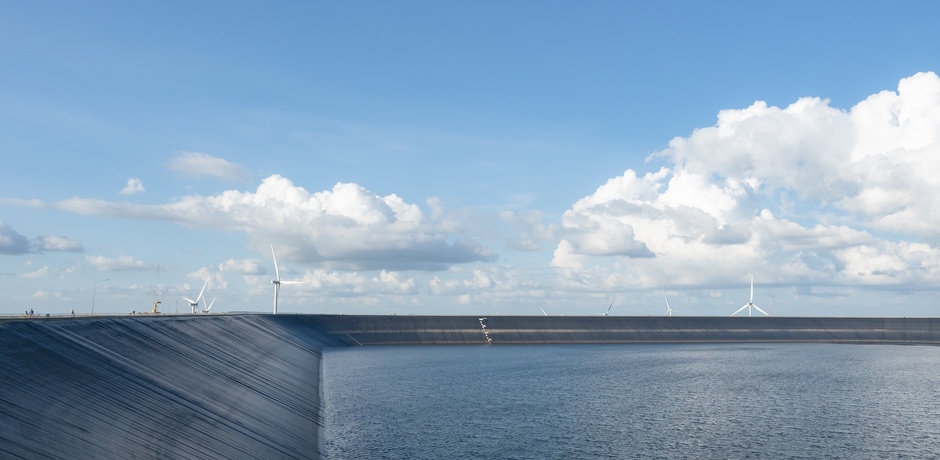
A pond needs a bed and perimeter that retain water without excessive seepage. The best approach depends on the pond’s size, purpose, location, soil conditions, and acceptable water loss. Some ponds hold water naturally; others need an engineered liner of compacted clay, concrete, or synthetic material. Options range from traditional earthwork to modern geomembranes, each with trade-offs. A small ornamental pond has very different needs from a large agricultural pond or stormwater basin, so liner selection is a key design decision.
[You may also be interested in our other guides for more detail on liner cost, liner lifespan, liner installation, and common mistakes.]
Natural Soil
Where native soil is dense and impermeable enough, no liner is needed. Clay-rich soils with a high proportion of fine particles can restrict water movement sufficiently, and even ordinary soil may work if some seepage is acceptable, groundwater levels are favorable, or natural inflows replenish the pond.
This is the simplest and cheapest option, since nothing is imported, but it depends heavily on local geology. Sandy and gravelly soils generally drain too quickly. Natural soil is most common for farm ponds, wildlife ponds, and larger landscape ponds that can tolerate some water loss. A soil investigation or simple percolation test shows whether the ground is suitable.
Compacted Clay
Clay has sealed ponds, reservoirs, and canals for centuries. Properly placed and compacted, it forms a dense barrier that greatly reduces water movement. The clay may come from the property or be imported, and is placed in controlled layers, each compacted to the required density to minimize voids. The liner must be thick enough and continuous across the bottom and sides.
It suits farm ponds, irrigation reservoirs, livestock ponds, stormwater ponds, and larger recreational or landscape ponds, and appeals where a synthetic liner is undesirable. However, it requires suitable material, specialized earthmoving equipment, and careful installation. Clay can crack if it dries out excessively, and erosion, burrowing animals, and construction damage can compromise it. Some installations add a synthetic liner or other protective layer over or beneath the clay.
Bentonite Clay
Bentonite is a natural clay that swells on contact with water, filling small spaces to form a relatively impermeable barrier. It can seal ponds where the existing soil is too permeable. Depending on ground conditions and installation requirements, it is mixed with existing soil, spread over the bed and then incorporated and compacted, or applied as a blanket layer.
It works well for farm ponds, small agricultural reservoirs, and natural-looking landscape ponds where the soil needs improvement. It is not suitable everywhere: performance depends on soil composition, water chemistry, and proper application, and it can be less reliable in very sandy or gravelly soils unless an abundant quantity is used to fill in between the grains of the soil.
Concrete and Cement-Based Linings
Concrete is a hard, durable surface that retains water when properly designed and built. It suits ponds needing a defined shape, stable sides, and an easily cleaned finish, and is common in ornamental garden ponds, koi ponds, fountains, water features, and some commercial or institutional installations. It can also serve in larger engineered structures where a rigid lining is desirable. Climate is an important factor, as freeze and thaw cycles are one of the most common causes of cement deterioration.
Concrete is not automatically waterproof, though. Ground movement, temperature changes, settlement, or poor construction can crack it, and joints and penetrations need careful attention. Waterproof admixtures, sealants, membranes, or specialized coatings may be needed for long-term retention. Cement-based renders and mortars are sometimes applied over masonry or prepared surfaces for a watertight finish. These suit smaller constructed ponds better than large earth-bottomed reservoirs, where flexibility and resistance to ground movement matter more.
Synthetic Pond Liners
Synthetic liners are among the most versatile and dependable options. Manufactured in sheets or rolls and laid over a prepared subgrade, they form a continuous barrier between water and soil, independent of the site’s clay content or permeability. Several geomembrane types differ in flexibility, strength, durability, and environmental resistance:
- EPDM rubber is flexible, UV-resistant, and stays pliable across a wide temperature range. It conforms easily to irregular shapes, shelves, and contours, and is popular for garden ponds, koi ponds, decorative features, and small to medium landscape ponds.
- PVC is lightweight, flexible, and easy to install, and suits smaller decorative ponds. Durability, UV resistance, and flexibility vary considerably with formulation and quality, so it is often less suitable than heavier-duty geomembranes for large or demanding projects.
- HDPE is strong and relatively rigid, with excellent chemical resistance, low permeability, and good resistance to degradation. It is widely used for stormwater ponds, agricultural reservoirs, wastewater lagoons, and industrial containment. Its stiffness complicates installation around complex shapes, and seams generally require specialized welding equipment.
- LLDPE is more flexible than HDPE while keeping much of polyethylene’s durability and chemical resistance. It suits larger irregular ponds and is often chosen for stormwater basins, agricultural ponds, and other containment where flexibility matters.
- RPE (reinforced polyethylene) combines polyethylene films with an internal reinforcing fabric, giving high tensile strength, puncture resistance, and dimensional stability at relatively low weight. It is useful for large farm ponds, irrigation reservoirs, and stormwater ponds needing a strong but manageable liner.
- RPP (reinforced polypropylene) is another reinforced option combining strength, flexibility, and environmental resistance. It is used in larger ponds, reservoirs, and containment applications requiring a durable liner with good dimensional stability.
Synthetic liners usually go over a prepared soil surface, often with a protective geotextile underlayment to guard against punctures from rocks and roots. Depending on the application, they may be covered with soil, gravel, or other protective material.
Choosing the Right Liner
No single material is best for every pond. A small garden pond is most easily built with EPDM, while a formal ornamental or koi pond may call for a concrete finish. A farm pond may rely on natural clay or compacted bentonite, but a synthetic geomembrane gives more predictable retention where the soil is unsuitable.
Stormwater ponds generally need a more engineered approach. Depending on purpose, they may hold water permanently, store runoff temporarily, or allow controlled infiltration. Many such ponds are designed for gradual leakage, but where leakage must be minimized, HDPE, LLDPE, RPE, or RPP geomembranes can provide reliable containment. For large reservoirs, wastewater lagoons, and industrial ponds, selection depends even more on engineering requirements, chemical exposure, expected service life, and installation conditions.
Ultimately, the best lining matches the site’s soil and groundwater conditions, the pond’s intended use, and the demands on the finished structure. Subgrade preparation, liner thickness, seam quality, and protection from damage matter as much as the material itself.
See our other guides for more details on liner cost, liner lifespan, liner installation, and common mistakes.