

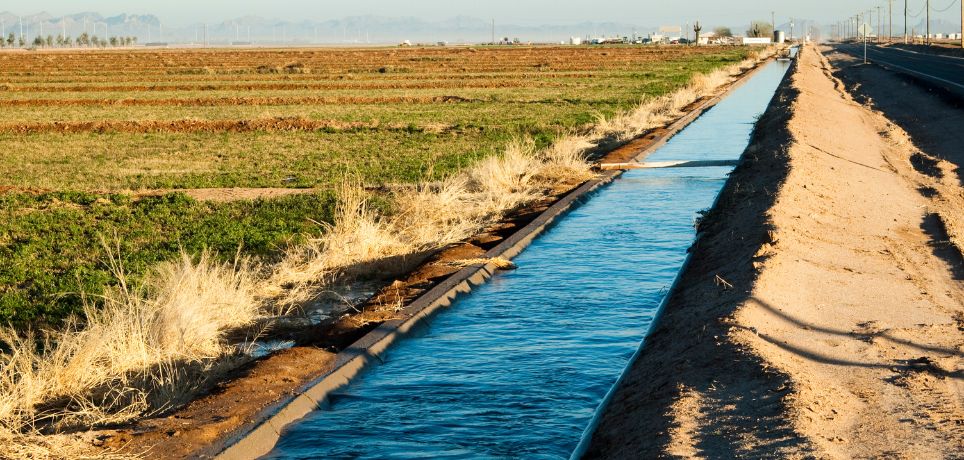
To dig a canal specifically to move water (as opposed to one for carrying boats), what factors should be considered to make the canal as perfect as possible? Obviously the purpose of the canal is the first factor in planning.
Canals are commonly built for irrigation delivery, flood control and diversion, drainage of agricultural or urban land, inter-basin water transfer, groundwater recharge, wastewater moving or treatment, and for environmental restoration such as maintaining wetlands or supplementing seasonal flows in rivers. Some canals are multipurpose, carrying irrigation water in dry seasons and floodwater during storm events.
Hydrology and Flow
Understanding how much water must move through the canal, how fast, and how often, forms the foundation of the design stage. The canal must account for average flow, peak flow during storms or snowmelt, and low-flow conditions that may occur during drought – and the flow variability matters just as much as the volume. A canal that functions perfectly at one flow rate may fail through erosion, sedimentation, or overflowing at another rate.
Slope is a critical aspect. Gravity-driven canals must follow a gradient that maintains movement without causing excessive velocity. Optimal efficiency is the aim: moving as much water as desired, at the speed required. Too little slope allows sediment to settle and vegetation to choke the channel; too much slope leads to erosion, bank instability, and downstream damage. And in pumped systems, energy efficiency changes the operational cost, and becomes a dominant consideration.
Alignment and Topography
A canal’s route should work with the landscape rather than against it. Alignments that follow natural contours reduce excavation, minimize energy losses, and improve long-term stability. Sharp bends should be avoided where possible, as they create turbulence, erosion, and increased maintenance. Where the terrain dictates a change in direction or elevation, transitions should be gradual and well engineered.
The relationship between the canal and surrounding land use is equally important. Proximity to homes, farmland, wetlands, and infrastructure influences safety measures, setbacks, and access requirements.
Soil and Geotechnical Conditions
The properties of the soil and subsurface materials determine whether a canal holds water or loses it. Permeable soils may require liners to prevent seepage, while expansive clays may crack and deform with moisture changes. Even concrete is permeable and can lead to water loss. Unstable or compressible soils can lead to bank failure or uneven settling, compromising flow and control structures.
Seepage is sometimes planned for, in canals intended to recharge groundwater. Here, controlled leakage can be beneficial, but it must be predictable and managed to avoid undermining the canal or adjacent structures.
Cross-Section
The shape and size of the canal cross-section affect capacity, stability, and maintenance. Trapezoidal sections are common for open channels, balancing efficient flow with stable banks. Depth-to-width ratios influence evaporation losses, sediment transport, and safety.
“Freeboard” is the vertical distance between the water surface and the canal crest, and has to be great enough to handle surges, waves, and unexpected inflows without overflowing the banks (overtopping). For flood-control canals, a generous freeboard is crucial, whereas for irrigation with a more measured flow, tighter tolerances can be designed in.
Lining
Choosing whether and how to line a canal is a major design decision. Earthen canals are less expensive and can support ecological functions, but they lose water to seepage and require frequent maintenance – they’re typically for short-term uses. Concrete, composite, or geomembrane canal liners improve hydraulic efficiency and contain water loss – with the fullest impermeability coming from synthetic geomembranes. The increased construction cost can be justified by the increased efficiency and longevity of the canal. See our article on Unlined Canals Versus Lined Canals for a fuller discussion.
Control and Regulation
A water-management canal must be controllable. Gates, weirs, check structures, turnouts, and overflow spillways regulate flow, maintain water levels, and protect against failure. These structures must be sized for worst-case conditions and designed for reliability, ease of operation, and safety.
Measurement is equally important. Flow meters, staff gauges, and telemetry systems allow operators to verify performance and adjust operations in real time, which is critical for irrigation efficiency and flood response.
Sediment
Water carries sediment, organic matter, and debris, all of which will compromise canal performance. The canal design should anticipate sediment loads from upstream sources, and provide ways for material either to pass through, to settle in designated areas, or to be removed mechanically. Sediments are one of the most common causes of canal degradation.
Environment and Ecology
Even canals built solely to move water interact with ecosystems. They may fragment habitats, alter groundwater levels, or become unintended wildlife corridors. Careful design can reduce harm or even provide benefits, such as vegetated banks for erosion control, fish-safe intakes, or seasonal flow regimes that support downstream ecosystems.
Water quality also matters. Stagnation, high temperatures, and nutrient buildup can turn a canal into a source of algae or odors if not addressed through flow management and design.
Longevity
A perfect canal on paper can fail in practice if it is difficult or expensive to maintain. Access for inspection, vegetation control, sediment removal, and repair must be built into the design. Materials should be chosen with local climate, labor availability, and expected lifespan in mind.
The canal should also be adaptable. Changes in climate, land use, or water demand may require higher flows, different operating schedules, or new control structures – all, decades after construction.
Safety Finally, canals can pose risks to wildlife and humans, especially children. Rapid flows, steep banks, and proximity to populated areas require safety considerations such as fencing, gentle side slopes, escape features, and clearly defined overflow paths. Countering failure scenarios such as bank breaches, blockages, or overflowing must be planned for.


