
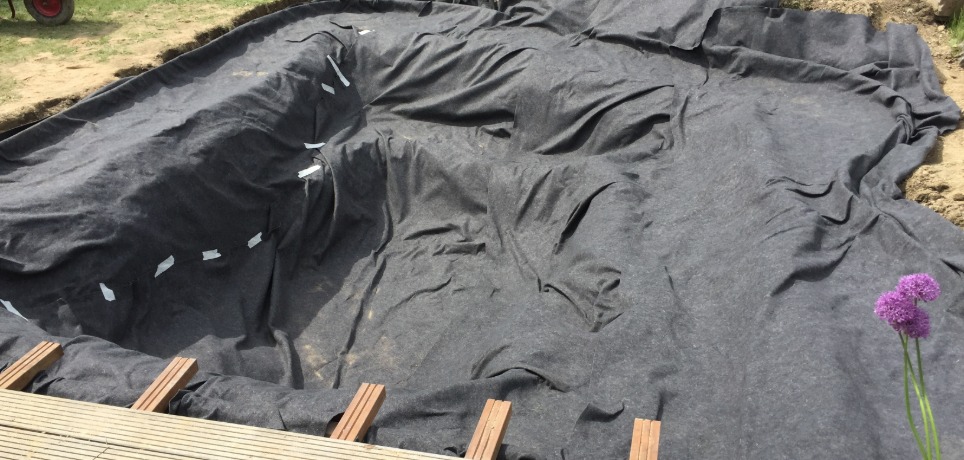
Choosing the best material to use as a pond liner is only part of the overall project: installing the liner correctly is equally important to prevent eventual failure of the liner. Whether the project is a farm pond, irrigation pond, decorative pond, wastewater lagoon, retention basin, or industrial pit, ground preparation and installation are necessary components of a successful liner that lasts for a long time.
Here are the major elements to consider in your project, and the common mistakes to avoid.
Subgrade
A liner conforms to the surface beneath it, so rocks, roots, construction debris, sharp soil clods, voids, and abrupt changes in grade will create concentrated stress points. A properly prepared subgrade should be smooth, reasonably uniform, compacted where appropriate, and free of anything capable of puncturing or excessively stretching the liner.
In some applications, an underlayment of geotextile cushion or properly selected soil may be appropriate beneath the liner. A liner is a waterproof barrier, not a load-bearing construction, and requires a properly constructed pond or pit. If slopes are too steep, embankments are poorly compacted, or the excavation contains unstable areas, putting a liner over the problem doesn’t make the underlying structure sound. Remember (and calculate) the pressures that will impact the liner when the pond is filled; settlement can put considerable stress on the liner.
Liner planning considers both sides of the membrane: determine if there may be sub-surface water or even gases migrating under the liner. Groundwater, trapped air or other gases beneath a liner can create uplift pressure. The result can be anything from bubbles and wrinkles to significant displacement or failure.
Where subsurface water is a possibility, drainage or pressure-relief provisions may need to be incorporated into the design. Consider drainage around the pond or pit. Poor surface drainage can allow runoff to flow underneath or around the liner. Saturated soils typically behave differently from the dry soils present during construction: soil itself can expand or contract, and ground can shift.
Liner Material
The choice of liner material depends on more than simple impermeability. important. Different materials have very different properties. EPDM, PVC, HDPE, LLDPE, RPE, RPP and other geomembranes differ in flexibility, puncture resistance, chemical resistance, UV resistance, temperature tolerance, welding characteristics and expected service life.
The aspects of the pond structure itself must figure into the choice of material, estimating what forces will impinge on the liner to degrade its working usefulness over time. And the contents of the pond or pit, and any regulatory requirements, will also influence material selection from the beginning.
Material thickness is NOT by itself an indicator of suitability for the project. HDPE, for example, is extremely impermeable, but also think and stiff. This makes it a less desirable material than, say, RPE, which delivers practically the same protection at half the weight and with much greater flexibility.
The cost/benefit calculation in the planning stage often mandates a thinner material for the best results. The required thickness depends partly on the subgrade, installation conditions, anticipated loads, chemical exposure and expected service life. A liner being marketed as “heavy duty” doesn’t necessarily mean it is appropriate for a particular containment application.
Delivery and Positioning
A related aspect of material thickness is the weight that must be delivered to the site, and whether the liner can be folder or must be rolled. This is important not only from the cost of shipment but also as a potential cause of damage to the liner itself, before it even meets the ground. This aspect of handling is often overlooked, but commonly can present great difficulties in the installation.
Geomembranes can be damaged before they ever reach the ground. Dragging them across rough surfaces, dropping rolls, using inappropriate equipment, walking on them with unsuitable footwear, or allowing equipment to operate directly on an unprotected liner can cause damage that may not be immediately obvious. Even with the optimal material choice, large liners also need appropriate handling equipment, and this must be part of the cost equation, and of the handling requirements.
Installation crews also differ in their skills and experience. Some liner manufacturers, such as Western Environmental Liner, will use their own salaried personnel for installations, but many projects depend on hiring a contract crew. Picking a good contractor becomes one more element to consider in the project planning. Skill with installation and, if necessary, welding in the field, are important qualities to be sure of.
Installation
Installers sometimes try to make a liner conform perfectly to every contour by pulling it tight, which can be a mistake. A geomembrane needs some ability to accommodate settlement, temperature changes and movement of the underlying ground. Allowing appropriate slack, and designing details such as slopes, corners and penetrations correctly can reduce stress on the material.
Ambient temperature during installation is a crucial consideration. Many geomembranes expand and contract substantially with temperature. Installing a liner in hot afternoon sun and then having it cool overnight can produce significant dimensional changes. Installation procedures should account for the material’s thermal behavior. This becomes particularly important with large sheets that cover thousands of square feet.
Liner sheets must often be welded in the field, and the seams become crucial to the success of the containment system. Poorly prepared surfaces, incorrect welding temperatures or speeds, contamination, inadequate overlap, wrinkles in the seam area and inexperienced welding can all produce weak points. A good installation isn’t simply a matter of laying out sheets and welding them together. Seams should be inspected and, where appropriate, tested according to the material and application.
Conforming the liner to the pond surface is nowhere more important than at its banks. The liner must be anchored properly to make sure it remains where it was installed, and wind uplift, water movement, soil movement and changes in water level can all affect it.
The liner must extend onto the bank soil to become anchored, but must also be covered to reduce UV and other exposure. This can take a little engineering. Ponds commonly use an anchor trench around the perimeter, while larger engineered containment systems may use more elaborate anchoring details. An inadequate perimeter anchor can allow the liner to pull away from the edge, wrinkle, or become exposed.
While the enemy of a pond liner is penetration, some are often necessary. Every pipe, drain, inlet, outlet, post, anchor or other penetration through a liner creates another potential failure point. Therefore, all penetrations should be designed into the project rather than improvised after the liner is installed. Proper boots, flanges, prefabricated fittings or other engineered details can provide a much more reliable transition between the liner and the structure.
Once a liner is installed in place, it is often covered with soil, aggregate or another protective layer—for example, to protect it from sunlight, animals, traffic, rock or mechanical damage. Obviously the material placed on top must itself be compatible with the liner. It shouldn’t need to be said that sharp aggregate or poorly graded rock can create the same puncture problem from above that rocks in the subgrade create from below. A suitable geotextile or other protective layer may be needed between the geomembrane and the cover material.
The installation should include a deliberate inspection and quality-control stage before the liner disappears beneath anything. Depending on the project, this can include visual inspection, seam testing, leak testing and electrical leak-location testing.